• TalkBass has been independent since 1998. Add your voice.
    Create a free account to reply to discussions, view embedded media, and browse with fewer display ads.
    Join freeLog in
    Want zero display ads or expanded classifieds tools? Compare plans.

The Fifths Tuning Club

We talk about temperaments here but that applies to the way sounds and notes mix and mingle together and I don't think it applies to tuning. Yes it is important in music if you want an ethereal sound for say a suspense thriller soundtrack where you want that perfect sound for to set the mood.

I was speaking about something that cello, viola, and violin players do. They tune the open notes of their instruments in perfect fifths against (I believe) their A strings which are tuned to concert pitch. Since they have no frets they can adjust the finger position of each note as needed to play against fixed pitch instruments when that is required. Three of their open notes will be a bit off compared to a piano, for example, however and I assume that they avoid open notes when that would be a problem. A fretless bass could be tuned in perfect fifths and fingered accordingly when even tempered notes are needed. But you cannot bend the notes on a fretted bass or at least you can only bend them up, so in my opinion a fretted bass should be tuned to even tempered notes using an electronic tuner rather than in perfect fifths as a cellist would. A fretted bass tuned against an electronic tuner will give you the same notes, good or bad, as any other even tempered instrument. Tune the open strings to perfect fifths and all the fretted notes will be neither even tempered nor just and I cannot see that as being a useful sate of affairs in many circumstances.

Ken
 
Sounds fascinating and very do-able.

However, I hear a lot of contemporary music : rock, country, pop which employs a low B.

For N S T , with lowest string being C, you would then need a 5 er with a a 'sub bass' string of F, which arguably may or may not even be audible, in order to have access to a low B.

Still; N S T is an amazing idea. I am certainly not against it.
 
If you want a B there are easier ways to get it. You can tune starting on B: B Gb Db Ab, or on A: A E B Gb, or Bb: Bb F C G. Most of us tune CGDA because a low C is low enough, it gives us three strings we already know, it makes cello music natural to play, and in one case that I know of because it makes playing with a string quartet easier. One of my basses has a Hipshot extender key set to tune between A and C. Even though I have never had cause to use it, it does represent another easy way to get a low B when you need one.

Ken
 
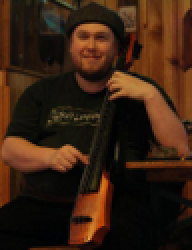
He certainly can play bass as if it were a lead guitar! Very nice, thanks for the link and for acquainting me with him. He doesn't appear to be nearly as famous as he should be from an internet search but a few players like him could make fifths very popular if they were more widely known. The gauges I use are in the range he suggests but I don't think you have to worry much about your bass neck because they should give total tensions very similar to standard sets just better balanced string to string.
 

Attachments

  • 01101429.jpg
    01101429.jpg
    186.1 KB · Views: 167
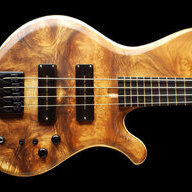
Nut: spacing .5" , width 1.5"
Bridge: .75"
Scale: 31.181"
Body: catalpa
Neck: northern ash
Fingerboard: black walnut
Weight: 5.5 lbs.
Tuning: DAE, EAD, DGG, CGG, and CFF
Pick-up: currently being replaced and will be on a slider. Not done yet PtF (Prototype Fail):(
__________________
damn kids and their 3-string basses


Thanks for the details. How's that Walnut working out as a fingerboard wood?

I think it would be fun to own a 3-string bass tuned EBF#.
 
How's that Walnut working out as a fingerboard wood?
Its not terrible but I do not recommend it. I've used black walnut as a fingerboard twice so I have some idea of the effect on the tone.
Overall tone growly but upper mids sound like baseball bat on metal trash can,:hmm: very hard to eq that out.
And its not the most durable, not that the frets move (gorilla glue :D) but if your kids drive their toy cars on it :rollno:
 
CGDA is awesome on fretless. What C string gauge did you go with?

Playing Bach's cello suites on the bass became my warmup routine before gigs :D


I couldn't get anybody from Circle K to answer an email or the phone. I dug through their chart and from previous experience, I like a little lighter gauge string than most because I like a looser tension.

Shooting for just under 40 lbs, I ordered a set:

C .124 36.9 lbs
G .082 37.2 lbs
D .055 37.7 lbs
A .035 36.1 lbs

For a close to 40 lb tension, I could have ordered:
C .130 40.4 lbs
G .086 40.7 lbs
D .057 40.4 lbs
A .037 40 lbs

I am currently running a .127 to .042 set on my 5er in 4ths.

Like the tension so far.
 
You'd be surprised, all those notes in the cello suites will now fall right under your fingers.

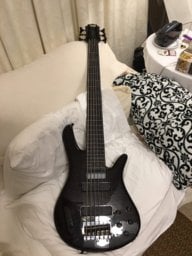
I got a package from LaBella today with some new strings for the Squier VI I got a couple/three weeks ago. It kinda sorta worked by pressing the original strings into service for CGDA and then tuning the top two D, G, in fourths. But with the right strings to tune CGDAEB it really, really sings! The shorter scale is kinda nice for tuning in fifths because the reaches are bit shorter, closer to those on a cello actually. The high voice on those upper strings chords nicely and suddenly the fuzz settings on my MS-60B do something useful. At one point I noticed an old AA battery from the MS-60B laying there and I even tried some bottleneck! There almost isn't anything this beast can't do but the owner of course has a long way to go before he can do much of it well.