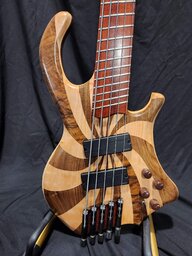
I'm not sure at all how much difference different woods make to the tone of an instrument, I would love to run an experiment making an identical guitar out of different woods using some lift out drop in set of electrics, same bridge etc to see what happens, just for my own benefit. Of course there's much more to it than what wood, there's things like glueing three bits together to make a body blank or laminating a maple (or other) top onto a body, they all have an effect on how vibration energy from the strings is dissipated and modified before being fed back through the bridge and nut into the strings which in turn modifies their vibration pattern... the sound. Those are the laws of physics and you can argue all you want (not you specifically

) but how you make a guitar will dictate how it sounds. I fully admit that that difference in sound will be very small but we share 98% of our DNA with the halibut, it's that 2% that makes the difference. What makes a Stradivarius violin better than an Bergonzi? I can't hear the difference personally but there are many who can (those who don't spend time stood in front of a bass cab and drum kit). In a nutshell, if wood didn't make a difference we would all be playing pink plywood P basses and all be very happy.
But I'm afraid I'm in the same boat, I don't have enough knowledge or experience to give an informed opinion on individual tonewoods but I have my suspicions that construction my play a bigger part than the actual wood itself and I would rather rid the word tonewood from the dictionary and replace it with something less mystical like "plank of wood"
I do think also if you are diligent and make a guitar that has good qualities it will probably sound good but yes luck has got a lot to do with it when you're as inexperienced as me