Been watching your trials and tribulations on the finsh, and all I can say is it looks great! Beautiful job.

Enjoy the benefits of a premium membership!
Upgrade Account
-
TalkBass has been independent since 1998. Add your voice.
Create a free account to reply to discussions, view embedded media, and browse with fewer display ads.
Join free Log in
Want zero display ads or expanded classifieds tools? Compare plans.
You are using an out of date browser. It may not display this or other websites correctly.
You should upgrade or use an alternative browser.
You should upgrade or use an alternative browser.
The Hossenfeffer Bass Build
- Thread starter Gilmourisgod
- Start date
More options
Who Replied?
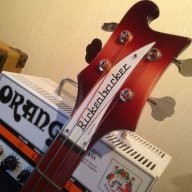
Send it to JH. I’m sure he’d be happy to clear coat it. You want to make sure you get that bubbling finish by the bridge custom effect they offer.I'ts never to late to screw up in Gilmourland, every step of this is a first for me. Next up my first clearcoat and polish job, the clear is going on THICK, I really don't want any sand-throughs, and I'm running out of dry days in the 60's to paint.



I actually thought about matte finish, like the unobtanium “noir” Ric 4003, but part of the purpose was to learn to paint, so high gloss it is. Famous last words if I sand through to color, of course.
I actually thought about matte finish, like the unobtanium “noir” Ric 4003, but part of the purpose was to learn to paint, so high gloss it is. Famous last words if I sand through to color, of course.
I imagine a perfectly even low gloss finish coat is just as difficult to do right though


Rôckhewer
Commercial User
- Feb 28, 2015
- 2,922
- 9,028
- Disclosures
- Owner/Builder- RockHewer Custom Guitars LLC
I had a matte finish bass briefly, and it just polished itself up to satin anyplace your clothes or skin rubs it anyway, so it’s not really a durable finish. I suspect most of the Noir Ric’s will be closet queens, so maybe they will stay matte.

This is a brutal build. This thread is the most satisfying because you've set yourself some impossible goals, yet you're getting there. You also bare all, and every trip up and setback is documented in unflinching detail. It makes a change from build threads that go from raw lumber to finished instrument almost at the wave of a magic wand.
The next question is, what is your next build? Going to shoot for a 4005 or Chris Squire signature? White finishes are meant to be about as hard as black finishes...
The next question is, what is your next build? Going to shoot for a 4005 or Chris Squire signature? White finishes are meant to be about as hard as black finishes...
Thanks, this is my usual approach to any brutally difficult craft I get fascinated with, stupid ambitious, resulting in spectacular failures, woe, and recrimination, sometimes ending with great satisfaction. Also, if you gloss over the eff-ups, people mistakenly think you know what you are doing, so you never get any good advice. It ain't over yet! I'm glomming onto the Winter 2018 Walnut build, a Walnut Ric 4004 style bass I promised my son. After that, no more Ric builds!This is a brutal build. This thread is the most satisfying because you've set yourself some impossible goals, yet you're getting there. You also bare all, and every trip up and setback is documented in unflinching detail. It makes a change from build threads that go from raw lumber to finished instrument almost at the wave of a magic wand.
The next question is, what is your next build? Going to shoot for a 4005 or Chris Squire signature? White finishes are meant to be about as hard as black finishes...

I'm glomming onto the Winter 2018 Walnut build, a Walnut Ric 4004 style bass I promised my son. After that, no more Ric builds!
But...but....but....What about my shortscale???......

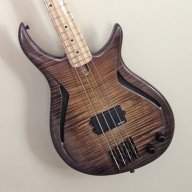
Spectacular! All the trials n tribulations and you are on to the clearcoat! I among many others here are ready to see the finished product. Can’t wait to see all that chrome next to the black and cb binding!


Looking good. The checkerboard with the black, even without any clear yet, looks terrific. It’s great that you kept going through all the setbacks and difficulties. Perhaps a bit early but congratulations. Looking forward to the finished product.

Freekmagnet
Commercial User
I'ts never to late to screw up in Gilmourland, every step of this is a first for me. Next up my first clearcoat and polish job, the clear is going on THICK, I really don't want any sand-throughs, and I'm running out of dry days in the 60's to paint.
I definitely hear you on that. I finished my first bass body 2 times. Completely stripped it down sanded and went again. One of my friends who was a pretty well know guy gave me advice to just get another body. But that only works when there’s a surplus.
You should be fine with the clear coats
.
Rôckhewer
Commercial User
- Feb 28, 2015
- 2,922
- 9,028
- Disclosures
- Owner/Builder- RockHewer Custom Guitars LLC
Just STAY OFF the corners ...for the first couple grits. They will obviously sand much faster. Like way faster than you expect. Depending upon where you plan to start sanding... I wouldn't touch that edge bullnose on the back, for instance...with anything lower than 2000 if wet...to start.Famous last words if I sand through to color, of course.
If you find that is way too slow, maybe drop back to 1000... dry, ...to really see what you are doing & when the orange peel is ALMOST gone...then move up... 2000 & 3000 are still removing material...quicker than you think on the corners...
Do as much flattening DRY... as you can..
And your sanpaper budget permits
.....(cause it gonna clog up when dry)
But honestly even an extra 20 bucks worth of sandpaper.... is worth it...to not see that telltail line or colored water whilst sanding...


Ask me how I know...
Ge'head...ask...


Rock
Thanks for the advice. I'm hoping to use no water at all. I got some Mirka Autonet up to 600 grit, and Abralon pads up to 4000. The Autonet doesn't clog, but the Abralon does eventually. I was thinking about trying naptha, I don't want any water getting in the screw holes that will mess up the paint by swelling. I don't have a buffing wheel, so I'm looking at those hand drill buffing pads.
Thanks for the advice. I'm hoping to use no water at all. I got some Mirka Autonet up to 600 grit, and Abralon pads up to 4000. The Autonet doesn't clog, but the Abralon does eventually. I was thinking about trying naptha, I don't want any water getting in the screw holes that will mess up the paint by swelling. I don't have a buffing wheel, so I'm looking at those hand drill buffing pads.
Rôckhewer
Commercial User
- Feb 28, 2015
- 2,922
- 9,028
- Disclosures
- Owner/Builder- RockHewer Custom Guitars LLC
Cool!Rock
Thanks for the advice. I'm hoping to use no water at all. I got some Mirka Autonet up to 600 grit, and Abralon pads up to 4000. The Autonet doesn't clog, but the Abralon does eventually. I was thinking about trying naptha, I don't want any water getting in the screw holes that will mess up the paint by swelling. I don't have a buffing wheel, so I'm looking at those hand drill buffing pads.
Well there ya go... that Mirka/Abralon stuff is even more pricey.
But
..."up to 600" ??
I am no expert...(finishing not my strong suit)
But what I am doing these days is ... ( over wood not paint)
Plowing on about 75% of my total buildup... let that cure & shrink back.
Then level sand to about 80% flat with 320
(Staying off the corners)
Then blend out the 320 scratches & scuff the corners with grey scotchbrite.
Then apply a final couple coats. Which always lay down MUCH better than the first few. (I don't use grain filler)
Then since it is much flatter now... I START wet sanding at 800.
Maybe 600...depending how rough...but that only on the large flat areas.
But then I don't use that waterbased stuff you guys have been discussing... so it may react completely different.
You are smart to avoid water in the holes etc... I have seen that cause issue. (Mostly only on maple...but still ) I cant imagine doing everything dry... at some point I feel it needs the clean clog free rubout.
As to buffing... I personally don't use a "buffing wheel". On flat surfaces I use the small car polishing type pads with a cheap pneumatic angle polisher. from harbor freight...with "heavy" and "light" cut, Maguires compound. Followed by swirl remover...or machine glaze.
On the corners...those same compounds with just a microfiber towel & a little elbow grease. Works just fine.
Again.... not trying to tell you what to do... but the beauty of learning in these forums is being able to compare notes from different builders, to pick & choose stuff that might work for you.
Good luck!....or...."break a leg"....


Last edited:


