• TalkBass has been independent since 1998. Add your voice.
    Create a free account to reply to discussions, view embedded media, and browse with fewer display ads.
    Join freeLog in
    Want zero display ads or expanded classifieds tools? Compare plans.

The Hossenfeffer III Build

@Gilmourisgod I wetsand wipe on poly with mineral spirits - I start with 1500 grit and work my way back down if it's needed, but it usually isn't. Your prep looks stellar and I'd be surprised if you needed to drop down even to 1000. I wipe mineral spirits onto the sandpaper to help it wet up a bit and then I use a very small splash of it (maybe 5-7 large drops) directly on the finish before sanding it. I wrap the sandpaper around an old white block eraser (staedtler brand) as white erasers don't seem to absorb mineral spirits fully (pink ones do though and get softer/gummier over time).

I work in small circles very lightly and change the paper often. Maybe once every 50 or so strokes? When the paper gets a bit loaded with sludge I change it out. I also wipe the sludge (swarf slurry?) off with a mineral spirit dampened soft rag. I don't use the same spot on the rag for the next wipe so it's always getting clean paper, clean spirits and clean rags. :thumbsup: Other things may work for others, but this has worked for me. I'm always cautious with wipe on poly as it's so much thinner than sprayed stuff. :)
 
@Beej Did you find it necessary to wetsand at all between coats of poly? Everything I read says you are supposed to, but the Highline Guitars guy says he "doesn't bother". One factor here is he does coats every two hours, a couple coats a day, so maybe there is a bit of "burn in" between coats. I'm a working stiff, so the only time I have is late evenings, so I'm on a 1 coat/24 hour schedule. I can probably get two a day over the weekends. Would mineral Oil soften the finish at all before it's fully cured? I Used Naptha instead of water on my HF1 build with Varathane Ultimate, didn't want to risk water softeneing the finish or soaking into open grain like tuner and screw holes and swelling the wood. How many coats are you laying on before final wetsand and buffing? I'm thinking 10-15?
 
@Beej Did you find it necessary to wetsand at all between coats of poly? Everything I read says you are supposed to, but the Highline Guitars guy says he "doesn't bother". One factor here is he does coats every two hours, a couple coats a day, so maybe there is a bit of "burn in" between coats. I'm a working stiff, so the only time I have is late evenings, so I'm on a 1 coat/24 hour schedule. I can probably get two a day over the weekends. Would mineral Oil soften the finish at all before it's fully cured? I Used Naptha instead of water on my HF1 build with Varathane Ultimate, didn't want to risk water softeneing the finish or soaking into open grain like tuner and screw holes and swelling the wood. How many coats are you laying on before final wetsand and buffing? I'm thinking 10-15?
I usually put on around 20-25 coats. I know that sounds like a lot but it's a thin building finish. :) I will put on a quick coat in the morning before I go to work, one right when I get home and another one around 9-10pm. Then on weekends, I'll do around 5 per day. This gets me over 20 in a week.

I've wetsanded between the very last coats, but before then no, I just remove dust nibs with a scotchbrite. I run my hands over the whole thing to feel for any dust nibs or hairs and then remove those with a soft scotchbrite. I've been able to use green in a pinch by just very lightly dusting the surface to remove the nibs. Every 6-10 coats or so, I'll go over the entire thing with scotchbrite and ensure it's really smooth. I wipe down any areas that have been scotchbrited (probably not a word) with mineral spirits and then apply the next coat of finish.

When I think I have enough, like after around 20 coats, I'll wetsand the whole thing and do another final coat. Sometimes twice but usually only once is needed. With really good prep, I've been able to buff that directly up to a high gloss after it's cured for a couple of weeks. :thumbsup:

I forgot to mention, I also hang all of my guitars directly over an oil-filled radiator heater that is set to over 25 degrees (about 77 F). This was a game changer for me as every kind of finish I've found dries faster and harder over heat. :)
 
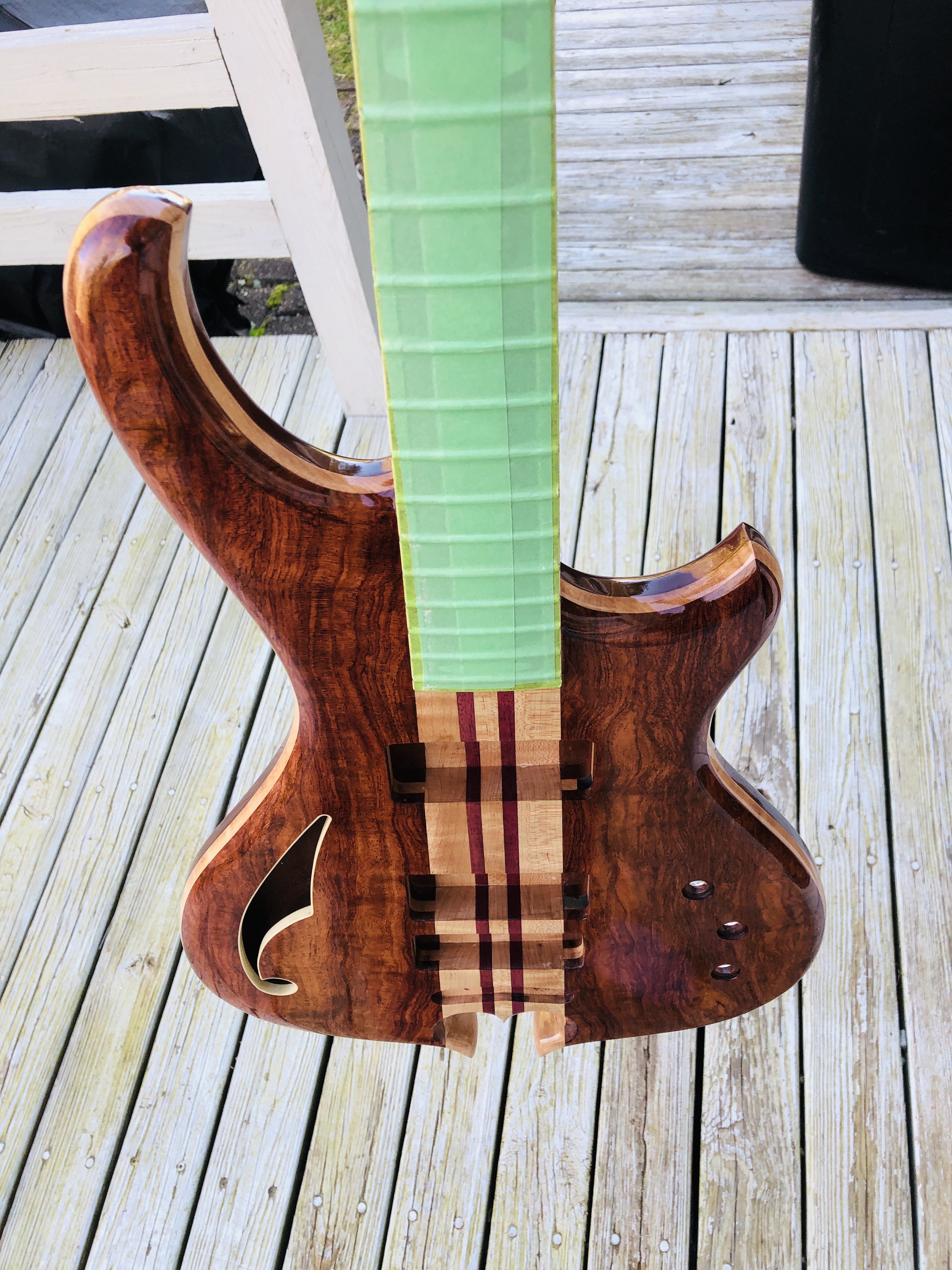
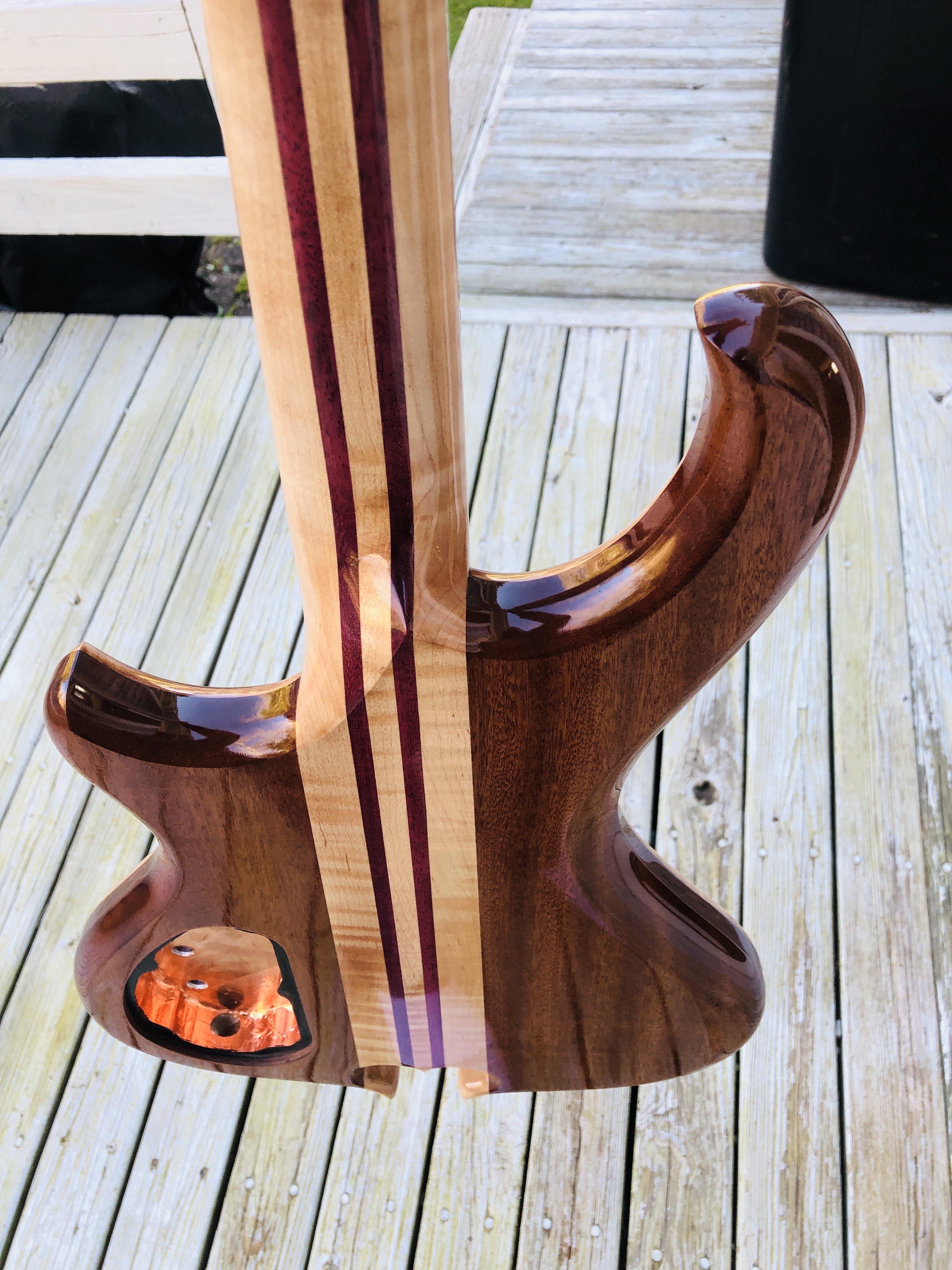
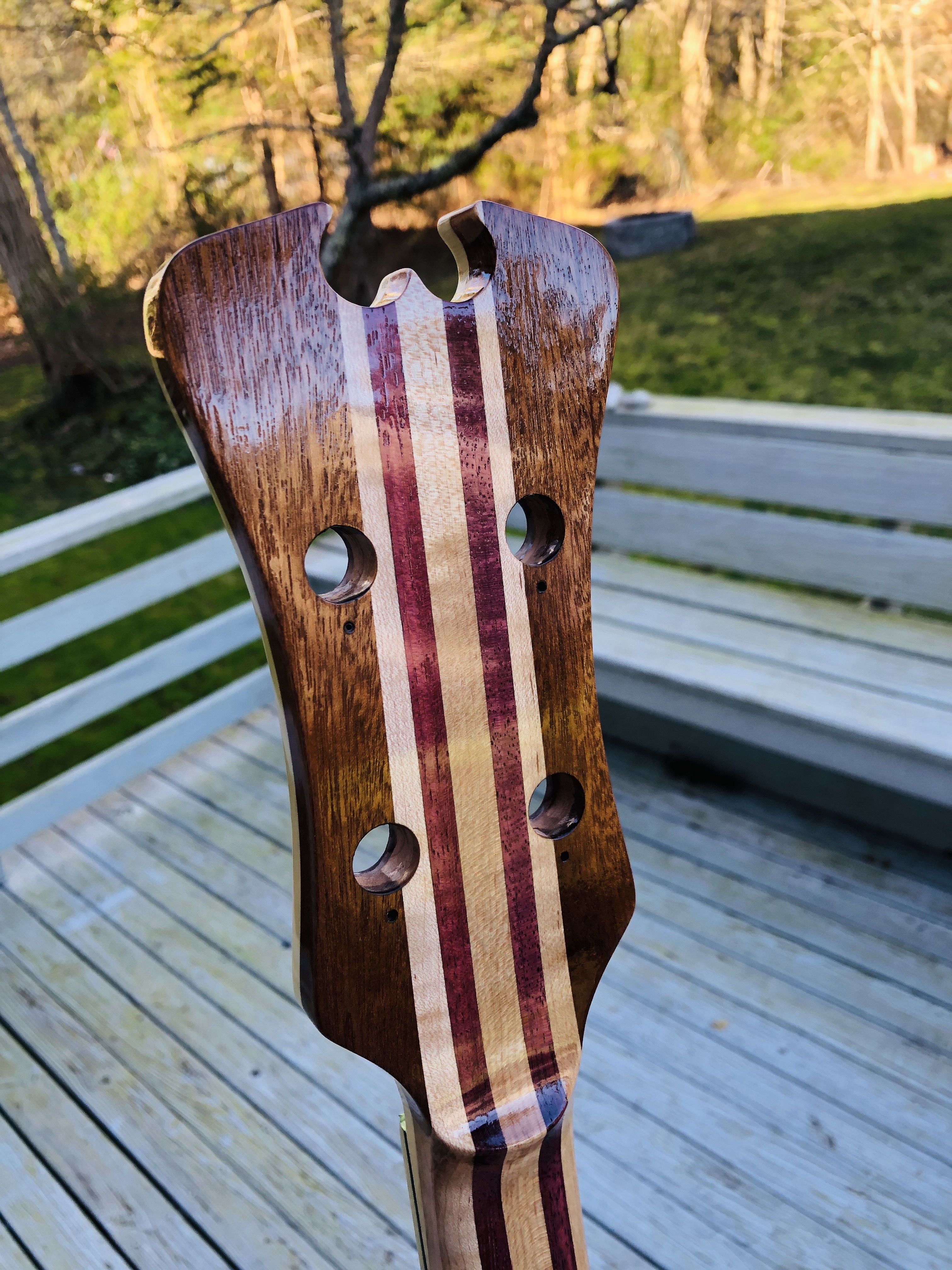
10 coats in on the Minwax Wipe On Poly. I've been giving it a light rubdown with a grey scotchbrite after every coat, which is usually once a day, all I have time for. I still have some grain showing through, which shouldn't surprise me given how thin this goes on, but I guess a second coat of epoxy pore filler would have been smart. This stuff is unforgiving of even the slightest surface imperfection, which all popped nicely after the first couple coats. Ive had to do some "drop fill" on a couple little dings and tool marks I missed in final sanding. I use a utility blade partly masked with tape to scrape the drop fill flush, then wetsand with 1000 grit. It worked, but I burned right through to bare wood on a couple spots doing it. I think I'm just banging up against the limits of my poor old-fart vision to locate these little flaws prior to finishing, cause I looked HARD before the first coat went on. sigh... I'm shooting for 25 coats total, so 15 more to go.
dSaA67e.jpg

Txbzrbi.jpg

dGqqD7W.jpg


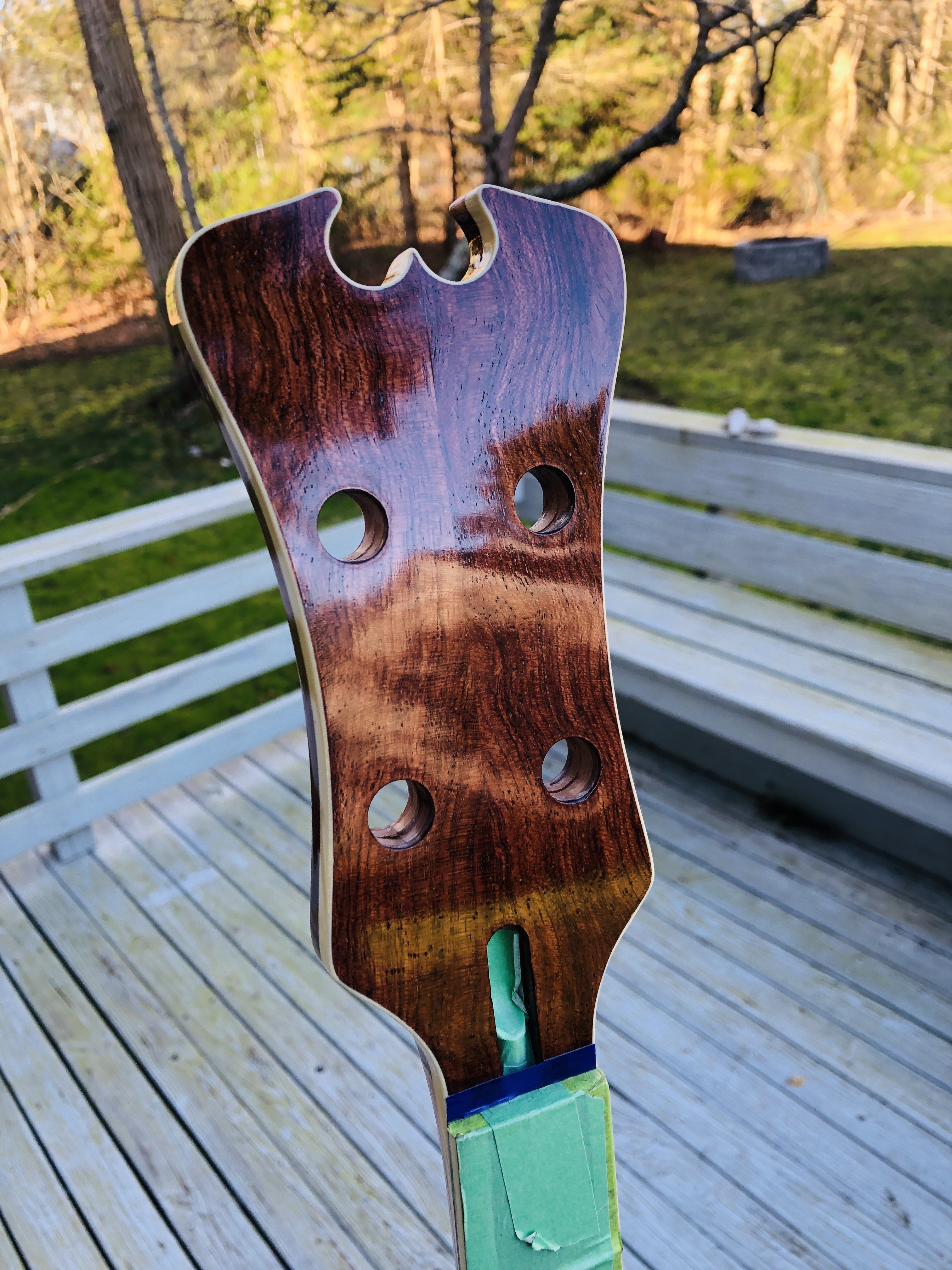
The back of the headstock looks like I didn't pore fill at all, but I know I did. Weird. This might get a lot more coats!
mrpXU40.jpg


Any advice on best practice to wet (or dry) sand Poly? I have automotive wet/dry up to 2000 grit, and can get 3000 grit locally, but that's it short of Micromesh. I have some of the little 2" square micromesh pads, but they are kinda played out.
 
You're getting pretty nice and even coverage and it's getting nice and glossy. I don't know if wet (or dry) sanding is necessary for the sake of polishing. I'd be afraid of burn through and unless there are runs or uneven areas from overlap I might just go right to a light compound, or nothing at all depending on what it looks like after the last coats.
 
That's gonna be stunning when it's done.
This is more of a question to anyone who knows, than a suggestion, but,
Could you do some aqua coat once this last coat of poly is dry, just where there's still open grain, then continue on with poly?
It dries fast enough that you could lightly sand it the same day and get the next coat of poly on. And you can scrape it on with a credit card or rub it in with a rag so there's not much on the surface to sand off. I'm guessing that could be done with the grey scotch right. It might help fill the pores enough that it doesn't take 100 more coats of poly, if you want them filled.
I'm just not sure if it sticks to and plays nice with the poly you're using.
 
I thought about Aquacoat, same question about compatibility. Anybody know? Another thought would be using regular poly, which is thicker, brush applied just on the headstock, maybe a few heavy coats to grain fill? One problem with a hippie sandwich is you can’t grain fill with sanding slurry, the purpleheart stains the maple.
 
I thought about Aquacoat, same question about compatibility. Anybody know?

I used AquaCoat and Minwax Wipe-On Poly on my WBO builds with no issues, if that answers your question about compatibility. Although I used it before the poly and didn't apply as many coats as you have. I am considering the same thing; another application or two of Aqua coat, then more poly to bring up the sheen a bit.
 
I used AquaCoat and Minwax Wipe-On Poly on my WBO builds with no issues, if that answers your question about compatibility. Although I used it before the poly and didn't apply as many coats as you have. I am considering the same thing; another application or two of Aqua coat, then more poly to bring up the sheen a bit.
Any reason to think it wouldn't work as a sort of "after finish grain filler? Never used it before, in fact I'm fairly clueless on grain filler in general. This will be my first high-gloss theoretically poreless finish on natural wood , only done Tru-Oil, Watco Danish, or opaque water based paint before this one.
 
Any reason to think it wouldn't work as a sort of "after finish grain filler? Never used it before, in fact I'm fairly clueless on grain filler in general. This will be my first high-gloss theoretically poreless finish on natural wood , only done Tru-Oil, Watco Danish, or opaque water based paint before this one.

After my initial applications of AquaCoat I sanded fairly aggressively to get it all off the surface. Not sure, yet, if it can be applied after poly and be smoothed out sufficiantly with scotch brite, without burning through the poly. I had thought to try it out this weekend...
 
  • Like
Reactions: Gilmourisgod
So, on the subject of The Dude, I was at a Starbucks the other day when a flock (Gaggle? Bevy? Horde?) of teenage girls breezed in, and started loudly referring to each other as "Dude", as in "Dude, did you hear what that guy just said to Jennifer?", and she's all like "No Dude, I was listening to Susan's story about that other guy that bought her an ice cream cone, so like, Dude, I didn't hear you". Is this some regional dialect update, or is this a "thing' now? Old Fart Enquiring Minds Need to Know!
 
  • Like
Reactions: Beej

Latest posts