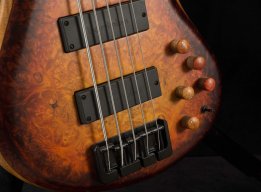
In short, there is magic in the smith pre-amp. You need to mess with the dip switches and learn the interaction between the series switches and pickup panning. It really is more versatile than most people think.
I spent a fair amount of time doing this last night, and of course you're right.
In particular, I took what I considered to be the "worst" sound it had and saw what I could do with it. This was the bridge pickup, solo'd, in series mode. What I found was, if I dropped the mids about 20%, boosted the bass about 10-15%, and maybe bumped the treble a tad (or none at all), it opened it up really nicely.
That said, I then I flattened all the EQ and went back to parallel mode, and still just liked it better, BUT, at least I wasn't "unhappy" with that new sound, and of course the more usable new sounds you can get, the more versatility you can enjoy. The key was the ability to cut the mids, and do so at the right frequency center. I definitely feel the Smith preamp is (as it should be) very well matched to the instrument.
Note: When I speak percentages above, that's literally just knob rotation range. I have no way to accurately gauge actual boost/cut percentages in dB, and I know it's not linear, so I'm just trying to keep it simple/reproducible.
That said, if you want to sit under a mix like a Fender style instrument, it isn't going to happen with a Smith!
Yeah, this is really all I was trying to say, but also trying hard to keep it from sounding like a slam.
I'm on my 3rd smith now. The neck profile of all three has been different. My BSR5J neck is much thinner, just as Vic has said, and plays much faster. It's actually the bass I just all other basses by -- it just feels that good. The Elite I had was much deeper profile though it was a 19mm bass. My current GN is sort of in the middle of those two, a bit deep, but more like a 90s Warwick (not a 2000s Warwick).
Cool! This is EXACTLY the case with me, though at this point, it's only been the one BSRJ and the one MS so far.








 My guess is that he won't do it on a bolt on though. At least, I have never seen one.


