
I'm disappointed that mine doesn't have a zero fret. It must be a configurator option I missed.
That is strange..Both my new Cazpars has the zero fret and I didn't have an option to select. You might want to ask Adrian or your dealer about that.

TalkBass has been independent since 1998. Add your voice.
Create a free account to reply to discussions, view embedded media, and browse with fewer display ads.
Join free Log in
Want zero display ads or expanded classifieds tools? Compare plans.
I'm disappointed that mine doesn't have a zero fret. It must be a configurator option I missed.
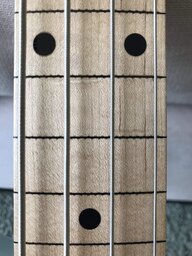

Scary - this thing is on my mind all the time and still I forgot while I was looking for the zero "fret" that it's fretless.


Reminds me of the time I was looking for my car keys. I was getting increasingly frantic, so I shifted the keys from my left hand to my mouth so I could use both hands to look for them better...Scary - this thing is on my mind all the time and still I forgot while I was looking for the zero "fret" that it's fretless.
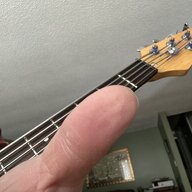
In wood working it is referred to as a scarf joint. Moving the joint lower as is done here is MUCH better for the structural integrity of the instrument than a shallow one at the headstock.Just got my couch picture and the front of it looks exactly like I hoped.
I've never seen a neck joint like that, and I'm fine with it visually. Are there any structural concerns I should have?
View attachment 4272335
Very interesting, and a wise observation.In wood working it is referred to as a scarf joint. Moving the joint lower as is done here is MUCH better for the structural integrity of the instrument than a shallow one at the headstock.

If the single-piece neck has a straight headstock like a Fender, the structural integrity would be about the same. If you tried to make a bent headstock as part of a single-piece neck, the scarf joint would be magnitudes stronger.Very interesting, and a wise observation.
How do you think this type of neck construction compares to a single, high quality piece of wood used to make the entire neck including the headstock?
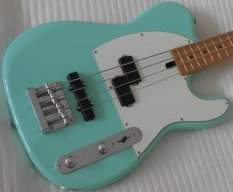
I'm considering ordering a Cazpar and I never noticed the zero fret before.
Is the only purpose of the zero fret to make the fretted notes and open notes sound the same? Am I missing anything?
Any concerns with durability? That fret will wear out before the others if you play open notes a lot. IIRC that's why Kiesel stopped putting zero frets on their headless models - too many complaints about rattling/buzzing open notes after fret wear.
If the single-piece neck has a straight headstock like a Fender, the structural integrity would be about the same. If you tried to make a bent headstock as part of a single-piece neck, the scarf joint would be magnitudes stronger.

I disagree with that assessment. The amount of wear a zero fret would receive would be miniscule compared to the wear on any other fret. Why? Because the string never moves at the zero fret. For wear to happen, there has to be movement and friction. When we fret a bass, our fingers push the string into the fret resulting in impact and friction, moreso if there is any vibrato involved. The zero fret on a bass equipped with one is the last fret that would experience any wear, even if you play a lot of open notes.Is the only purpose of the zero fret to make the fretted notes and open notes sound the same? Am I missing anything?
Any concerns with durability? That fret will wear out before the others if you play open notes a lot. IIRC that's why Kiesel stopped putting zero frets on their headless models - too many complaints about rattling/buzzing open notes after fret wear.
That's a good point. I guess the amount of string movement over the zero fret depends on the nut - how far back it is and the relative height. There will definitely be some movement because it's not fixed there.I disagree with that assessment. The amount of wear a zero fret would receive would be miniscule compared to the wear on any other fret. Why? Because the string never moves at the zero fret. For wear to happen, there has to be movement and friction. When we fret a bass, our fingers push the string into the fret resulting in impact and friction, moreso if there is any vibrato involved. The zero fret on a bass equipped with one is the last fret that would experience any wear, even if you play a lot of open notes.
Based on the image of my bass on order, which I will gratuitously show again here, the nut is closer to the zero fret than most fingers are to the frets they are utilizing when they fret. The nut is going to hold the string in place laterally, tension is going to hold it in place vertically with respect to the fretboard, and there isn't enough moment to allow it to move much. I suppose if you play the first fret a whole bunch, forcefully and with vibrato, you could conceivably get some string movement on the zero fret. Otherwise, there just isn't going to be enough movement there to matter.That's a good point. I guess the amount of string movement over the zero fret depends on the nut - how far back it is and the relative height. There will definitely be some movement because it's not fixed there.
I disagree with that assessment. The amount of wear a zero fret would receive would be miniscule compared to the wear on any other fret. Why? Because the string never moves at the zero fret. For wear to happen, there has to be movement and friction. When we fret a bass, our fingers push the string into the fret resulting in impact and friction, moreso if there is any vibrato involved. The zero fret on a bass equipped with one is the last fret that would experience any wear, even if you play a lot of open notes.

Personal opinion, the zero fret does nothing.
The sound of an open note is not the same of a fretted note. Not with the zero fret or the nut. I risk saying without the zero fret, the sound of an open note would be closer to the fretted one.
The fretted note has the finger behind the fret, and that changes the sound. Not the fret.
The zero fret does one specific thing very well. It removes nut height from the equation. The frets are all installed on the same fretboard, on the same shallow arc, so the height of the string behind the first fret is exactly where it should be. With nuts, this is often not the case.Personal opinion, the zero fret does nothing.
The sound of an open note is not the same of a fretted note. Not with the zero fret or the nut. I risk saying without the zero fret, the sound of an open note would be closer to the fretted one.
The fretted note has the finger behind the fret, and that changes the sound. Not the fret.
The zero fret does one specific thing very well. It removes nut height from the equation. The frets are all installed on the same fretboard, on the same shallow arc, so the height of the string behind the first fret is exactly where it should be. With nuts, this is often not the case.
Perhaps some people's ears are good enough to hear the difference between an open string with a nut vs. with a zero fret, my ears are not that good.