
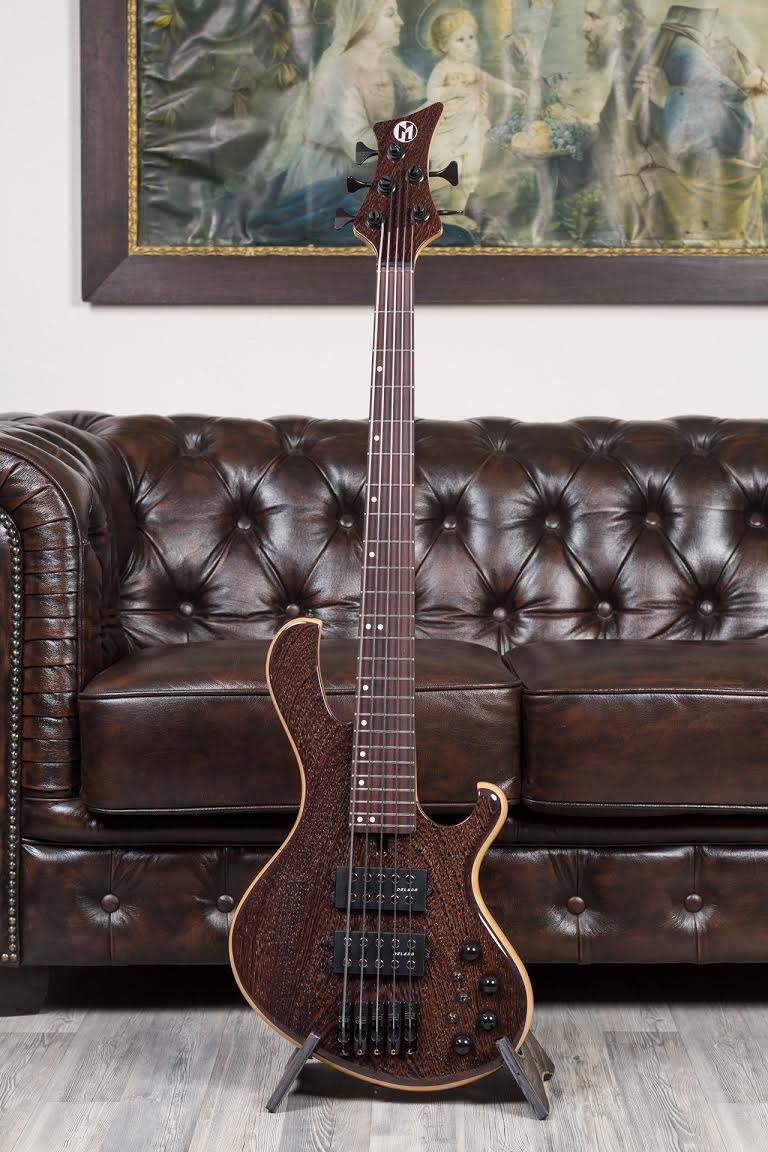
Got my couch picture! Now to refresh tracking every half hour as it makes the long trip over the Atlantic.

TalkBass has been independent since 1998. Add your voice.
Create a free account to reply to discussions, view embedded media, and browse with fewer display ads.
Join free Log in
Want zero display ads or expanded classifieds tools? Compare plans.
That's a beaut. Pardon my ignorance - is the top Wenge or something else?Got my couch picture! Now to refresh tracking every half hour as it makes the long trip over the Atlantic.View attachment 4274291
I can hear differences between the F#, F and open E, other than the fundamental frequency. Most of the difference seems due to larger changes in string length as I move out to the lower numbered frets. Switching frets from the G to the F has a similar tonal change to me as the F# to the open E. I think some of 'open string' sound is just a 'longest string sound'. If the nut isn't causing problems due to poor design, then the contribution of nut versus 0 fret is smaller than the increasing change in string lengths. I can place my finger slightly further from the fret when I want it out of the equation--if I put a finger on a fret its because I want it to sound different. To make a 0 fret sound more similar to the first, I suppose you'd have to leave enough room beyond the 0 fret so you can finger-adjust the tone if you want.Excellent point, I totally agree.
Yup that's a Wenge top!That's a beaut. Pardon my ignorance - is the top Wenge or something else?
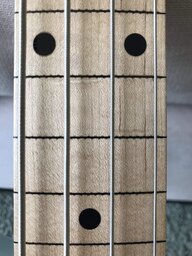
I'm envious of that Wenge top. I almost pulled the trigger on one. What's the fretboard wood again, Ziricote or Macassar Ebony? ARe those the ceramic magnet, exposed-pole pickups?
I disagree with that assessment. The amount of wear a zero fret would receive would be miniscule compared to the wear on any other fret. Why? Because the string never moves at the zero fret. For wear to happen, there has to be movement and friction. When we fret a bass, our fingers push the string into the fret resulting in impact and friction, moreso if there is any vibrato involved. The zero fret on a bass equipped with one is the last fret that would experience any wear, even if you play a lot of open notes.
This makes some sense, but there are definitely grooves wearing into my zero fret, and there is no visible wear on the rest of my frets. My thought was that it must be from tuning it, but I don't really know why. It does appear to be wearing much more quickly though. Or differently, at least.
I have read that it is easier to do a zero fret than file a nut, which might be some of the reason Maru uses one. Like others, I can't hear any difference in the sound of an open string, but I am thinking there might be some buzzing caused by it, at least on mine.
I am thinking about having the zero fret filed flush with the fingerboard and having a new nut installed and filed. To get it intoned, I have to pull the saddles too far back anyway, so it actually might help that problem in addition.
Unless you move the nut, I would think you'll have bigger intonation issues than you do now.
Maybe it would if the space has to be on the other side of all the frets, which I guess makes sense. I didn't actually think about it that much, but I'm sure whoever I take it to would tell me the options. I definitely don't like the zero fret though.
Hmmm, thinking about it, I guess that would change the distance to the first fret, which would mess things up in ways that probably wouldn't be easy to deal with. Idk, there probably isn't an easy way to get rid of the zero-fret, is there.
I think you'd have to remove the zero fret and cut a slot for the nut so that its inner edge lies right where the zero fret sits now. A good luthier shouldn't have a any problem doing that but the resale value will take a hit if that concerns you.

Pickups are Delano MC5 FE, so yeah you're right. I listened to all the options on Youtube and that sounded like what I wanted the most. I've never played Delanos so I'm excited to hear how this sounds.
Real beauty!Got my couch picture! Now to refresh tracking every half hour as it makes the long trip over the Atlantic.View attachment 4274291
 Which Delano pickups and preamp did you choose?
I had an acoustic guitar that I took in to get set up by Mike Lull (when he was still alive). He told me that one of the issues the guitar had was that the nut was in the wrong place. He gave me two options, one of which was cosmetically nicer but cost prohibitive, so I chose for them just to put a new nut in the correct place and I would just live with the gap where the nut used to be. It's not really that bad, but then I didn't pay a Maruszczyk price for it either.
I don't understand why the zero fret would wear in your situation, but I'm not questioning that it happened. My recommendation would be to leave the nut where it is (do not replace the zero fret with a nut), and have a luthier replace the zero fret with a stainless steel fret. That would give you all of the advantages of the zero fret, plus it will take forever for that fret to wear at all. I know you don't like zero frets, but I think if you had one that wasn't causing you problems, you'd warm up to it.
By the way, have you contacted Maruszczyk about it? Or is it not a Maruszczyk bass? (If you mentioned it earlier, I forgot.)
Thanks! Pups are Delano MC5 FE and the preamp is the Toneformer 3MS/TPS. I kinda wanted a 3 band EQ but with fewer knobs.Real beauty!
Mine's relaxing at the Memphis TN Fedex hub. Yours @jschulman? Road trip!Thanks! Pups are Delano MC5 FE and the preamp is the Toneformer 3MS/TPS. I kinda wanted a 3 band EQ but with fewer knobs.
Did it always have that "far away" sound? I would think Adrien and his crew would want to know about a problem, especially an odd problem.From what I can tell doing searches, it isn't uncommon for a zero fret to wear relatively quickly. I can see how it would because tuning it really does act like a saw. There might be other reasons though.
I don't think the problem is due to wear, yet, but it may have something to do with it having the zero-fret and not having an angled headstock, since I recently saw something related to that. I've mentioned it before, but the bass has this weird "far away" sound to it. One of our singers noticed it when I started playing it, so it isn't just preference. It really sounds odd. I've tried a few things: strings, different bridge, different pickups, etc. Nothing seems to change it. Of course, it is a Maruszczyk, but because it's such an odd problem, I wouldn't contact him about it.
These things aren't Squiers. For that price, you should definitely contact them. Anyone serious about their craft would want to know about issues like that, and you deserve a decent bass for that money.From what I can tell doing searches, it isn't uncommon for a zero fret to wear relatively quickly. I can see how it would because tuning it really does act like a saw. There might be other reasons though.
I don't think the problem is due to wear, yet, but it may have something to do with it having the zero-fret and not having an angled headstock, since I recently saw something related to that. I've mentioned it before, but the bass has this weird "far away" sound to it. One of our singers noticed it when I started playing it, so it isn't just preference. It really sounds odd. I've tried a few things: strings, different bridge, different pickups, etc. Nothing seems to change it. Of course, it is a Maruszczyk, but because it's such an odd problem, I wouldn't contact him about it.