• TalkBass has been independent since 1998. Add your voice.
    Create a free account to reply to discussions, view embedded media, and browse with fewer display ads.
    Join freeLog in
    Want zero display ads or expanded classifieds tools? Compare plans.

The Official MTD USA Thread

+ 2. None of my MTDs (and a couple of them have been around the block) have ever shown any signs of wear in the finish.
Wow... I'm surprised... I guess depending on what you mean by "wear", I guess.

Every MTD I've ever owned has gotten shiny spots over the pickups and a little bit between from my tending to anchor off the B and/or the pickups off and on. They also tend to get a little shiny below the first string (G in my case, 5 string) from slap... even if you don't slap a ton (which I don't), and even the back will get buffed a little bit over time, and also around the knobs a little.

I find the "shine" comes pretty readily, though as has been posted before, it's not really getting "into" the finish, so while it is an indication of "player wear", it's NOT an indication of diminishing of the finish/protection. So again, depending on what you mean by wear.

FWIW.
 
Just one thing about MTD strings: I noticed notes on the B string above the 12th fret were sounding off, while my tuner said they were fine. It seemed that the fundamental was correct, while the overtones were out of tune. I did some searching in the strings section, and found that this occurs with tapered strings in general, and the longer and thinner the tapered part, the worse it gets.
This surprises me. I do think the exposed part of the string could be shorter, but I would expect MTD strings to be a perfect fit for MTD basses!
The problem isn't that simple.

Tapered strings solve one problem, but bring another. The short answer is, you're always gonna' have overtone issues with a string that big fretted that short.

However, I will say that I find the "least evil" to be non-tapered, and a .125-.130 gauge, depending on scale length, string brand, string material (nickel vs steel vs hybrid), and pickup type. Yes, I do think it helps if you have a narrower aperture pickup type, like a J bass type picukp, or, a "single sensing" soap (which are rare).

The "bad" news is, it just takes some experimentation to find what works best for you, which means you gotta' spend some money and be patient and mindful/remembering as you go through strings.
 
Wow... I'm surprised... I guess depending on what you mean by "wear", I guess.

Every MTD I've ever owned has gotten shiny spots over the pickups and a little bit between from my tending to anchor off the B and/or the pickups off and on. They also tend to get a little shiny below the first string (G in my case, 5 string) from slap... even if you don't slap a ton (which I don't), and even the back will get buffed a little bit over time, and also around the knobs a little.

I find the "shine" comes pretty readily, though as has been posted before, it's not really getting "into" the finish, so while it is an indication of "player wear", it's NOT an indication of diminishing of the finish/protection. So again, depending on what you mean by wear.

FWIW.
The only thing that I can see (and this is on the oldest of my MTDs - around ten years old) is a tiny bit more shininess evenly distributed just above the neck pickup. It's so minimal that it could just as likely be a natural variation in the finish. Maybe it's the colours I've tended to favour with MTDs but, really, I can't find any signs of what I would consider wear in the finishes. Perhaps it's the lightbulbs I use...
 
...Tapered strings solve one problem, but bring another. ...
The "bad" news is, it just takes some experimentation to find what works best for you, which means you gotta' spend some money and be patient and mindful/remembering as you go through strings.

What problem do they solve, then? And I mean in your experience, of course. I read that tapered strings intonate better (contrary to my experience, if you can call this issue intonation), and that their articulation is clearer.

And may I ask what strings you use?

One thing I already found out is I think this is the first bass on wich I prefer stainless steel strings over nickel.
 
What problem do they solve, then? And I mean in your experience, of course. I read that tapered strings intonate better (contrary to my experience, if you can call this issue intonation), and that their articulation is clearer.

And may I ask what strings you use?

One thing I already found out is I think this is the first bass on wich I prefer stainless steel strings over nickel.
The "issue" is usually regarding string distortation at the break angle of the bridge saddle. If it's sharper, a full wound string would get much more bent out of shape than a thinner less-wound string, and, the full wound string might not vibrate as cleanly and freely. However, depending on where the bridge pickup lives, if it's close to the tapered part, it can actually sense from a variable string diameter section, or at least close to it, and still be affected, which is not as consistent in overtones as a string that's not varied in diameter/design.

Unfortunately, both notions hold water, and it just boils down to the design of the bass and which type if imperfections are more or less noticeable to your ear.

I don't mind tapered, but I don't really like exposed core. But full/normal, with a gentle break angle seems best to me.
 
Oh, and overtones vs intonation IS different, and it would make sense that a string that was able to vibrate more freely when shortened, would probably intonate better. But, IMHO/IME, by then the overtone presence is strong enough at least on a B string that I'm not sure I can say it's a big enough benefit for the tapered string to offset the rest.

Put most simply, intonation is with regard to the fundamental. Overtones are the non-fundamentals.

Keep in mind, this is NOT scientific. This is only IME, and without even really doing as much with exact same brands on different basses, etc. Pretty ad hoc distribution of strings over different basses (some through necessity - tapered if I ran out of saddle adjustment, for example), and just generally what I seem to have the best luck with.

So grain of salt here.
 
Thanks, Vic! I appreciate your input.

To my ears, the overtones of an exposed core B-string are too present.

I just noticed that, while full 5-string MTD sets always have an exposed-core B-string (at least on bassstringsonline), you can also order a 4-string set and a separate conventional B-string, for about the same total price. I did not know that.
So I guess I found my perfect strings for my 535...
 
After owning a few MTDs and put various strings, from R.Cocco, MTD, Sadowsky, Smith, Dean Markley, DR and even a set of cheap strings (seriously cheap), I found to my ears that Dean Markley SR 2000 is 'best' for me. It produces a warm but still bright treble, as all MTD owners know, Treble on an MTD can be harsh, and the SR 2000 seems to eliminate this issue.

Regarding the finish, I called Mike and ask about the durability of his finish, and he said that he uses the same finishing material as used on a Jeep's Bumper. So I guess you can go off-road and cross country with your MTD :eyebrow: And I never liked gloss finish on a natural colored wood, except for 'vintage' basses, so a regular finish should do fine, and only minor wears stated above happened during time.


Mike also suggest me, to make the finish keep on looking matte (not gloss), do not use too much oil or cleaning materials, as the finish is already very though and is not from oil, except for the need to regulary oil dark fretboards (maples are finished), the rest of the bass just need wiping with dry cloth, and if it's dirty and need extra cleaning, literally a drop of lemon oil should do it, I quote this from Mike.

I like my current MTD a lot... I had a gig on sunday where I use my MTD and my Upright, I set the EQ on my Tecamp at the same position, and I only use floor monitors, my MTD gives the support the Band needs, while being very audible (we had Strings and Brass section), I hear that the MTD gave the same quality of Low End support that my Upright gave, and with the same amp setting/DI out channel, the soundguy didn't have any problem.

Truly satisfied...
 
I too have tried the same strings mentioned above and I have settled on the Dean Markley SR 2000's. They came stock on my MTD AG 5. And I agree, they tame the MTD treble harshness, and warm up nicely. As you may know, all of the strings are tapered, but I have not noticed any intonation or overtone problems. I also use a TecAmp head, and in my opinion, they match up very well. Like Vic, my AG 5, which will not be a year old until June 16, 2013, show signs of my hands coming in contact with the body, just below the bridge pick up. I suspect that when I slap, the back of my fingers on my right hand contacts the body, and the natural oils from my hands creates the gloss. It doesn't bother me, so I have no interest in trying to remove the gloss...it adds character. :-)
 
Thanks, Vic! I appreciate your input.

To my ears, the overtones of an exposed core B-string are too present.

I just noticed that, while full 5-string MTD sets always have an exposed-core B-string (at least on bassstringsonline), you can also order a 4-string set and a separate conventional B-string, for about the same total price. I did not know that.
So I guess I found my perfect strings for my 535...

I also prefer the non-tapered MTD B string, and I just order them that way (4-string sets with separate non-tapered B).
 
I also prefer the non-tapered MTD B string, and I just order them that way (4-string sets with separate non-tapered B).

I used to do that too but I found it was just too much of a pain to try and get hold of the non-tapered Bs. And, honestly, I don't notice enough of a difference in tone or feel for it to be a big enough deal to go to the trouble.
 
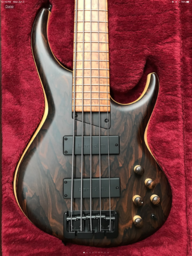
Here is me and my pride and joy.
 

Attachments

  • image.jpg
    image.jpg
    74.8 KB · Views: 151
Nice shot and beautiful AG5 Virgil!

Got my 534 (ash body, walnut top, maple neck/FB) back in December & it continues to blow my mind! Per Vic's recommendation, I was gonna try some DR's after the stock MTD's but had a set of brand new D'addario XL Nickels lying around so what the heck, threw em on and have been pleasantly surprised...non tapered B and totally diggin it. Last time i played these we're on my old & now sold Roscoe's...kinda forgot how musical they can sound. I remember them dying quick but lucky for me I actually like how nickels sound when they are heavily broken in... May stick with these for a bit, inexpensive too;)
 
I have been using the Dean Markley SR 2000. They break in and settle quite quickly. My AG 5 will be a year old next week, and I have only used Dean Markleys. I also had Mike to set it up for me in March, and it is perfect. I don't want to touch the action. In a years time, no neck adjustments have been needed.
 
Hi all...just bought a new to me 535-24 ash/redwood/wenge neck and fb

Looking for any and all info regarding proper care and maintenance of wenge necks and fretboards...tried a search and came up with a lot of nothing


Thanks TB

Glad to hear you took the leap! I don't think wenge needs any special care, really. Oil the fretboard every so often as you would rosewood or ebony. I don't think you have to worry about the neck at all as it has already been sealed.
 
Glad to hear you took the leap! I don't think wenge needs any special care, really. Oil the fretboard every so often as you would rosewood or ebony. I don't think you have to worry about the neck at all as it has already been sealed.

Great...thanks bass12

Can't wait til she arrives!!!! Latest update says Wednesday...after a 12 hour work day :-(

I'm sure that I'll stay up a bit later...
 
Apparently it is possible to set the gain for the on-board preamp internally.
Did anyone use that successfully?

My AG-4 has less output than my other active basses, so increasing the gain would help me even out the volume and compressor settings.
 
Apparently it is possible to set the gain for the on-board preamp internally.
Did anyone use that successfully?

My AG-4 has less output than my other active basses, so increasing the gain would help me even out the volume and compressor settings.
Yes, there's a pot inside the control cavity that you can adjust. I think they're usually set pretty low initially so you should have no problem getting plenty of output from your preamp with one quick turn of the screwdriver.