
Enjoy the benefits of a premium membership!
Upgrade Account
-
TalkBass has been independent since 1998. Add your voice.
Create a free account to reply to discussions, view embedded media, and browse with fewer display ads.
Join free Log in
Want zero display ads or expanded classifieds tools? Compare plans.
You are using an out of date browser. It may not display this or other websites correctly.
You should upgrade or use an alternative browser.
You should upgrade or use an alternative browser.
- Status
- Not open for further replies.
More options
Who Replied?

GG7
There a few posts that I saw where tb's went to local hardware store and purchases tool to adjust the rod-in case you do not want to wait another week!
I have to go down to the city today, so I will stop by Lowes and see if they have anything that looks like it will work.
Its going to have to be a really thin walled driver. The clearance between the trus rod nuts and the base of the headstock is less than an 8th of a inch on this bass. I might have to take some of the wood out from under the nuts.
Why do they leave you so little room to get a driver on these? Seems kind of lame. My 4001 never needed any adjustment since it was perfect when I bought it used, so I have never had to do this to one of these before.

GG7,
That is another way to do it, although I would not carve out the area in the headstock area. A thin walled nut driver will work. Never put more effort into turning the truss rod nuts than you can generate with wrist force. If you have to get a ratchet to exert more force, STOP! It does not take too much to get the neck moving.
I do not know why the driver fits on some but not all basses. It's just one of those things but it's not nearly as cumbersome as taking the neck off my old Fender P to adjust the rod. That sucked!!
It's just like some TRC's will slide right off once the three screws are removed and some will not. Some you can slide out of the way to do your adjustment but to remove it, a string needs to to be removed. Thankfully none of my 7 have this issue, close but they all come off if I need them to.
Sepp
That is another way to do it, although I would not carve out the area in the headstock area. A thin walled nut driver will work. Never put more effort into turning the truss rod nuts than you can generate with wrist force. If you have to get a ratchet to exert more force, STOP! It does not take too much to get the neck moving.
I do not know why the driver fits on some but not all basses. It's just one of those things but it's not nearly as cumbersome as taking the neck off my old Fender P to adjust the rod. That sucked!!
It's just like some TRC's will slide right off once the three screws are removed and some will not. Some you can slide out of the way to do your adjustment but to remove it, a string needs to to be removed. Thankfully none of my 7 have this issue, close but they all come off if I need them to.
Sepp
Some folks have taken the standard one and took a grinding wheel to it, making it both thinner, and conical in shape to better get under the adjustment nut.
Whoops...I see someone already suggested it.
Regarding the 'almost-to-perfectly flat' neck, it's basic engineering. That is what will put the neck into the most compression, which makes it stronger, lessens dead spots, and a whole host of other things that increase the bass'es performance. Coupled with not too high action which also adds to optimal neck compression, and you get an amazing sounding and playing bass.
Whoops...I see someone already suggested it.
Regarding the 'almost-to-perfectly flat' neck, it's basic engineering. That is what will put the neck into the most compression, which makes it stronger, lessens dead spots, and a whole host of other things that increase the bass'es performance. Coupled with not too high action which also adds to optimal neck compression, and you get an amazing sounding and playing bass.
Thanks for the additional info guys! The cover on this one comes off easily without having to move the strings, which is a plus!
I read on some of the older threads here about tapping the driver onto the nut with a light hammer or rubber mallet. That might do the trick in this case the first time I try this with the new driver (s). The wall of the driver might scoop out the wood that may be in the way. It won't be more than a shaving or two I would say.
Thanks for the input on how much to tighten them too! The RIC manual says 1/2 turn at a time and then let the rods do their job for awhile before adjusting again. Sounds like that might be too much? I don't know about that.
The current relief on this thing is pretty dramatic. You can see the bow in the neck easily just with the bass on your lap in playing position. Very obvious with the strings at pitch. I would think a 1/2 turn would be the minimum about of additional opposite force required to straighten this one out.
I read on some of the older threads here about tapping the driver onto the nut with a light hammer or rubber mallet. That might do the trick in this case the first time I try this with the new driver (s). The wall of the driver might scoop out the wood that may be in the way. It won't be more than a shaving or two I would say.
Thanks for the input on how much to tighten them too! The RIC manual says 1/2 turn at a time and then let the rods do their job for awhile before adjusting again. Sounds like that might be too much? I don't know about that.
The current relief on this thing is pretty dramatic. You can see the bow in the neck easily just with the bass on your lap in playing position. Very obvious with the strings at pitch. I would think a 1/2 turn would be the minimum about of additional opposite force required to straighten this one out.

GG7,
I'm pretty fanatical with my bass necks. I purchased a tool from POtR that is basically a heavy duty straight edge with notches at the fret locations. I place it on the neck to see just how straight the neck is. I do this from time to time. Generally if there is anything more than a wisp of light from where the tool touches the neck, the neck needs adjustment and I tweek accordingly.
Hey, I warned you, I am fanatical!!
Another real helpful hint is to fret the E string on the fist fret with your left hand. Do this like your playing the bass, not flat on a table. Next fret the E string at the 17 or 19th fret with your right pinkie while your hand stretches toward the nut. Unless you have short stubby fingers, you should have no problem reaching your right thumb to or near the 9th fret. Basically you have turned your E string into a straight edge. Now thump the E string with your right thumb at the 9th fret. If the string is sitting on the frets then you have back bow and need to loosen the truss rods. If you have a bit of travel then you have new bow, excessive relief and you need to tighten your truss rods. Also, make sure your bass is in tune before checking for straightness. You want real world tension on the neck.
In a pinch I'll sight down the neck from body to headstock and I can normally pick up how straight it is.
Sepp
I'm pretty fanatical with my bass necks. I purchased a tool from POtR that is basically a heavy duty straight edge with notches at the fret locations. I place it on the neck to see just how straight the neck is. I do this from time to time. Generally if there is anything more than a wisp of light from where the tool touches the neck, the neck needs adjustment and I tweek accordingly.
Hey, I warned you, I am fanatical!!
Another real helpful hint is to fret the E string on the fist fret with your left hand. Do this like your playing the bass, not flat on a table. Next fret the E string at the 17 or 19th fret with your right pinkie while your hand stretches toward the nut. Unless you have short stubby fingers, you should have no problem reaching your right thumb to or near the 9th fret. Basically you have turned your E string into a straight edge. Now thump the E string with your right thumb at the 9th fret. If the string is sitting on the frets then you have back bow and need to loosen the truss rods. If you have a bit of travel then you have new bow, excessive relief and you need to tighten your truss rods. Also, make sure your bass is in tune before checking for straightness. You want real world tension on the neck.
In a pinch I'll sight down the neck from body to headstock and I can normally pick up how straight it is.
Sepp
Absolutely no difference whatsoever between the Ric-o-sound box and a male stereo to two female mono's . Just get the stereo end long enough so you are not hanging two mono cables off the instrument jack.
Sepp
Sepp
IF you decide to tap the driver on, CLAMP the fretboard to the neck - i.e. use a pistol grip clamp just behind the nut.Thanks for the additional info guys! The cover on this one comes off easily without having to move the strings, which is a plus!
I read on some of the older threads here about tapping the driver onto the nut with a light hammer or rubber mallet. That might do the trick in this case the first time I try this with the new driver (s). The wall of the driver might scoop out the wood that may be in the way. It won't be more than a shaving or two I would say.
Thanks for the input on how much to tighten them too! The RIC manual says 1/2 turn at a time and then let the rods do their job for awhile before adjusting again. Sounds like that might be too much? I don't know about that.
The current relief on this thing is pretty dramatic. You can see the bow in the neck easily just with the bass on your lap in playing position. Very obvious with the strings at pitch. I would think a 1/2 turn would be the minimum about of additional opposite force required to straighten this one out.
When you go to adjust the nuts, snug them up if they are really loose, then turn them 1/2 turn and see if the neck moved near enough. After that, you might only need to turn the bass side nut, not the G side.
What Sepp said about fretting the E or G string to check straightness. A capo at the first fret helps do this.
GG7,
I'm pretty fanatical with my bass necks. I purchased a tool from POtR that is basically a heavy duty straight edge with notches at the fret locations. I place it on the neck to see just how straight the neck is. I do this from time to time. Generally if there is anything more than a wisp of light from where the tool touches the neck, the neck needs adjustment and I tweek accordingly.
Hey, I warned you, I am fanatical!!
Another real helpful hint is to fret the E string on the fist fret with your left hand. Do this like your playing the bass, not flat on a table. Next fret the E string at the 17 or 19th fret with your right pinkie while your hand stretches toward the nut. Unless you have short stubby fingers, you should have no problem reaching your right thumb to or near the 9th fret. Basically you have turned your E string into a straight edge. Now thump the E string with your right thumb at the 9th fret. If the string is sitting on the frets then you have back bow and need to loosen the truss rods. If you have a bit of travel then you have new bow, excessive relief and you need to tighten your truss rods. Also, make sure your bass is in tune before checking for straightness. You want real world tension on the neck.
In a pinch I'll sight down the neck from body to headstock and I can normally pick up how straight it is.
Sepp
LOL! Sounds like me!

I will go check out that leveling tool you mentioned over at POTR! I assume that it is specific to the guitar model right, because of the slots for the frets?
Sounds like a handy tool to have, although I owned my 72 4001 for 10 years and I never did anything to the neck adjustment. It always played like a dream the whole time I owned it.
It was studio use only though. I never gigged with it or anything, so that probably kept it stable. Man I miss that thing!

With that bass sitting in the warehouse since mid-2011, I'm not too surprised of the bow. Be aware you ight need to file the nut slots to get the string(s) lower over the first fret. RIC leaves them a tad high because it is easier to remove nut material than add something back in........ Wish that RIC made these more playable out of the box than this, or at the very least INCLUDED the dang wrench so I could adjust the neck!
Glad the new bubinga is the best looking. Nice.

Ric5
Inactive
- Jan 29, 2008
- 29,772
- 30,452
- Disclosures
- I like 5, 8, 10, and 12 string basses
2 of my favorite Rickenbacker basses have necks that don't really flatten out. 1960s 4001 basses had crazy thin necks that were hard to make flat.
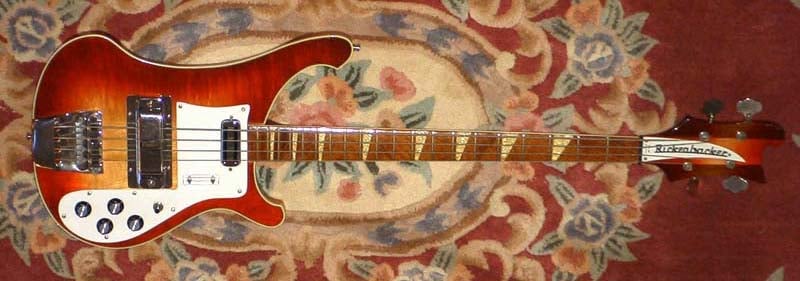
And this one here has a quirky neck but it is a great player ...
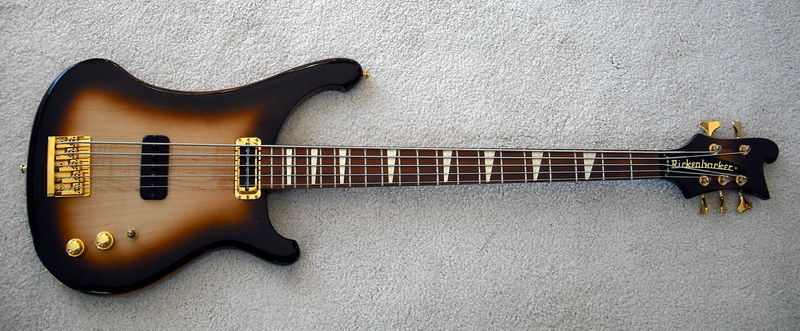
And this one here has a quirky neck but it is a great player ...
IF you decide to tap the driver on, CLAMP the fretboard to the neck - i.e. use a pistol grip clamp just behind the nut.
When you go to adjust the nuts, snug them up if they are really loose, then turn them 1/2 turn and see if the neck moved near enough. After that, you might only need to turn the bass side nut, not the G side.
What Sepp said about fretting the E or G string to check straightness. A capo at the first fret helps do this.
Thanks for that added info! Why clamp the fretboard? Worry about it popping off or something?
At the moment, the rod threads are extending beyond the end of each nut by a little more than about 1/8th of an inch and look even with each other in that regard. Does that give you guys an idea of how much force they currently are having on the neck?
As I said earlier... To my eye, the rods seemed to be totally backed off, cause as I brought the strings up to pitch I could see the neck being pulled forward as the tension increased.
Kind of shocking to witness actually compared to my American Deluxe Jazz Bass, which came out of the case nearly perfectly setup action and truss rod wise. Only needed a small intonation adjustment on the G string and she was ready to roll!
Is what I am seeing right now with this 4003 normal for a factory fresh bass? I had heard that RIC didn't do any kind of setup to these when they ship them out, and I can honestly say... They weren't kidding! LOL!
Where the hell is that damn wrench! Was over at Lowes today, and unfortunately they didn't have anything that looked thin walled enough to work on the truss rods on this bass.
With that bass sitting in the warehouse since mid-2011, I'm not too surprised of the bow. Be aware you ight need to file the nut slots to get the string(s) lower over the first fret. RIC leaves them a tad high because it is easier to remove nut material than add something back in.
Glad the new bubinga is the best looking. Nice.
Thanks! Yeah... All three of the 2011s I received had really nice boards. I would have been happy with any one of them in that regard. This one had a little more of the dark streaks running through the grain, and of course, the JetGlo paint hasn't started peeling off yet!
Roger on the nut slots! I think I am good on that score based on my visual inspection with the strings at pitch. The strings appear to be riding about right to my eye now. Looks about the same distance from open to fretted at the first and second as my Jazz Bass which is just the way I like it.
The other end of the fretboard is another story. At the moment, I would have to pull out my lap steel slide to do any playing on that half of the neck! lol!
2 of my favorite Rickenbacker basses have necks that don't really flatten out. 1960s 4001 basses had crazy thin necks that were hard to make flat.
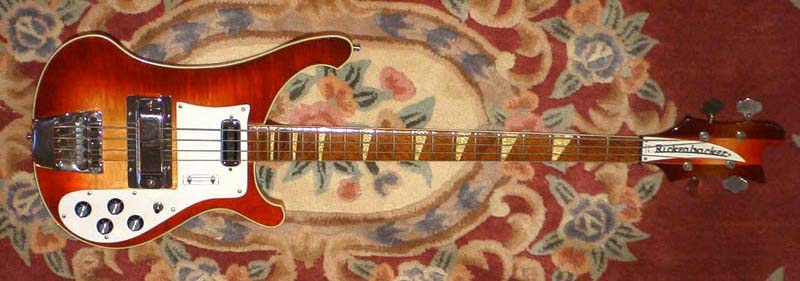
And this one here has a quirky neck but it is a great player ...
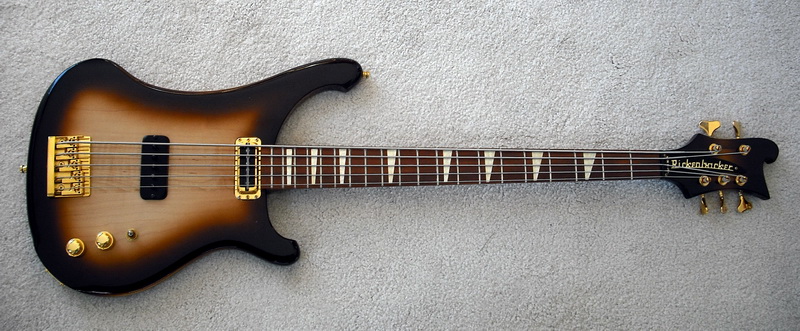
I love that FireGlo with the checked binding!
 Have you guys noticed that their current production FireGlos have a lot plainer looking maple than your example produced back in the 60s and into the early 70s? Maybe it is just the limited number of more modern examples I have seen, but the grain patterns are always pretty Blah, so the FireGlo finish has nothing to play off of.
 My 72 4001 JetGlo had the same binding. Why did RIC stop using that as a standard option offering? It makes the bass look so much classier to my eye! Gives it a real vintage feel! I have seen some of their recently produced one off guitars and many of them have that same binding, so they obviously still have access to the same material.
How does that one play with some relief in it? Is you action above the 12th fret still decent? Did you have to bottom out the bridge saddles?
I wish I would have paid more attention to these details when I owned the 72. It just felt right the minute I took it off the wall at Hollywood Ca. pawnshop back in 77. It was my first long scale bass, and was all I had for reference, but the action felt great on both ends and never buzzed on me when I played it. I only use a pick, so it may have rattled a bit with fingers instead, but the action was nice and low. Not over the top low, but I would say under 4/32nds give or take.

From what I was told, YES. The factory box still had the original FedEx shipping label on it from Rickenbacker to MusiciansFriend dated April 2011.
Roger on the nut slots! I think I am good on that score based on my visual inspection with the strings at pitch. The strings appear to be riding about right to my eye now. Looks about the same distance from open to fretted at the first and second as my Jazz Bass which is just the way I like it.
The other end of the fretboard is another story. At the moment, I would have to pull out my lap steel slide to do any playing on that half of the neck! lol!
Kind of a shame that the bass you've now finally got in your possession is nigh on unplayable! if that isn't the worst kinda tease you could suffer at this juncture, I don't know what would be
- Status
- Not open for further replies.


