

Enjoy the benefits of a premium membership!
Upgrade Account
-
TalkBass has been independent since 1998. Add your voice.
Create a free account to reply to discussions, view embedded media, and browse with fewer display ads.
Join free Log in
Want zero display ads or expanded classifieds tools? Compare plans.
You are using an out of date browser. It may not display this or other websites correctly.
You should upgrade or use an alternative browser.
You should upgrade or use an alternative browser.
- Status
- Not open for further replies.
More options
Who Replied?Slainté to the new Rickenbacker Club thread!
That's cool. I barely got to know Dale before he left the RIC forum but he seems like a great guy.
It may very well be an idiosyncrasy, but it's hard for me to say. I've never encountered a case of dead E string on any Ric but one, which was a 4001C64 with too much tailpiece lift. Otherwise I've never noticed it on anything. However by playing with pickup height I made a weird discovery: backing off the pickup actually tends to make the bigger strings sound livelier. Apparently bigger strings are more prone to magnetic interference, or that'd be my guess. And since people often tell people to raise the neck pickup to get more volume, and it is at a highly flexible section of the string length, I bet this could cause some serious problems. I think better advice is to lower the bridge pickup to match the neck pickup output. I also know people like to beef up the E string gauge to get more tension out of it but sometimes this chokes the sound.
As for dead spots, I don't think they are "permanent" but they are intrinsic to the wood in a way. However my 2008 4003FL, which has a pretty bad dead spot at the 10th fret of the D string unlike my other Rics, has sort of improved with time. Maybe it's just the setup but I can barely hear the dead spot now, yet back when I first bought it the dead spot was pretty severe. I modded the tailpiece to have 7 screws as an experiment, maybe that's what helped.
Jaymi said:actually Dale Fortune is better...he knows more about Ricks than any other person I know when it comes to refin'ing....
That's cool. I barely got to know Dale before he left the RIC forum but he seems like a great guy.
BlueTalon said:Well, if other people are mentioning [dead E string] as a criticism specific to Rickenbackers, is it possibly an idiosyncrasy of Ricks? And is there anything that can be done about it? Is a dead spot on a neck just a dead spot forever, or can it be livened up? It seems like the deadness gets more pronounced after the 3rd fret, if that helps.
It may very well be an idiosyncrasy, but it's hard for me to say. I've never encountered a case of dead E string on any Ric but one, which was a 4001C64 with too much tailpiece lift. Otherwise I've never noticed it on anything. However by playing with pickup height I made a weird discovery: backing off the pickup actually tends to make the bigger strings sound livelier. Apparently bigger strings are more prone to magnetic interference, or that'd be my guess. And since people often tell people to raise the neck pickup to get more volume, and it is at a highly flexible section of the string length, I bet this could cause some serious problems. I think better advice is to lower the bridge pickup to match the neck pickup output. I also know people like to beef up the E string gauge to get more tension out of it but sometimes this chokes the sound.
As for dead spots, I don't think they are "permanent" but they are intrinsic to the wood in a way. However my 2008 4003FL, which has a pretty bad dead spot at the 10th fret of the D string unlike my other Rics, has sort of improved with time. Maybe it's just the setup but I can barely hear the dead spot now, yet back when I first bought it the dead spot was pretty severe. I modded the tailpiece to have 7 screws as an experiment, maybe that's what helped.
Member # 88 checking in on page one. I've got a case of RAS, for a 660/12. Yeah, they make great guitars too.


Ric5
Inactive
- Jan 29, 2008
- 29,772
- 30,452
- Disclosures
- I like 5, 8, 10, and 12 string basses

Slainté to the new Rickenbacker Club thread!
That's cool. I barely got to know Dale before he left the RIC forum but he seems like a great guy.
It may very well be an idiosyncrasy, but it's hard for me to say. I've never encountered a case of dead E string on any Ric but one, which was a 4001C64 with too much tailpiece lift. Otherwise I've never noticed it on anything. However by playing with pickup height I made a weird discovery: backing off the pickup actually tends to make the bigger strings sound livelier. Apparently bigger strings are more prone to magnetic interference, or that'd be my guess. And since people often tell people to raise the neck pickup to get more volume, and it is at a highly flexible section of the string length, I bet this could cause some serious problems. I think better advice is to lower the bridge pickup to match the neck pickup output. I also know people like to beef up the E string gauge to get more tension out of it but sometimes this chokes the sound.
As for dead spots, I don't think they are "permanent" but they are intrinsic to the wood in a way. However my 2008 4003FL, which has a pretty bad dead spot at the 10th fret of the D string unlike my other Rics, has sort of improved with time. Maybe it's just the setup but I can barely hear the dead spot now, yet back when I first bought it the dead spot was pretty severe. I modded the tailpiece to have 7 screws as an experiment, maybe that's what helped.
I had "dead" notes on my 71 Fender Jazz bass: the 2nd, 3rd, and 4th frets on the G string. A tech "glued" (so he said) the frets and it seems to have greatly improved the sound. Has anyone heard of this before?
It's all about tuning the instrument's resonance to something different which a bit of voodoo at this time. Usually truss rod tweaks are a good choice for Rics as well as an overall thorough setup. Each year I become more firmly a believer in the idea that pickups need to be lowered, not raised, too...

Member # 88 checking in on page one. I've got a case of RAS, for a 660/12. Yeah, they make great guitars too.
I hear ya! If I can ever stop buying 4004/4003 basses, I'll have to pick up a Ric 620/12 in Fireglo.
Ric5 - great pix to start off part 5 of this thread.
Cassius - great tutoral on the RWRP pickup mod.
Rickenbacker Club Member #339.
4003 in Jetglo
4003 in Midnight Blue
4001 C64 in Fireglo
4004Cii in Trans. Purple
4004Cii in Mapleglo



Any club numbers left?
Here is my 4001 (NA240), signed by "Eloise", created in January 1974
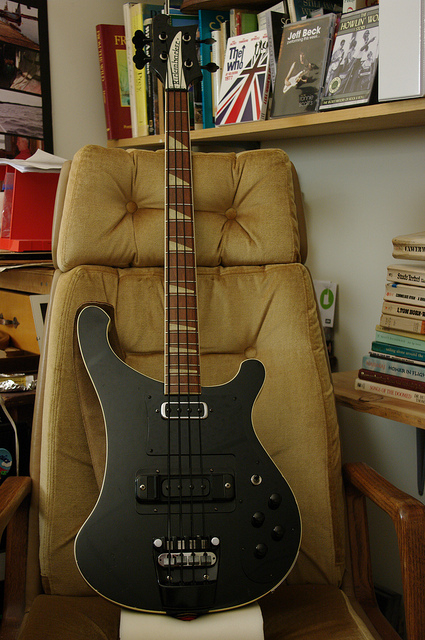
I bought it third hand in 1983 from Biker Ernie. This December I finished the rest of my work on the instrument. In all, the work I did my self was: new Hipshot 'Ric' tuning machines, new saddles, sanded/primed/painted cleared coated the bridge as black gloss from the original chrome, re-soldered loose wiring, replaced the bridge pickup mount, added a 'treble bezel', new screws, added a black pickguard and dome knobs and by-pased the .047 capacitor to give the bridge pickup its full output and bass frequency capability. My biggest project on this bass was a complete electrostatic shielding job using copper tape with a conductive backing-now the pickups are 99% silent except for a little sizzle when my fingers touch the bridge pickup poles. The finale was a set of DR's 'Black Beauties'.
A few months ago I had it set up for the first time since I've owned it. The luthier didn't have to adjust it much (but had to make his own tool to do it properly), but what he did made it even better. He told me that my Ric was the "most playable Ric (bass) of this vintage that I've worked on yet."
Call it the "Backinblacker" and I love this bass even more now.
Here is my 4001 (NA240), signed by "Eloise", created in January 1974
I bought it third hand in 1983 from Biker Ernie. This December I finished the rest of my work on the instrument. In all, the work I did my self was: new Hipshot 'Ric' tuning machines, new saddles, sanded/primed/painted cleared coated the bridge as black gloss from the original chrome, re-soldered loose wiring, replaced the bridge pickup mount, added a 'treble bezel', new screws, added a black pickguard and dome knobs and by-pased the .047 capacitor to give the bridge pickup its full output and bass frequency capability. My biggest project on this bass was a complete electrostatic shielding job using copper tape with a conductive backing-now the pickups are 99% silent except for a little sizzle when my fingers touch the bridge pickup poles. The finale was a set of DR's 'Black Beauties'.
A few months ago I had it set up for the first time since I've owned it. The luthier didn't have to adjust it much (but had to make his own tool to do it properly), but what he did made it even better. He told me that my Ric was the "most playable Ric (bass) of this vintage that I've worked on yet."
Call it the "Backinblacker" and I love this bass even more now.
Well part five it is then!
2006 4003 Amber Fireglo
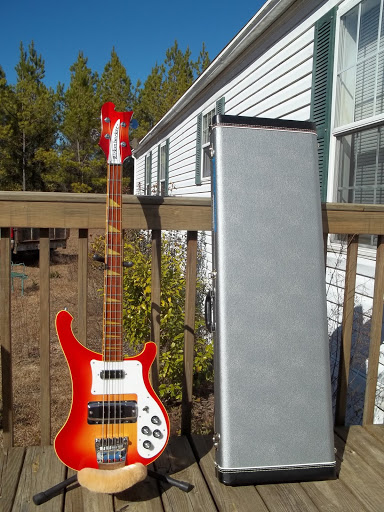
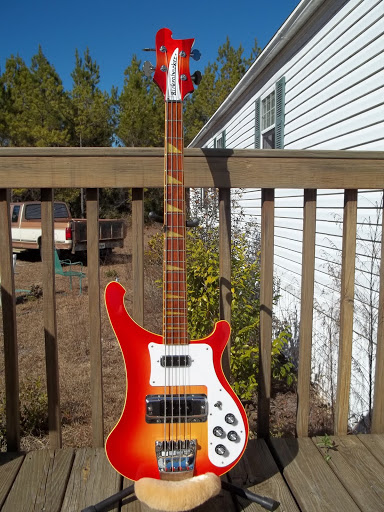
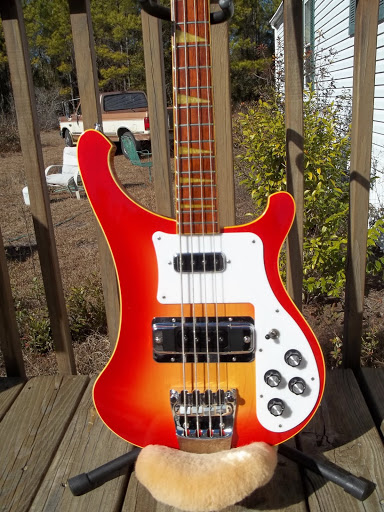
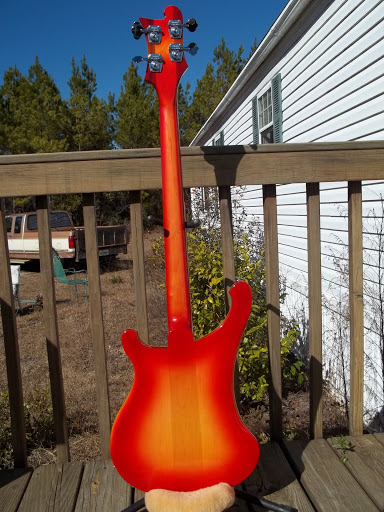
I really like the look. Maybe I should add one to my collection.


REPOSTING:
As long as we're sharing: Saturday night I played a full four set night using my Ric for 90% of the show (for the first time - generally my MIA P-bass was my goto bass). I played my 2010 4003 through my new Ampeg Pf500 and my 410hlf classic. A touch on chorus pedal and some tone shaping / minor overdrive from my Sansamp. Maybe the best tone ever for me in 28 years playing. The recently added treble bezel and setup (by my local shop - turns out his store doesn't sell Rics but he used to set em up all the time) made the 4003 extremely comfortable to play and the new pf500 really blew me away tonally. I am going to say that thing we all say just before our next bout of GAS: "I think I found my perfect set up!"
As long as we're sharing: Saturday night I played a full four set night using my Ric for 90% of the show (for the first time - generally my MIA P-bass was my goto bass). I played my 2010 4003 through my new Ampeg Pf500 and my 410hlf classic. A touch on chorus pedal and some tone shaping / minor overdrive from my Sansamp. Maybe the best tone ever for me in 28 years playing. The recently added treble bezel and setup (by my local shop - turns out his store doesn't sell Rics but he used to set em up all the time) made the 4003 extremely comfortable to play and the new pf500 really blew me away tonally. I am going to say that thing we all say just before our next bout of GAS: "I think I found my perfect set up!"

It may very well be an idiosyncrasy, but it's hard for me to say. I've never encountered a case of dead E string on any Ric but one, which was a 4001C64 with too much tailpiece lift. Otherwise I've never noticed it on anything.
Same here. I own three Rics and have played a dozen more. Never noticed a problem with the E string. I don't doubt it occurs, as with many brands of bass, but I think it must be relatively rare, and in the majority of those rare occassions there is usually a fix. I've read about various fixes that involve setup, pickup height, etc. Good call on pickups being too high as well cassius. Too much magnetic energy can have the reverse effect, like cancelling. I've had pickups seem to "die" on me when set too high and I was digging in heavily. Gotta find that sweet spot.

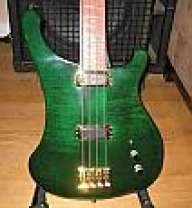
Oh my! Is that a factory finish? I'd love to see the rest of that Bass!
Oh my! Is that a factory finish? I'd love to see the rest of that Bass!
Thanks BassGen , that is my '08 4004cii ,2005 Color of the year Blue Burst , The headstock is indeed lighter in the center , it's not the lighting .
- Status
- Not open for further replies.

