

Enjoy the benefits of a premium membership!
Upgrade Account
-
TalkBass has been independent since 1998. Add your voice.
Create a free account to reply to discussions, view embedded media, and browse with fewer display ads.
Join free Log in
Want zero display ads or expanded classifieds tools? Compare plans.
You are using an out of date browser. It may not display this or other websites correctly.
You should upgrade or use an alternative browser.
You should upgrade or use an alternative browser.
The Sushi Box FX Secret Society
- Thread starter kranahan
- Start date
More options
Who Replied? How's this?


Much clearer than before! Approved.

Alright, Sushi Box held a companywide meeting tonight (that's right, both of us), and we have concluded that the Dr. Wattson mod described previously DOES NOT WORK. I don't have a mathematical or scientific explanation why, as based on my understanding of audio and electronics, limited though it is, it should work.
I know another way to fix this problem, but it involves a redesign of the board, as it would be too involved to modify an existing board. I'm not giving up, I'm going to keep playing with it (because it's bothering me), but I want everyone to know that you SHOULD NOT attempt the mod previously I described (I hope no one else has yet).
I apologize for the inconvenience, and I assure you we have our best (and only) people working on it.
I know another way to fix this problem, but it involves a redesign of the board, as it would be too involved to modify an existing board. I'm not giving up, I'm going to keep playing with it (because it's bothering me), but I want everyone to know that you SHOULD NOT attempt the mod previously I described (I hope no one else has yet).
I apologize for the inconvenience, and I assure you we have our best (and only) people working on it.

Alright, based on some further testing and evaluation, there are two viable fixes that could work. One is moderately difficult for a DIYer and gives okay results, the other is very difficult for a DIYer and gives ideal results.
The problem is that I took the preamp as-is from the actual amplifier circuit, which sometimes works and sometimes doesn't. I generally try to do as little modifications as possible when stompboxifying a preamp so it can be as close to the original as possible. Unfortunately this Hiwatt preamp was 100% designed to have a phase inverter and power amp after it, and tapping the output before the phase inverter to use as a standalone preamp is not working very well.
Technical explanation (feel free to skip if you don't care):
The Hiwatt schematic I followed has 3 gain stages. The gain control goes between the first and second, and the tone stack goes between the second and third, with the master volume going immediately after the tonestack. This is unusual as tonestacks are most commonly found either after the first gain stage (Fender, Alembic) or after the last gain stage (Ampeg, Orange, Sunn). Sometimes if the tonestack comes at the end you have a cathode follower (buffer) after the tone stack. Well the Hiwatt, and thereby the Dr. Wattson, has an additional gain stage after the tonestack. This means that the master volume isn't a true master volume control, it controls how much input gain goes into the last gain stage. This is not ideal for a stompbox, as turning up the master volume also increases the gain of the output. To make the circuit more ideal for use as a stompbox I would pull the master volume out from where it is now, replacing it with a resistor divider to drop interstage gain, then place the master volume at the very end AFTER the last gain stage. This would allow it to actually control the volume, and not just the amount of gain going into the last stage.
So what does this mean? Well I'm not really sure. I could redesign the Dr. Wattson board to fix the problem going forward, then have a "factory recall" where I take all the existing Dr. Wattsons out there and modify them for the fix. But that gets tricky because there are some outside of the US, and waiting 2 months (in some countries) or even 2 weeks (inside the US) to get a pedal fixed doesn't sound great. I know there are at least a couple people that have said the output volume doesn't bother them, in which case obviously nothing needs to be done, but there have been a handful that would like the output volume dropped.
Anyway, it's 11pm here, I still have a lot to do tonight, so let me know what you think, I'll check in before I go to bed.
The problem is that I took the preamp as-is from the actual amplifier circuit, which sometimes works and sometimes doesn't. I generally try to do as little modifications as possible when stompboxifying a preamp so it can be as close to the original as possible. Unfortunately this Hiwatt preamp was 100% designed to have a phase inverter and power amp after it, and tapping the output before the phase inverter to use as a standalone preamp is not working very well.
Technical explanation (feel free to skip if you don't care):
The Hiwatt schematic I followed has 3 gain stages. The gain control goes between the first and second, and the tone stack goes between the second and third, with the master volume going immediately after the tonestack. This is unusual as tonestacks are most commonly found either after the first gain stage (Fender, Alembic) or after the last gain stage (Ampeg, Orange, Sunn). Sometimes if the tonestack comes at the end you have a cathode follower (buffer) after the tone stack. Well the Hiwatt, and thereby the Dr. Wattson, has an additional gain stage after the tonestack. This means that the master volume isn't a true master volume control, it controls how much input gain goes into the last gain stage. This is not ideal for a stompbox, as turning up the master volume also increases the gain of the output. To make the circuit more ideal for use as a stompbox I would pull the master volume out from where it is now, replacing it with a resistor divider to drop interstage gain, then place the master volume at the very end AFTER the last gain stage. This would allow it to actually control the volume, and not just the amount of gain going into the last stage.
So what does this mean? Well I'm not really sure. I could redesign the Dr. Wattson board to fix the problem going forward, then have a "factory recall" where I take all the existing Dr. Wattsons out there and modify them for the fix. But that gets tricky because there are some outside of the US, and waiting 2 months (in some countries) or even 2 weeks (inside the US) to get a pedal fixed doesn't sound great. I know there are at least a couple people that have said the output volume doesn't bother them, in which case obviously nothing needs to be done, but there have been a handful that would like the output volume dropped.
Anyway, it's 11pm here, I still have a lot to do tonight, so let me know what you think, I'll check in before I go to bed.

@Sushi Box FX ,
Point us to the Hiwatt schematic you are using and there are some smart people here that can help with suggestions.
Point us to the Hiwatt schematic you are using and there are some smart people here that can help with suggestions.
I like the idea of the volume controlling the second gain, is it not possible to add a actual master volume at the very end?
So I remember where I got it from, but looking through them I'm having trouble remembering which one I used. Mine looks the most like this, so I'm pretty sure it's this one: https://hiwatt.org/Schematics/DR_LEAD_2InputPre.gif@Sushi Box FX ,
Point us to the Hiwatt schematic you are using and there are some smart people here that can help with suggestions.
If it helps, this is my schematic:
It is possible, but that extra knob has to go somewhere, and the way the board is set up right now there just isn't a great way to put it in (unless you squeeze it in at the top like @Sonicblaze did on his).I like the idea of the volume controlling the second gain, is it not possible to add a actual master volume at the very end?

@Sushi Box FX ,
Point us to the Hiwatt schematic you are using and there are some smart people here that can help with suggestions.
Yeaahhhhhh.... that schematic is for smarter people than me... LOL
5sg.


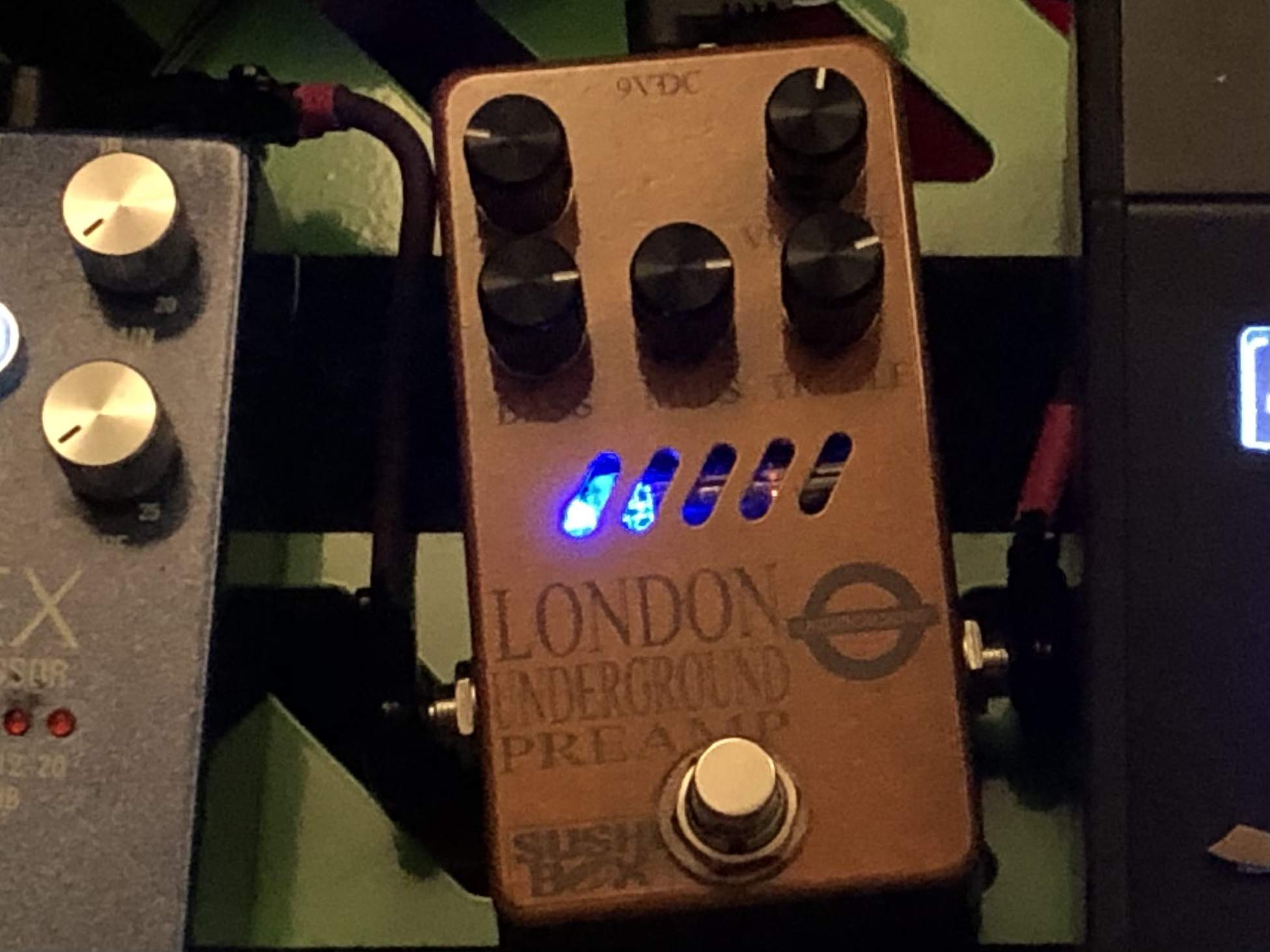
The London Underground is pretty spiffy. Favorite first impression, it’s very responsive to dynamics. Lovely clean, boosted tones, with EQ that’s got no bad settings , and some really sweet tones too. Breakup from 10 o’clock to 3 o’clock is very satisfying. For more gain I think I prefer goosing the input level over maxing the gain. It seems to really enjoy it when you slam the input. I like it.
Changing R16 to 560k should reduce the output by 6 dB (i.e., half).
Changing the load on the tone stack does have some influence on the its response. The Duncan Tone Stack Calculator indicates that it impacts the "treble" level more than mid and down. For example, with the tone knobs centered, going from 22k to 560k reduces the low bump at 40 Hz by 6 dB, the mid dip at 300 Hz by 6 dB, about 6.5 dB at 1 kHz, and about 8 dB at 6 kHz.
To keep the same load on the tone stack:
Changing the load on the tone stack does have some influence on the its response. The Duncan Tone Stack Calculator indicates that it impacts the "treble" level more than mid and down. For example, with the tone knobs centered, going from 22k to 560k reduces the low bump at 40 Hz by 6 dB, the mid dip at 300 Hz by 6 dB, about 6.5 dB at 1 kHz, and about 8 dB at 6 kHz.
To keep the same load on the tone stack:
A no-board-design-change mod would be to decrease the value of the master potentiometer while increasing the value of R16 and keeping the total around the original 272k. A 100k pot and 180k for R16 would reduce the maximum output to about 39% of the original maximum output. That's just over 8 dB reduction.
To try this on existing boards, change R16 out for 180k and place a 240k resistor across the master pot.
To try this on existing boards, change R16 out for 180k and place a 240k resistor across the master pot.
Last edited:
Playing around a couple of days ago with the pedal into a mixer and adjusting overall speaker volume using the console input gain, while trying various combinations of pedal gain and master volume, I kind of had that impression that the master volume changed the tone, but thought it was volume levels or tired ears playing tricks. So maybe not?It is possible, but that extra knob has to go somewhere, and the way the board is set up right now there just isn't a great way to put it in (unless you squeeze it in at the top like @Sonicblaze did on his).
A third, final volume would be great! I’d send my pedal for that, and pay for time and material (it’s not like the pedal is not working as intended). In the meantime I will try an 100k external volume as you had advised earlier.
Last edited:

Alright, Sushi Box held a companywide meeting tonight (that's right, both of us), and we have concluded that the Dr. Wattson mod described previously DOES NOT WORK. I don't have a mathematical or scientific explanation why, as based on my understanding of audio and electronics, limited though it is, it should work.
I know another way to fix this problem, but it involves a redesign of the board, as it would be too involved to modify an existing board. I'm not giving up, I'm going to keep playing with it (because it's bothering me), but I want everyone to know that you SHOULD NOT attempt the mod previously I described (I hope no one else has yet).
I apologize for the inconvenience, and I assure you we have our best (and only) people working on it.
I just wanted to say that this amount of honesty and transparency deserves a round of applause.
There are very few businesses that are ever this upfront with their costumers and admirers about a problem.
Candor! It’s kinda refreshing.


Last edited:
Have to second 40Hz ‘s comment about the level of honesty and transparency shown here by Senor Sushi . Truly commendable ! Also in opening up the thread to potential solutions by TB members with enough electronic “chops “ to add their thoughts shows a really high level of humility on Nathan’s part .... Kelly

But he never shows us what he had for breakfast. Disturbing.

That's a perfectly cromulent solution.
A noble toan embiggens the smallest man
So this was basically what I was thinking, but changing R16 isn't having anywhere near the drastic effect I was expecting. I went as high as 5.6M for R16 and the output was still crazy loud, unity being around 8:00. I will play with it some more tonight and see if adding a resistor across the pot helps as well.Changing R16 to 560k should reduce the output by 6 dB (i.e., half).
Changing the load on the tone stack does have some influence on the its response. The Duncan Tone Stack Calculator indicates that it impacts the "treble" level more than mid and down. For example, with the tone knobs centered, going from 22k to 560k reduces the low bump at 40 Hz by 6 dB, the mid dip at 300 Hz by 6 dB, about 6.5 dB at 1 kHz, and about 8 dB at 6 kHz.
To keep the same load on the tone stack:
A no-board-design-change mod would be to decrease the value of the master potentiometer while increasing the value of R16 and keeping the total around the original 272k. A 100k pot and 180k for R16 would reduce the maximum output to about 39% of the original maximum output. That's just over 8 dB reduction.
To try this on existing boards, change R16 out for 180k and place a 240k resistor across the master pot.
Another thought I had, this schematic uses a 220k linear pot for the master volume, whereas other schematics use a 220k log or 500k log pot, I'm thinking a log taper would help as well, shift the response so it doesn't get as loud as fast. Another thing for me to try when I dig in again tonight.
Frosted mini wheats today, but I get the off brand in the big bag because they have more frosting than the original.But he never shows us what he had for breakfast. Disturbing.
Something just isn't right. The circuit on the board can't be the circuit in the schematic. A 5.6 M R16 would be 4.8% of the original output. A 26.4 dB reduction.I went as high as 5.6M for R16 and the output was still crazy loud
Last edited:
Welcome to the confusionSomething just isn't right. The circuit on the board can't be the circuit in the schematic. A 5.6 M R16 would be 4.8% of the original output. A 26.4 dB reduction.

One thing I haven't tried is removing that R16 connection completely to see if the signal disappears.
@Sushi Box FX you tried that yet and/or checked the traces themselves? Wondering if maybe the signal is coming from 2 places and that's why R16 isn't behaving as expected. Granted that's a totally baseless hypothesis except random guess
Last edited:


