As is often the case, the truth is literally in the middle.
As in, in a country lying between Russia and the USA, and one which knew the Craze before any other: namely (...no, not Canada but) the UK.
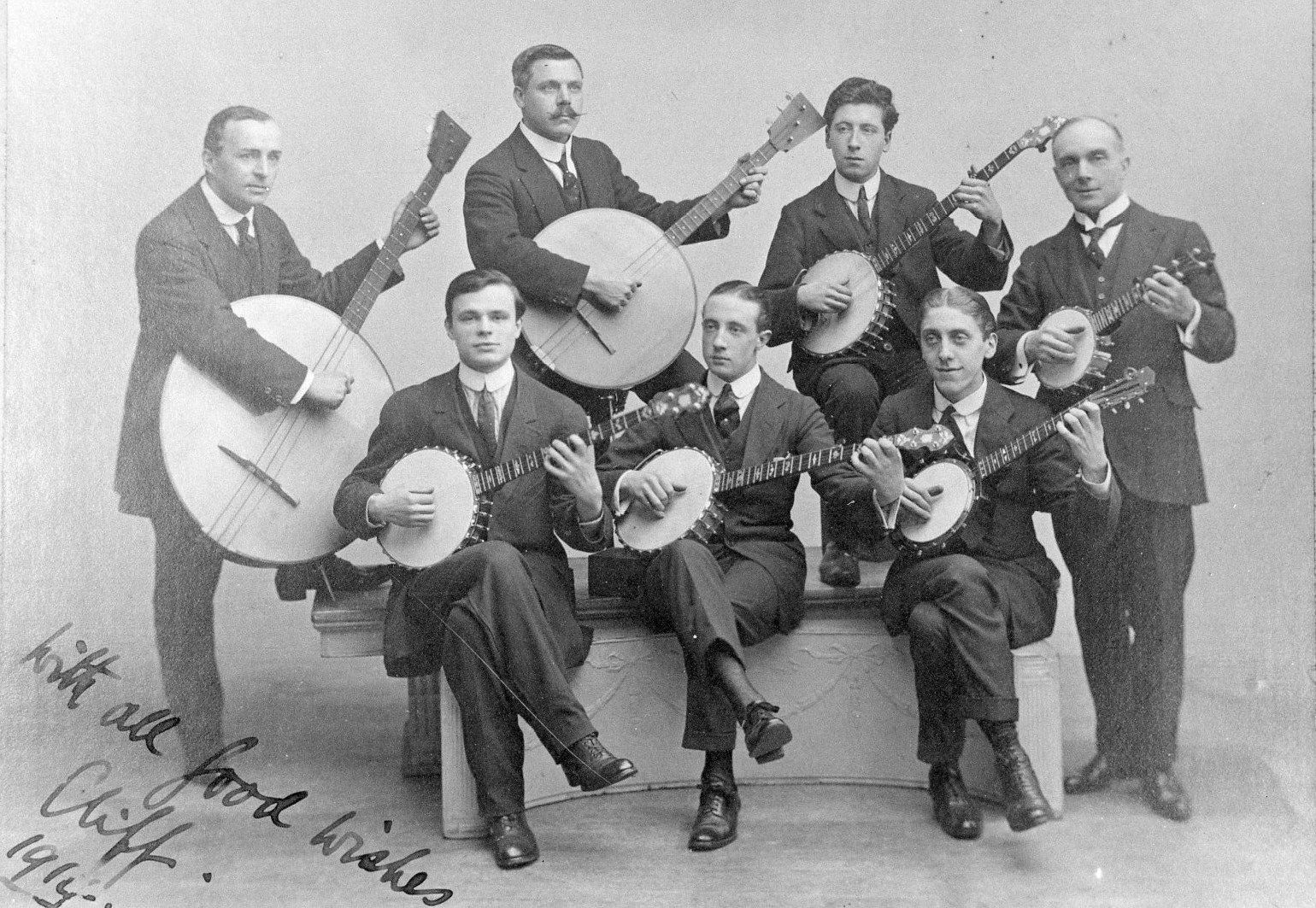
Have a look here:
Clifford Essex Story - born in 1900
The dedicator in the inscribed photo, "Cliff", is likely to be either of two banjoists in the photo itself: Mr. Clifford Essex, Sr. (top right) or Jr. (bottom middle), as captioned in this lower-res version of the same picture,
^ [Possibly published on Essex Sr.'s own
Banjo-Mandolin-Guitar Magazine (
B.M.G.), the longest running music periodical in the UK (original run was 1903-1976) and "the oldest fretted instrument magazine in the world".
As I advised GretschWretch
back in July, the collection of BMG issues once owned by the late Mr John Field, banjoist, has been (per his will) OCR-scanned and made available online with free access here:
BMG Magazines ]
Back to the instruments themselves, from the first link above:
So the balalaika callbacks may well not be a coincidence, but the instruments were UK-made.
The tunings for the bass and contrabass banjo, there, are (bar virtually rummaging through all those early BMG issues for the answer) anyone's guess:
- if the balalaika connection runs deeper than just the headstock shape, they should be guitar and bass-guitar EAD, respectively;
- alternatively, for all we know, the bass might also be CGD (cello tuning minus the high A), or CGB (plectrum-banjo tuning minus the high D, but an octave below), and the contrabass GDA or something in that neighbourhood;
- or they could be a mixture of the above.
- - - - - - - - - -
Re the differently-sized mandobasses,
There is some chance they were differently-tuned as well.
This puppy, a
chitarrone moderno, is a year older (1911) than the Gibson mandobass:
View attachment 5384839
35.43" scale.
Link Removed
Here's a pic of what appears to be a bigger specimen by the same manufacturer, Monzino in Milan:
https://www.talkbass.com/attachment...5936737388_5722728264905067832_n-jpg.4956790/
According to
Silvio Ranieri, who wrote about it in the 1910s or '20s, Monzino had introduced the instrument, then called an
arcichitarra, way back in 1890:
back in July
Also per Ranieri, Monzino's instrument was tuned the same as a double bass, but a 'mandolone' by a Neapolitan competitor was instead ADGC (tololoche tuning).
Double-octave down violin/mandolin tuning (GDAE) was, possibly, another option: it is also the original tuning of the
viola baixo (the Portuguese ABG, from the late 1870s).