
Enjoy the benefits of a premium membership!
Upgrade Account
-
TalkBass has been independent since 1998. Add your voice.
Create a free account to reply to discussions, view embedded media, and browse with fewer display ads.
Join free Log in
Want zero display ads or expanded classifieds tools? Compare plans.
You are using an out of date browser. It may not display this or other websites correctly.
You should upgrade or use an alternative browser.
You should upgrade or use an alternative browser.
The World's Most Beautiful Fretless Basses ...
- Thread starter TheRam
- Start date
More options
Who Replied?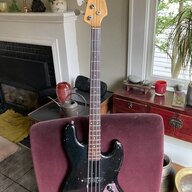


What is the brand of the bass in the background middle? With the black strings and burl top?
Is it a Rob Allen or what?
....perhaps it falls under the "or what" category, but it's a little experiment that Rob and I did. It's awesome, but if you learn to use the piezos, you can cop the tone from the mags. The mags also take away a little sustain, but it's still good.
Many fine basses!
Me, I'm less ambitious. Here's a link to my Fender/Warmoth P:
http://www.flickr.com/photos/19652150@N02/2068468907/
It's sitting here on its stand beside me. I've been trying to decipher a gospel song to perform at church, and have been assigned either Dobro or harmonica. I just could not hear a lead part on there, so I drug out the ol' fretless P and...
...instant love. All right. This will get used on the song.
But it's funny. I get typecast. I played nothing but bass for three years among some guys who didn't want me to play anything else. At the church everybody looks upset when I suggest the possibility of me not playing lead on a song. So now maybe they'll want me to play the bass AND the Dobro....
Me, I'm less ambitious. Here's a link to my Fender/Warmoth P:
http://www.flickr.com/photos/19652150@N02/2068468907/
It's sitting here on its stand beside me. I've been trying to decipher a gospel song to perform at church, and have been assigned either Dobro or harmonica. I just could not hear a lead part on there, so I drug out the ol' fretless P and...
...instant love. All right. This will get used on the song.
But it's funny. I get typecast. I played nothing but bass for three years among some guys who didn't want me to play anything else. At the church everybody looks upset when I suggest the possibility of me not playing lead on a song. So now maybe they'll want me to play the bass AND the Dobro....
....perhaps it falls under the "or what" category, but it's a little experiment that Rob and I did. It's awesome, but if you learn to use the piezos, you can cop the tone from the mags. The mags also take away a little sustain, but it's still good.
Either way, it's still a nice Rob Allen. I prefer the look of koa more than spalted maple, but I'm just insane...
Either way, it's still a nice Rob Allen. I prefer the look of koa more than spalted maple, but I'm just insane...
They both have unique feels and vibes, but the koa top really glows!!!
When I was still planning the bass, Rob showed me this block of outstanding koa and I knew I should snag it.

I can't sit by in silence to this nonsense about real players playing junky instruments. This is rubbish.
As a professional player, I know many of the cats around town who play full-time on most of the sessions and gigs.
The best players in town play quality gear like Sadowsky, Ken Smith, custom basses etc...these are the cats that are constantly busy AND get some of the BEST paying work in town. Sure, some of these cats may also have a $500 Skyline or 80's Kramer bass but that's in addition to the more expensive gear they own.
I've also seen a lesser amount of full-time players who play crappy basses or other crappy instruments. These are the guys who always cry poor and are always borrowing **** on the gig. I've seen these guys get fired from gigs because they never fix their broken equipment or they have horrible tone. I've seen, first hand, OVER and OVER band leaders saying "I'm not calling this guy back because he's got cheap, horrible sounding equipment". These players, though full-time, are usually the ones who get the lesser desired, lower-paying gigs. Of course, there are exceptions to the above statement, but as a rule, full time guys don't play junk.
I repeat ....Most, but not all, of the guys I know holding down quality gigs play quality instruments.
Go to any Cirque de Soleil show and you'll see the bass player with up to 3 quality basses in his area..i.e. an F bass ( $3,000 +), Lakland 55-94 and an electric upright.
It is true that most electric bass guitars that cost over $10,000 are purchased by lawyers and such. Those instruments are the either the anniversary models or have a ridiculous amount of inlay on them..etc. However, most top working pros are still purchasing instruments that range on average from $2,500-$5,000. These are high quality yet practical instruments designed to deliver quality tone and quality workmanship and reliability. Most pros I know, including myself, play such instruments.
Back when I was a full-timer, I didn't have any "dogs" in my gigbag. Typically I went on a gig with a Lakland 55-94 ($3600 retail), a Zon Sonus Special 5 Fretless ($3575 retail), and a NS Design CR5M ($3600 retail). All the guys I knew that were doing the same types of gigs I did had instruments that were of commensurate quality & cost.
I see the biz from a different side now, and yes, quite a few of my customers are "weekend warriors", but just as many (actually probably more) are at least making a sizable portion of their income from using the instrument we made for them.
There's nothing intrinsically wrong with using a beater as your primary breadwinner as a gigging bassist, but my experience is that most guys that are out there in the trenches are not doing it with a used MIM Fender P as their primary tool. If you are, kudos to you for finding what works for you, but let's not bash the next guy's choice.
In the end, they're all tools anyhow. And by the way, the guy that commented about hobbyist woodworker's tools being more expensive than those that do it every day for a living is obviously not spending any time in a woodworking shop.
I am.
You're wrong.

. . . The collectors and hobbyists are the people who keep the high-end guitar and bass builders in business!
Likely true, but for no other reason than they out number the professional musicians about 100 to 1. They also keep Fender, Ernie Ball and every other instrument manufacturer in business.
. . . real players understand that the subtleties of "tone" are about 95% gone in the context of a full band situation, and playing technique is everything in a real playing situation.
Again, I agree. But, how what does this have to do with what instrument you play?
I consume a great deal of professional music, either through live concerts or DVD/blu-rays, and I see a preponderance of top-end basses. Sadowsky, Lakland, whatever. I also see "coffee table" basses all the time.
Most of my taste are outside of rock/pop, and in those settings, the custom instruments are even more prevelent. And, BTW, those players are top-end pros. Certainly a "real musician" by anyone's standard.
Sometimes I think TB tends to be a little narrow-minded. There are lots of places that "real musicians" dwell besides bars and music videos.

Is that a Link Removed What was it like? Been wanting to try one out ever since I found the web site.
Yes, it was. It was a nice bass, the super short scale upper fretless was a hoot.
Likely true, but for no other reason than they out number the professional musicians about 100 to 1. They also keep Fender, Ernie Ball and every other instrument manufacturer in business.
I've got a pretty good perspective on this topic: the fact is that companies like Fender, et al, actually depend MORE on the hobbyist than a company like Brubaker or Smith, because their business model is based on a numbers game to make a smaller margin work. Companies that make the high end instruments have to make do with lower output numbers and more margin on each instrument (hey, it's an open secret, we do this for two reasons - 1) we make our living at it and need to make at least some profit to do so; 2) we truly love what we do!
).
Please see the context to which I was replying.Again, I agree. But, how what does this have to do with what instrument you play?
Sometimes I think TB tends to be a little narrow-minded. There are lots of places that "real musicians" dwell besides bars and music videos.
This is the most intuitive thing I've heard in a really long time! Very sig worthy.
I suppose things may vary from region to region, but most of the professional musicians I know work all day teaching lessons then all weekend playing cover gigs. What they like vs. what they play are often 2 different things. I don't thumb my nose at cover gigs, but I'd pull my hair out (if I had any) playing the popular tunes. As far as I know, only one or two professionals play the boutique gear, not because they dislike it, but only because the gigs around here aren't gonna come close to paying enough to cover that kind of bill. Although, some of the older dudes have told me about the old days where they could make mad money playing just gigs.
I'm far from a professional musician, but that doesn't mean I don't practice enough or know about tone. Subsequently, just because a bass has a coffee table top doesn't mean that the tone is going to be so radically different that it won't work in the context of the music. I know that some will say that producers hate basses with more than 3 knobs, but just because a bass is active doesn't mean it's going to have an immensely loud signal or overly high end tone.
Although, one should never underestimate the doctor/lawyer type. It took a strong type A personality to get where they are. That same determination can work extremely well in the context of music. Although, I'd say pharmacists are often a little better because we have much more free time.

- Oct 29, 2005
- 1,038
- 39
- Disclosures
- Endorsing Artist: Aguilar Amp Gruv Gear and Mono Cases

Completely believable. Real working who make their entire living from music very often see instruments as a tool. I think it's the same with any profession. A home hobbyist woodworker is more likely to have high priced tools than a professional woodworker in may cases. To the pro, the tool is just a job to get the work done. They will have a well made pro quality tool, but not necessarily the high end custom tool with all the bells and whistles that the accountant who works with a tool for his own pleasure will have.
Based on my experience with luthiers, this couldn't be farther off base. They typically buy industrial quality tools and have far more of them than a hobbyist. Tools that can stand up to production use.
It's not an absolute, it's just a trend. I'll bet anyone who works in the music instrument business will notice it. The collectors and hobbyists are the people who keep the high-end guitar and bass builders in business! And there's nothing wrong with having bass as a hobby and spending $5000 on a coffee table with strings if that's your thing.
While this may be true of some brands, a quick scan of my working bassist friends contradicts it. The overwhelming majority of them have higher end basses. While most aren't spending over $5k, they certainly are playing well into the boutique range of instruments. And while some may be coffee tables with strings, you don't have to look very hard to find actual basses instead.
Also, real players understand that the subtleties of "tone" are about 95% gone in the context of a full band situation, and playing technique is everything in a real playing situation.
I LOL'd at that because AFAIK I am a real player and this is silly. The vast majority of time my tone comes through. And IME most of the people I know who are buying nicer basses and rigs are concerned with having their tone come through. It's actually pretty easy... you learn how to play, you buy a nice instrument, use adequate amplification and work with competent people. I seriously doubt most boutique owners are using their basses merely as triggers.
If anything, they're more concerned with their tone than others. I'm not talking about the folks who just show up for a gig and hope for the best. If I rattled off just the local working players I know, probably 95% of them use boutique basses and maybe half of the ones who don't would like to. I don't know anyone who's just using something because it looks good. There are few things more aggravating than great looking basses that sound or play subpar.

I've got a pretty good perspective on this topic: the fact is that companies like Fender, et al, actually depend MORE on the hobbyist than a company like Brubaker or Smith, because their business model is based on a numbers game to make a smaller margin work. Companies that make the high end instruments have to make do with lower output numbers and more margin on each instrument (hey, it's an open secret, we do this for two reasons - 1) we make our living at it and need to make at least some profit to do so; 2) we truly love what we do!
+1
If Kevin Brubaker had to depend on hobbyists...


Although this is getting pretty far out-of-bounds, my thinking has always been to put amplification first. Then get a nice bass, whatever that means to you - $3-$10K, basically the cost of a decent used car. I think it is much harder to make a great bass sound good through mediocre amplification than vice versa. Setup on instruments also has alot to do with your tone. Lower end instruments with a great setup can play and sound fantastic. That's why I support my local luthier. Not just guitar builders, but guys who do great setup work as well.
My response to the discussion about doctors/lawyers basses versus true musicians instruments is two-fold.
Firstly, because I own a CT bass with stripes on it, many people assume that I am a collector and not a die-hard musician. That's quite an assumption, but I really don't feel the urge to set the record straight. I am way too old to worry about what other people think.
Secondly, I think there is a bigger issue which is important. As I scroll through the above pages, I see dozens of fantastic instruments - most of which were purchased off the beaten path. In my eyes, this is a good thing. If none of us played "different" instruments, then one could only imagine what Fender quality control would be like. The more of us that continue to play Foderas, Sadowskys, Nordys, CTs, etc, etc - the louder the message is to Fender. There are viable alternatives to the norm, and this is a good thing. It'll keep Fender on it's toes (if it has toes?).
My favourite quote on this subject comes from Carl Thompson. Carl and I had the fortunate opportunity to see Les Paul play at The Iridium about 3 years ago where he still plays weekly. Les was playing a Les Paul Recording guitar which is hardly one of Gibson's sought after instruments. When our neighbour asked us what guitar Les was playing, Carl told him, "It doesn't matter. It might matter to him, but it shouldn't matter to us."
Firstly, because I own a CT bass with stripes on it, many people assume that I am a collector and not a die-hard musician. That's quite an assumption, but I really don't feel the urge to set the record straight. I am way too old to worry about what other people think.
Secondly, I think there is a bigger issue which is important. As I scroll through the above pages, I see dozens of fantastic instruments - most of which were purchased off the beaten path. In my eyes, this is a good thing. If none of us played "different" instruments, then one could only imagine what Fender quality control would be like. The more of us that continue to play Foderas, Sadowskys, Nordys, CTs, etc, etc - the louder the message is to Fender. There are viable alternatives to the norm, and this is a good thing. It'll keep Fender on it's toes (if it has toes?).
My favourite quote on this subject comes from Carl Thompson. Carl and I had the fortunate opportunity to see Les Paul play at The Iridium about 3 years ago where he still plays weekly. Les was playing a Les Paul Recording guitar which is hardly one of Gibson's sought after instruments. When our neighbour asked us what guitar Les was playing, Carl told him, "It doesn't matter. It might matter to him, but it shouldn't matter to us."


