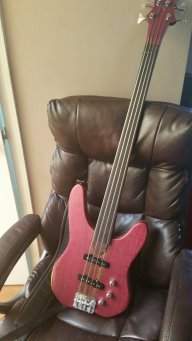

Enjoy the benefits of a premium membership!
Upgrade Account
-
TalkBass has been independent since 1998. Add your voice.
Create a free account to reply to discussions, view embedded media, and browse with fewer display ads.
Join free Log in
Want zero display ads or expanded classifieds tools? Compare plans.
You are using an out of date browser. It may not display this or other websites correctly.
You should upgrade or use an alternative browser.
You should upgrade or use an alternative browser.
Thinking of BEAD, lose the G?
- Thread starter rockinrayduke
- Start date
More options
Who Replied?

A Hipshot D-Tuner works, too.
If you have the mental plasticity to deal with the different tuning interval between your D and A string, then a D tuner works.
A bass tuned to D standard maintains the intervals between strings as 4ths, which works much better for my brain.

I tried it. I thought I would like it, but I missed the G string. I've switched from exclusively 4 strings to exclusively 5 strings now. No regrets.
Yep. Every time I play a string instrument which isn't tuned to 4ths it runs my mental mojo.If you have the mental plasticity to deal with the different tuning interval between your D and A string, then a D tuner works.
A bass tuned to D standard maintains the intervals between strings as 4ths, which works much better for my brain.

If you have the mental plasticity to deal with the different tuning interval between your D and A string, then a D tuner works.
A bass tuned to D standard maintains the intervals between strings as 4ths, which works much better for my brain.
I played in drop tunings for much of my "early years" in punk and metal bands, so it's an easy switch for me.
But yes, I agree it may not be for everyone.
I played in drop tunings for much of my "early years" in punk and metal bands, so it's an easy switch for me.
But yes, I agree it may not be for everyone.
I'm old enough that transposing is tough enough - the 5th interval is something that I wouldn't feel comfortable taking on stage.
I have one in BEAD (35") and one in EADG (34").
Mostly I use BEAD if I'm playing dub(ish) lines. Honestly, partly it's to get some extra life out of an old instrument that's threatening mechanical failure. Also partly to gauge whether I'd try a fiver to get the low notes, and yes, I know that isn't the only reason to use one. I do like the differet tones I get from the different gauges, so... when it finally dies on me, I'll probably be forced to decide.
Mostly I use BEAD if I'm playing dub(ish) lines. Honestly, partly it's to get some extra life out of an old instrument that's threatening mechanical failure. Also partly to gauge whether I'd try a fiver to get the low notes, and yes, I know that isn't the only reason to use one. I do like the differet tones I get from the different gauges, so... when it finally dies on me, I'll probably be forced to decide.

I couldn't give up my G string. I use it too often. I could actually do your "count the times" evaluation on my 5 string and discover I only use my B string a handful of times in a gig. But the times I use it, I really need/want it. Uptown Funk for example. Sounds lame if it isn't down low. Yeah, I could get a really good octave pedal but there are licks that require "standard" strings, too. Then I'm turning the octave pedal on and off. I'd rather have a 5 and use the B as a sweet thumb rest than deal with an octave pedal or alternate tuning.
Believe me, I've had this argument in my head with myself MANY times. It always ends up with me playing my Roscoe 5 string. No one complains.
Believe me, I've had this argument in my head with myself MANY times. It always ends up with me playing my Roscoe 5 string. No one complains.

Last originals band, did not miss the G at all. Wrote all basslones for BEAD.
Most recent cover band: Use the G far more than I'd use the B, so kept everything in standard tuning. Fretless fivers with no lines and wide bridge spacing are not cheap or easy to find. I'm ok with it.
BEAD can totally work, but it does need to be planned for.
Most recent cover band: Use the G far more than I'd use the B, so kept everything in standard tuning. Fretless fivers with no lines and wide bridge spacing are not cheap or easy to find. I'm ok with it.
BEAD can totally work, but it does need to be planned for.

- Feb 8, 2005
- 3,636
- 1,053
- Disclosures
- Endorsing Artist: Bag End - Dean Markley - Thunderfunk
...I feel like that had I thought of D standard tuning back when I went BEAD, I might have never gone 5 string.
I (pretty much) play 5ers exclusively and am happy with my Stambaughs.
However, knowing what I know now, if I had to do over I'd probably go with a 4 string tuned DGCF, plus a hipshot tuned to C.
To me, this would yield several advantages and few downsides.
I would only sacrifice one note on the low end, B and only 2 more on the top end.
Additionally I could use heavier strings and my top string (F) could be a real bass string with more than 1 wrap (like almost every manufacturers G below .050" gauge) so the tone would be more even.
The downsides would be losing that open E which comes in handy for a lot of tunes and styles, and having to relearn the fretboard.
Yes, I could just transpose everything but I know the sound of my notes (especially open strings) too well for it not to freak me out if I played an "E" but the actual note I heard was a D. I'm just weird that way, plus it's way too late now lol.

I've never played a 5 string. Actually, I tried one many years ago, and it felt so foreign to me (neck width and that extra string), so I gave up the idea of it.
What I DID do was tune one of my basses (low to high) CGDA, similar to New Standard Tuning, as used by Robert Fripp (of King Crimson fame).
It allowed me to have a similar feel to a 4 string, but with an extended range that the dropped two steps on the lower and up one step on the upper string provided. Since this tuning is in 5ths, it made it easier for me to play typical "guitar" power chords or add in those "extra notes" that you generally have to "reach for" on a standard (or BEAD) tuned 4 string. It was also quite a nice treat to use this tuning for independent left/right hand bass/chordal melody interplay (ala Chapman Stick or Warr Guitar styles).
It worked for me. Didn't miss that low B (C worked out quite well).
I may revisit this adventure at some point in the future.
What I DID do was tune one of my basses (low to high) CGDA, similar to New Standard Tuning, as used by Robert Fripp (of King Crimson fame).
It allowed me to have a similar feel to a 4 string, but with an extended range that the dropped two steps on the lower and up one step on the upper string provided. Since this tuning is in 5ths, it made it easier for me to play typical "guitar" power chords or add in those "extra notes" that you generally have to "reach for" on a standard (or BEAD) tuned 4 string. It was also quite a nice treat to use this tuning for independent left/right hand bass/chordal melody interplay (ala Chapman Stick or Warr Guitar styles).
It worked for me. Didn't miss that low B (C worked out quite well).
I may revisit this adventure at some point in the future.
I spent half of 1989 playing BEAD, and didn't once notice anything "missing" (it was a 24-fret bass, and was fully playable right up to that top D note). But back then there didn't actually seem to be much value in it, for everyday playing... I finally recorded one song in B and then set it back to EADG for good as I was lazy enough that transposing stuff up a fourth was an annoyance. 
I like BEAD as long as I'm playing stuff I've written, not covers. For covers, I find myself missing the G.
For my own stuff, I have a pretty high threshold for idiosyncrasy. For instance, for the past month I've nearly exclusively been playing a bass tuned in fifths: DAEB. It started as a preudo-Morphine tuning, but I'm actually finding it worthwhile well beyond it's obvious power chord utility. Having those wider intervals available so easily is actually a lot of fun.
For my own stuff, I have a pretty high threshold for idiosyncrasy. For instance, for the past month I've nearly exclusively been playing a bass tuned in fifths: DAEB. It started as a preudo-Morphine tuning, but I'm actually finding it worthwhile well beyond it's obvious power chord utility. Having those wider intervals available so easily is actually a lot of fun.

There is no perfect solution.
Best advice given earlier is to have a really good understanding of your actual range required for your parts. For example, Uptown Funk uses the low D as a root with the low C as a passing tone. In live performance, you can get away with ghosting that passing tone and use a 4 with the HipShot. But, if I'm recording that part for a demo, then I want the 5 to get it right.
Learning to play the 4 tuned DADG with the released HipShot is well worth the effort. IME, that is the most versatile instrument for live performance. But, as I said earlier, there is a place for the 5 as well. You can get by with either, but have to learn the trade offs.
Best advice given earlier is to have a really good understanding of your actual range required for your parts. For example, Uptown Funk uses the low D as a root with the low C as a passing tone. In live performance, you can get away with ghosting that passing tone and use a 4 with the HipShot. But, if I'm recording that part for a demo, then I want the 5 to get it right.
Learning to play the 4 tuned DADG with the released HipShot is well worth the effort. IME, that is the most versatile instrument for live performance. But, as I said earlier, there is a place for the 5 as well. You can get by with either, but have to learn the trade offs.
I did it for a while, but it was weird. I play skinny neck 5's and that works pretty well for me. I don't use my low b all the time, but like in when I like it, so won't leave home without it. So much so that I don't really dig me a 4 so much. I mean I can play a 4, both a BEAD and standard tune, but It's kinda not my thing... To me it's as different as fretted is to fretless....
For me, I could see it if there were underlying circumstances, like for example, a specific genre of music that a 5 could prove handy. Say P&W or Country. Add it a need to have a ligth-weight bass. That could make me do it. Would still be strange and disorienting to me....
For me, I could see it if there were underlying circumstances, like for example, a specific genre of music that a 5 could prove handy. Say P&W or Country. Add it a need to have a ligth-weight bass. That could make me do it. Would still be strange and disorienting to me....

MDBass
Supporting Member
- Nov 7, 2012
- 8,590
- 14,892
- Disclosures
- Endorsing Artist: Dingwall-Fender-Bergantino-Dunlop-Tech 21-Darkglass-Nordstrand
A player I knew in LA restrung a 4 string Dargie Delight Sterling to BEAD which I thought was a cost effective way to get the benefits of a fiver without buying one. Anyone ever tried this and did you miss the G string?
"Cost effective" doesn't really have anything to do with it: my main, and most expensive, bass is usually tuned this way.
I just prefer the feel and look of a four string for most things, unless you're doing a lot of Top 40/wedding kind of gigs and a five really is necessary.

Also, this is how Anthony Jackson first started getting into extended range bass way back in the day.
But he pretty quickly went to 6-strings, adding back the G and a high C to boot

This thread just goes to show that people have different gigs. I can cover some shows with a standard 4-string, and while I have a D-tuner I only use it occasionally. I can play the same show on a 5-string and will use the B-string but rarely for notes below E, instead using it up the neck so I'm not shifting positions. Another gig I played 6-string the first 7 shows, for the last show I brought a 5 and ended up missing the high C. On a different gig, I wouldn't even think about the high C.
Just depends on what notes you think you need, and how you want to make them. There are good arguments for a 6 in that you can play a wider range without moving your left hand. There are good arguments for a 4 in that you don't have to worry about damping extra strings and the "less is more" can kick in to induce you to play less notes.
No single right answer...
The 'dividing line', I think, between fours and fives is not the discussions of 'floppy b-strings' and the usual topics.
To me, I believe for most guys, and this is rarely if ever mentioned, is fingering (and the resulting string-spacing and fingerboard width issues) across four strings or five strings. Some are firmly rooted in the choices across a four-string fingerboard, and others can adapt (or start off) with more strings. And either approach is entirely valid, there is no 'better' or 'worse', only what suits you.
There are lots of guys flying BEAD on fours, and it works just fine. The great thing is you can try it once or twice with your favorite four-string without changing or modifying anything in most cases: Then if you really want to commit, change or modify your nut and bridge saddles and there you are. Or you can go back to EADG, no harm no foul, except for the cost of those couple of BEAD sets. Pretty cheap experiment in the overall scheme of things.
To me, I believe for most guys, and this is rarely if ever mentioned, is fingering (and the resulting string-spacing and fingerboard width issues) across four strings or five strings. Some are firmly rooted in the choices across a four-string fingerboard, and others can adapt (or start off) with more strings. And either approach is entirely valid, there is no 'better' or 'worse', only what suits you.
There are lots of guys flying BEAD on fours, and it works just fine. The great thing is you can try it once or twice with your favorite four-string without changing or modifying anything in most cases: Then if you really want to commit, change or modify your nut and bridge saddles and there you are. Or you can go back to EADG, no harm no foul, except for the cost of those couple of BEAD sets. Pretty cheap experiment in the overall scheme of things.

Of course. Hence my statement that this was how he "first" got into extended range bass.But he pretty quickly went to 6-strings, adding back the G and a high C to boot
Last edited:

I did it for a lot of years. i didn't miss the g string. you only lose the 5 highest notes at the end of the neck. I much preferred the thinner neck.
I strung the bass with BEAD strings. If I was gonna do it again i would just use strings made specifically for drop down tuning. that way you dont have to file wider slots at the nut. And the smaller neck isn't being pulled by the tension of thicker strings.
DR Strings DDT-45 Drop-Down Tuning Stainless Steel Medium Bass Strings
I strung the bass with BEAD strings. If I was gonna do it again i would just use strings made specifically for drop down tuning. that way you dont have to file wider slots at the nut. And the smaller neck isn't being pulled by the tension of thicker strings.
DR Strings DDT-45 Drop-Down Tuning Stainless Steel Medium Bass Strings
Last edited:


