• TalkBass has been independent since 1998. Add your voice.
    Create a free account to reply to discussions, view embedded media, and browse with fewer display ads.
    Join freeLog in
    Want zero display ads or expanded classifieds tools? Compare plans.

Double Bass Thumb position

I did something similar but for a different reason:

The previous owner of my 5-string EUB let a luthier round the fingerboard more to get the same bowing angle as on a 4- string. That means that the height of the fingerboard edge went down to (almost) zero at the end of the fingerboard. This edge cut into the right thumb when playing pizzicato. I easily got a blister there after a rather short time of playing.

I took a piece of beech (or oak?) about 1x1.5 cm and with the length from the heel end to the end of the fingerboard and glued it on with epoxy, then rounded the lower edge of it to avoid a sharp edge cutting into my right hand thumb. Playing is much easier now and no more blisters, but the board got also more rigid that way.
 
  • Like
Reactions: bassmanbrent
Hey Brent, well first I have to get the jokes about "dusty end", "cash register", "only dogs can hear those notes", etc etc out of the way. . . I think the "thick fingerboard" comments might be on the money. Now that I'm back to spiros, my bass is ringing really nicely up high and it's freaking me out. I have a very thick fingerboard on there. The comments about arco practise and the correct LH weight are true too, but I know you already have that part sorted. Cheers my friend!
 
Hey Brent, well first I have to get the jokes about "dusty end", "cash register", "only dogs can hear those notes", etc etc out of the way. . .

Yeah, I know. There's no money way up there :-) And thanks for your thoughts, LM. I am beginning to think that the thinness of the FB and it's flexibility past the heel are a big part of what's going on here. Your bass has always sounded killer to me, BTW.
 
There’s money up there but it is hard won. I’m going to say bow it. Go slow. Pay close attention to your finger angle to the fingerboard. Try changing up your positions I.e. vertical, angled, hand weight and/or “pressure”. Focus on intonation. Playing in tune should vibrate the bass, just as it does in the lower registers. Seek resonance. Play the upper register then go down and repeat your line in the lower register. Compare. Of course play with bow/finger placement. Just try everything to get the whole bass engaged. Experiment with vibrato. Slow, deliberate. Change speeds. Draw sound, don’t force sound. Try lightness with your pizz, don’t force it. Pizz from the side, more like an electric guitar pluck, see what that gives you. Then move across to the other strings. Is one string more resonant? Sometimes you can be surprised that the notes on the A string actually sound better than the g string even though that string is so much thicker. Go back to all of this every day for a couple of weeks. You will find that there are really nice tones up there but you have to learn how to find them and then replicate them at will.
 
  • Like
Reactions: Chris Fitzgerald
It never hurts to work on technique but yes there are a number of things someone can do the fingerboard to address this. It takes someone with a lot of experience to do this kind of work. I know some players go so far to have a kind of reverse scoop.

I don't play this type of set-up so don't look at me to tell you anything more than that. If you know someone who is getting this sound with their bass ask them about it.
 
  • Like
Reactions: bassmanbrent
There’s money up there but it is hard won.

I'm sure you know this, but it's meant to be a joke, as in "no one wants to hear a bass player playing way up there. Roots and fifths only, please."

Thanks for your thoughts on the technical aspects too. I'm not saying that it isn't important, 'cause clearly it is. That said, I am talking about the weakness in a specific bass, which is pretty dead above Bb on the G string. I have another bass (wearing dominant solos) that sounds great up to a high E on the G string and is perfectly usable to the 2nd octave G, so I'm mostly looking for thoughts on setup that might help. Cheers.
 
  • Like
Reactions: Paps and TroyK
Yeah. And it’s a good joke! I get you. Sounds like you’re just referring to the bass, not your playing. In that case I’d suggest looking at the post. Not much else is going to be a quick fix. You could go as far as getting a post re-cut and fitted. But if the bass isn’t resonating in that region I can’t thing of anything else to adjust that isn’t the player. Have you heard other people play it while you listen out front? Same deadness?

I totally understand dead basses. They certainly exist. That’s one of those variables to mention when we recommend spending as much a person can afford to get the best bass they can. A balanced even sound all over the board is pretty vital if you want to play the whole bass. Over the last few years I’ve defaulted to searching down sound issues in me more than equipment but then again I have a nice instrument, not perfect by any stretch but good enough. Sorry to derail a bit with my mansplaining.
 
Interesting idea! I’ve never seen it before but that doesn’t mean it’s not possible…
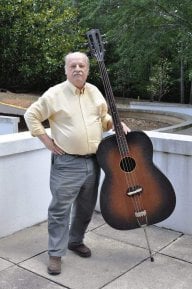
Regal was doing this long ago.

upload_2023-11-17_14-4-35.jpeg


If you look closely you can see the overhang. As with DB, the Bassoguitar's neck ends at the top block (dovetail), and a sculpted reinforcing block was placed beneath the rest of the fingerboard. My first Bassoguitar lacked this reinforcement, and the fingerboard had been dressed so many times that it had a knife edge (ouch!). I had to glue a 1/2" dowel under there to give the fingerboard some "pushback."

Gretsch does/did something similar with its archtop electrics.
 
Impersonal and rhetorical. Directed at the instrument not the messenger.
At last, a Ukulele I might be able to play...(but maybe only once!!)

Actually, if they have not been neglected or abused, these things aren't so bad. I find that the bridges are too tall and the endpins too short for my tastes -- and the necks kind of chunky. But once those quirks are adjusted to, these things are kind of fun. The tops are ladder-braced, so the instrument will sound nothing like a double bass (not that it ever was intended to) and, being the top is flat, a player can slide the bridge to any place between the tailpiece and the soundhole to get whatever scale length s/he wants.

The biggest surprise is that these basses are quite comfortable played across the knee. That reach out to the nut is not nearly as daunting as one would expect. (And, as I am discovering, Bassoguitars are wildly sensitive to string selection).

upload_2023-11-17_16-56-18.png
 
Yeah. And it’s a good joke! I get you. Sounds like you’re just referring to the bass, not your playing. In that case I’d suggest looking at the post. Not much else is going to be a quick fix. You could go as far as getting a post re-cut and fitted. But if the bass isn’t resonating in that region I can’t thing of anything else to adjust that isn’t the player. Have you heard other people play it while you listen out front? Same deadness?

I totally understand dead basses. They certainly exist. That’s one of those variables to mention when we recommend spending as much a person can afford to get the best bass they can. A balanced even sound all over the board is pretty vital if you want to play the whole bass. Over the last few years I’ve defaulted to searching down sound issues in me more than equipment but then again I have a nice instrument, not perfect by any stretch but good enough. Sorry to derail a bit with my mansplaining.
This forum is all about basssplaining
 
This forum is all about basssplaining
Yeah, for sure. I just think I missed the point of the thread a little bit. I sometimes read through too quickly and just start typing:). There were some good suggestions looking at the fingerboard etc. I’ve morphed into a technique tweaker over the years, I look for everything in my hands and body if something isn’t sounding right. Decades ago I was an all instrument guy, thought everything had to do with the bass. Any shortcomings I had I figured was because I needed a better bass. Now I’m the opposite. But there are certainly basses that need help. I read posts though my own prism of practice and daily routine. TB helps me see other perspectives.
 
Decades ago I was an all instrument guy, thought everything had to do with the bass. Any shortcomings I had I figured was because I needed a better bass. Now I’m the opposite.

I’m definitely not saying this applies to you, but I do think it’s kinda funny and spot on… When I visited the David Gage shop a bunch of years ago, David said to me (something like) ‘If you’re always messing with your setup, it means you aren’t practicing enough’. Yup, nailed it (in my case anyhow).
 
I’m definitely not saying this applies to you, but I do think it’s kinda funny and spot on… When I visited the David Gage shop a bunch of years ago, David said to me (something like) ‘If you’re always messing with your setup, it means you aren’t practicing enough’. Yup, nailed it (in my case anyhow).
Oh it’s me alright. I just practice until I’ve found the sound I’m looking for. It’s incremental and frustrating sometimes but the sound comes eventually.
 

Latest posts