• TalkBass has been independent since 1998. Add your voice.
    Create a free account to reply to discussions, view embedded media, and browse with fewer display ads.
    Join freeLog in
    Want zero display ads or expanded classifieds tools? Compare plans.

Thunderbird Club

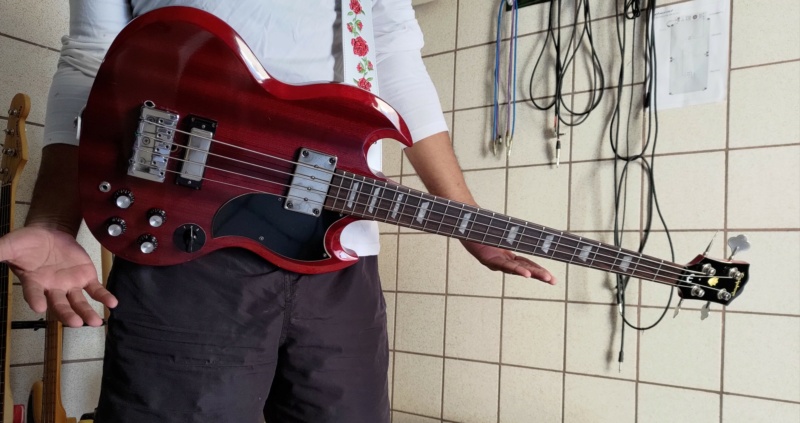
I've tried that Gibson style of bass several times. Even brought a guitar player's Epi version home for a week to see if I could make one work. The tones I could get were "suck" and "really suck" at home. I don't know if it was the bass, strings, me or all three. In fact after a couple goes at it, I put it back in the case to took it back to him days later. I know from some recordings the Gibson versions can sound really good. Maybe playing loud through a Marshall is needed. I never could figure it out...as much as I wanted to.


I have no experience with the newer ones, either Gibson or Epi but the old ones take some work to get used to.
 
All this talk of balance and dive is pretty academic considering the large degrees of individual interpretations used for the word “diver”. I absolutely would not call a bass that drops a quarter inch when let go a diver, yet some on this thread clearly would. I have my own definitions of diver that apparently differ from others definitions, as I’m sure many others do as well.

In my book - given a standard padded bass strap (approximately 3” wide) made of smooth leather, a regular cotton blend shirt and a playing position with the headstock between 1:00 and 2:00, the bass should not have significant movement towards the floor when let go. With significant defined as anything in excess of a couple of inches in drop. The couple of inches drop being about the amount I would even notice and attempt to correct while playing.

All that said, I don’t recall having any divers in my Tbird lineup. Now if I wore silk shirts, and used nylon guitar straps I might have different results. Likewise, if I used a 4” wide suede backed strap with no shirt I’d have different results.

FWIW - I’ve even heard some people define neck diver as any bass headstock that tips towards the floor when attempting to balance it on your leg while sitting. Using that definition, nearly every bass I own falls in that category with some much worse than others.
 
I'm kinda the opposite on the 3-point, I love it. :thumbsup:
Super easy to work with, imo - I hate having to try & adjust all those little grub screws like most bridges use. :rollno:


I hate to say it but my favorite is the Fender bent plate. Once I realized you should loosen the strings with a three point they also became very easy. Also when I realized that the two allen screws on the two point are to prevent tipping after they're set up they became a lot easier too.
 
All this talk of balance and dive is pretty academic considering the large degrees of individual interpretations used for the word “diver”. I absolutely would not call a bass that drops a quarter inch when let go a diver, yet some on this thread clearly would. I have my own definitions of diver that apparently differ from others definitions, as I’m sure many others do as well.

In my book - given a standard padded bass strap (approximately 3” wide) made of smooth leather, a regular cotton blend shirt and a playing position with the headstock between 1:00 and 2:00, the bass should not have significant movement towards the floor when let go. With significant defined as anything in excess of a couple of inches in drop. The couple of inches drop being about the amount I would even notice and attempt to correct while playing.

All that said, I don’t recall having any divers in my Tbird lineup. Now if I wore silk shirts, and used nylon guitar straps I might have different results. Likewise, if I used a 4” wide suede backed strap with no shirt I’d have different results.

FWIW - I’ve even heard some people define neck diver as any bass headstock that tips towards the floor when attempting to balance it on your leg while sitting. Using that definition, nearly every bass I own falls in that category with some much worse than others.


Yes, I use wide (3-4") either cotton or wide leather straps so I have no neck dive on anything, even my long scale EB4-L or EB-3's. I've owned many Rics and have never had one which I would consider to have neck dive, that was a new one on me when I first got here. The T-Birds seem to like to be about level but I don't consider that to be neck dive either.
 
I'm kinda the opposite on the 3-point, I love it. :thumbsup:
Super easy to work with, imo - I hate having to try & adjust all those little grub screws like most bridges use. :rollno:
As far as set up goes, I find the two piece to be the quickest of the bunch to set up, followed closely by the three point, then the Supertone and finally the Babicz.
For looks, it’s the two piece.
For flexibility, it’s the Supertone.
For engineering marvels, it’s the Babicz.
For sound, I can’t really tell the difference in any of them.
For playability, it’s a wash because I very rarely ever play by the bridge, or rest my hand on it, or do windmills.
For cost, it’s the three point, it comes free with the bass and works perfectly good.
 
As far as set up goes, I find the two piece to be the quickest of the bunch to set up, followed closely by the three point, then the Supertone and finally the Babicz.
For looks, it’s the two piece.
For flexibility, it’s the Supertone.
For engineering marvels, it’s the Babicz.
For sound, I can’t really tell the difference in any of them.
For playability, it’s a wash because I very rarely ever play by the bridge, or rest my hand on it, or do windmills.
For cost, it’s the three point, it comes free with the bass and works perfectly good.


I think the old bar bridge is pretty.
 
Bar bridge?


That's what I call these, not sure of the correct name. I have one on my '65. This isn't it.


iu
 
Last edited:
That's what I call these, not sure of the correct name. I have one on my '65.


iu
Ok, got it. My mind was stuck on thunderbirds.
I’ve never owned a Gibby with a bar bridge although it’s not far off in concept from a Dano bridge. So, how do you intonate it? Or is it more of a “ya got what ya got” design.
 
Ok, got it. My mind was stuck on thunderbirds.
I’ve never owned a Gibby with a bar bridge although it’s not far off in concept from a Dano bridge. So, how do you intonate it? Or is it more of a “ya got what ya got” design.


You can pull it back with two allen screws that touch the posts, the problem is when they're all the way forward and the intonation is still flat which can happen if you like low action. If they're within range they're pretty good, Jack Bruce's bass had one.
 
"dive" is subjectively used to describe any bass neck that shifts downward to any degree when let go, to one that falls to the earth when let go.
Apples/oranges. I don't consider coming down a few inches from the angle I play at as "dive". When it drops down at a 45* angle(or more), that's DIVE.
images
 
I have mentioned before, but will say again. I have 65 EB0. single mudbucker at the neck. I disconnected one of the coils to run as a single and took the offending cap that's wired straight across it out of circuit. Easy reversible 30 minute mod with a soldering iron. Opened up the sound to an incredible degree and also dropped the output to a more useable level.
I can now use the eb0, a p bass, and a t bird one after the other on stage without changing eq or gain levels.
They all sound different, but have similar useable levels and sound scape. Unlike your normal overpowering mudbucker.
Give it a try folks !
That’s a good idea!
 
The Spanish R is pronounced almost like a D anyway, I can do that easily, it's the double R I can't do. I can pronounce English R (we just don't in Mass), I just can't trill with my tongue. Right near the beginning of this video she gives an example.


And then we have the S's that sound like D's and the C's and Z's that sound like Th. Then the great debate if LL sounds like a Y or a J. Do V's sound like V's or B's....and they keep telling you that Spanish is easy because it is rules based, except that the most common items break all the rules...then there are those stinking accent marks. Dios mío
 
And then we have the S's that sound like D's and the C's and Z's that sound like Th. Then the great debate if LL sounds like a Y or a J. Do V's sound like V's or B's....and they keep telling you that Spanish is easy because it is rules based, except that the most common items break all the rules...then there are those stinking accent marks. Dios mío
I think those things stay pretty consistent within each country.
 

Latest posts