• TalkBass has been independent since 1998. Add your voice.
    Create a free account to reply to discussions, view embedded media, and browse with fewer display ads.
    Join freeLog in
    Want zero display ads or expanded classifieds tools? Compare plans.

Thunderbird Club

Well I've got that insert glued in, I'd hope to not remove any finish when pulling it... But I would be interested. I like the look of those.
Would it work in a curved top instrument?
I’ve never done it but I did see a pic from someone in this thread that did. It does fit the bolt pattern but obviously does not sit flush on the top of the bass. Kinda eliminates the concept of “full contact bridge” but the person that did it says it works and is functional. My OCD would keep me from doing it.
 
I’ve never done it but I did see a pic from someone in this thread that did. It does fit the bolt pattern but obviously does not sit flush on the top of the bass. Kinda eliminates the concept of “full contact bridge” but the person that did it says it works and is functional. My OCD would keep me from doing it.
I'm not sure I ascribe to the full contact with body theory. The three point actually functions very well, and is anchored pretty well. If that bridge the Les Paul came with hadn't broken I'd have no issue.
 
I gotta admit, I had my share of issues fitting a Supertone to my Goth. The Supertone essentially (and unfortunately) served the purpose as an extractor for the body inserts. Not necessarily the fault of the bridge, just a weak link in the three point design. So as opposed to continuing to use the Hipshot bolts that rely on the biggest design shortcoming of the three point I decided to “Fenderize” the Supertone and drilled 4 countersunk holes thru the bridge into the body. Works fantastic and has made the bridge truly high torque full body contact.
View attachment 4993581
That's cool.
 
Well I've got that insert glued in, I'd hope to not remove any finish when pulling it... But I would be interested. I like the look of those.
Would it work in a curved top instrument?

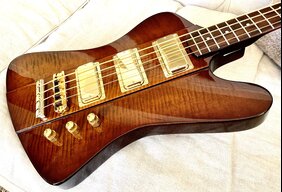
I guess it depends on the curve, and how attached you are to it sitting flush. The bridge is very flat on the bottom.

The problem with Epiphones, and maybe the Hipshots have the same problem?, the Epi inserts have a lip that sits above the surface of the body.
Gibson inserts are flush.
So, there are two versions of the bridge, one that is smooth on the bottom for Gibsons, one that has a recess machined out for the raised Epi inserts to fit into.
 
Unusual NR. I think I've only seen it in one other pic.
1.jpeg
 
I gotta admit, I had my share of issues fitting a Supertone to my Goth. The Supertone essentially (and unfortunately) served the purpose as an extractor for the body inserts. Not necessarily the fault of the bridge, just a weak link in the three point design. So as opposed to continuing to use the Hipshot bolts that rely on the biggest design shortcoming of the three point I decided to “Fenderize” the Supertone and drilled 4 countersunk holes thru the bridge into the body. Works fantastic and has made the bridge truly high torque full body contact.
View attachment 4993581
but it’s only (here we go) a “weak link” insofar as the supertone install is concerned….if all the inserts sat flush Hipshot could make the bottom surface all flat….the inserts were never envisioned as handling pull (out of socket) forces…..maybe they should just thread the inserts so they screw in…..the 60k dollar question I guess….worse part is, one can’t tell when or if the inserts come out….
 
I guess it depends on the curve, and how attached you are to it sitting flush. The bridge is very flat on the bottom.

The problem with Epiphones, and maybe the Hipshots have the same problem?, the Epi inserts have a lip that sits above the surface of the body.
Gibson inserts are flush.
So, there are two versions of the bridge, one that is smooth on the bottom for Gibsons, one that has a recess machined out for the raised Epi inserts to fit into.
I know this about the Supertone. But, why does Epiphone not just recess the insert flanges? Seems just dumb. Is it a Gibson-imposed restriction??
 
I know this about the Supertone. But, why does Epiphone not just recess the insert flanges? Seems just dumb. Is it a Gibson-imposed restriction??
Interesting question. Turns out the Eppi Embassy bass I got had shoulderless inserts. I haven’t checked my Eppi VP bass, but it might be the same. I wonder if the Eppi shouldered inserts are only related to the three point bridges.
 
I guess it depends on the curve, and how attached you are to it sitting flush. The bridge is very flat on the bottom.

The problem with Epiphones, and maybe the Hipshots have the same problem?, the Epi inserts have a lip that sits above the surface of the body.
Gibson inserts are flush.
So, there are two versions of the bridge, one that is smooth on the bottom for Gibsons, one that has a recess machined out for the raised Epi inserts to fit into.
The one with recesses is what's on my Epi EB-0.
 
I guess it depends on the curve, and how attached you are to it sitting flush. The bridge is very flat on the bottom.

The problem with Epiphones, and maybe the Hipshots have the same problem?, the Epi inserts have a lip that sits above the surface of the body.
Gibson inserts are flush.
So, there are two versions of the bridge, one that is smooth on the bottom for Gibsons, one that has a recess machined out for the raised Epi inserts to fit into.
Babicz also offers their replacement with the recesses for the epi inserts with the “shoulders.”