Dingwall D-Bird New Bass Review
For those Tbird lovers out there looking for something different but still familiar - the Dingwall D-Bird Standard.
This is the Thunderbird club so I’d be remiss if I didn’t say I love the traditional reverse and non reverse Gibson and Epiphone thunderbirds. They are unquestionably classics in every sense of the word. I’d frame this review as - how does this Dingwall D-Bird offering (now replaced by the D-Roc) stack up against our traditional Tbird. The quick answer is, it’s as different as it is similar.
Think of the Gibson Tbird as a high powered muscle car from 1970, kind of a Hemi Cuda of sorts. A little beefier and more flowing than earlier model muscle cars but packed with a high performance engine just begging to be unleashed. Now look at the Dingwall - sleek, slim, aerodynamic shaped, built with top end speed in mind - kind of a Ferrari by comparison. I’d proudly own either car (or better yet, both), and both are worth about the same in todays market. Each car serves its intended purpose quite well.
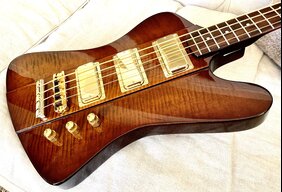
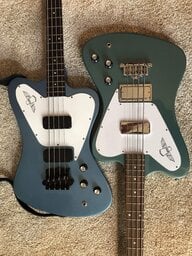
Sheldon Dingwall and his design team appear to have taken every opportunity available to massage key features of the DBird into Ferrari territory. The three point (or earlier two piece bridge) is replaced by 4 individual single string units that offer string spacing adjustability as well as fast easy tuning and intonation tweaks. The truss rod is quickly accessed at the heel without having to remove any covers. The strap lock system is completely recessed and perfectly placed for zero neck dive playing. The tummy cut is huge, about a third of the back of the bass has been carved away to make room for our anatomy, and the forearm cut is nicely shaped as well. Both the upper and lower wings have been streamlined into about as thin as they could dare go and still house the electronics. The 3 to 5 piece rock maple neck is well rounded and kind of jazz bass feeling to me. The headstock is about as crisp and sharp and minimal as it can be and still have room for the Hipshot tuning machines. The fanned frets are a pleasure to play, really no issue at all to get used to, and the pau Ferro fretboard is glass smooth and fast with zero fret overhang and nicely rounded edges. Then there’s the attention grabbing “in your face” aquamarine sparkle finish (I expect Ferrari to copy it any day now). All in all, a boatload of great features, not necessarily an improvement over the original, but certainly a different take with performance, speed and sleek looks in mind.


But how’s it sound?
Different. Very different than a creamy smooth deep bass backline setting on a Tbird. But there’s obviously more than one setting on a Tbird, so what about the more aggressive forward in the mix gritty sound you can get from an Epiphone VP or one of the vintage Tbirds? Yep, the Dingwall does that in spades on the bottom end and continues on in that vein all the way to a screaming 10,000 RPM redline as you focus more on the rear pickups and top end of the tone knob. This bass is perfectly capable of cutting through any mix with laser precision and sledgehammer force.
The four position pickup selection knob has an odd (at least to me as a new Dingwall user) selection of pickup combinations. I would have done it differently but after a quick explanation I at least get the logic in what Dingwall did. They have it set up as (Bridge for Jazz bass; Bridge + Center for Stingray bass; Center for P bass; All three for Dingwall) for the four positions. And I get that to a degree when switching through the options. But I would have probably set it up as Bridge; Center; Neck; All three.
It looks like the selector knob can be user reset, I’ll keep it as is for quite a while if ever changing it, just because it does offer a lot of tones not available on a traditional Tbird.
So if your tone goal is creamy smooth, deep and dark, backline, foundation focused and laid back this probably isn’t the best choice for you. However, if you’re in a heavy mix with lots of content, or heavy drummers and screaming Marshall guitar stacks and want to be heard this bass will easily do the trick. It’s flexible enough to fit in just about any tone setting, but when you want low and dark there are probably better choices out there, such as the Goth bass or the 2021 NR.