• TalkBass has been independent since 1998. Add your voice.
    Create a free account to reply to discussions, view embedded media, and browse with fewer display ads.
    Join freeLog in
    Want zero display ads or expanded classifieds tools? Compare plans.

Thunderbird Club

I'm not 100% sure the first year of production, I know they were in production by 2017, maybe as early as 2016? Don't remember seeing a 2015.....

Afaik, all the VPs have been made in Indonesia, as well as the Classic Pros, and most of the Pro 4/5 basses (my Pro 5 is a first-year 2009 made in China, the later years were Indonesia).
The tuners have changed, maybe 2018-ish? from a large mount-plate to a smaller mount-plate (maybe other differences?), but I think both versions were Wilkerson.
Of course, as with most things Gibson/Epiphone variations probably exist.......
:)

Thanks Kara - my Swiss BMC road and cross bikes were made in Indonesia and are high-end kit. Many top brands are made there in state-of-the-art factories owned by the 'mother' companies from Italy, France, Belgium, Switzerland and the US. So like Korea, an Indonesian product is a good quality product - as long as the 'mother' company oversees it responsibly.
 
Mine is a 2017 which I think is from the first run. I thought it was made in Indonesia but I could be wrong. It also has the big vintage style Wilkinson tuners.

Captura de tela 2023-06-13 174743.png


Another decoder link, say this:

This Epiphone guitar was made in 2017 during August
Samick factory in Indonesia
 
Last edited:
I found this at: Epiphone Serial Number Lookup - Authority Guitar

"11 Digit Serial Numbers
11 digit serial combinations originate from the factories DeaWon/Unsung/Qingdao in China or Unsung-Korea or Samick-Indonesia. Both Electric and Acoustic Instruments were produced here.

This ‘generally’ is the pattern: year/year/month/month/factory id x2/production number x5)

As the complexity of the serial format changes throughout the destinations, its best to use our serial number decoder, as you stand a good chance of receiving a date also (month & year)."​

:)

Great! Thanks again K! I used the provided serial # finder and learned that my bass (regardless of what was written on the inside of the control cavity cover*) was made Sept 23rd / 2018 at the Samick Indonesia factory. Which makes this bass a 5 yrs old NOS from 2018. (stored somewhere for 5 years) Love NOS, it's like wanting something from the past you really liked and being able to buy it years later brand new! If the tuners changed sometimes in 2018, this one was after that change to the smaller Wilkinson tuners.

*curious who wrote that date...
 
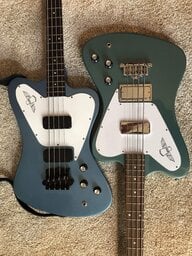
I just got on the VP bus and need some info. Like, what was the 1st year it was introduced? Is there a serial # record? Where were they made (I'm assuming mine is MIK as it has Korean pots) and have they been made in the same country for all the years leading to 2023? I recall reading here that tuners have changed - what tuners and what years did that happen? Any other info would help if you know of it. I checked Wiki and it needs updating because the VP isn't mentioned. Thanks ahead of time -

After playing it since it arrived yesterday - I'm kinda' smitten by this bass. I'm going to take it to TSC's rehearsal on Thursday night to confirm what I'm already hearing at home - that it's an exceptional bass both in sound and feel of that neck. It really is very much like my '64 II - a neck that I know "like the back of my hand" - a neck I've played since 1974. So now experiencing this - those of you owning one of these; the neck feels like a '63-'65 Thunderbird bass, and totally stock - it sounds really, really good. (and is way cheaper than a vintage T-bird!)

With this bass, Epiphone did what Fender did with their Road Worn series years ago; they produced a really exceptional bass for under $1k. Fenders RW series P's & J's sold like hotcakes. (not certain if the are still being made) I played a J in a music store and it played/sounded great! Aside from being "road worn", it was light and similar to the VP - a legit RI of an early '60s Jazz. It was on sale (just under a grand) and I was tempted but I already have a few awesome J's. The VP for the price I got it for is a steal. I don't need another bass, but I'm tempted to keep this one 'as is'... that's how good it is.

View attachment 5093363

Having played mine the past couple shows I'd say I like my Gibson necks a bit better, they're thinner and a little smaller, thus they fit my hand better. The VP is nice and certainly quite playable, with Gibson NR pickups ir really has a bit more bass and lo mid grunt.
 
Having played mine the past couple shows I'd say I like my Gibson necks a bit better, they're thinner and a little smaller, thus they fit my hand better. The VP is nice and certainly quite playable, with Gibson NR pickups ir really has a bit more bass and lo mid grunt.

I wonder if the VP necks have some discrepancies over the years. I know the Epi Goths had different necks one year to the next. My VP feels as good as my '64 II. I'll do more extensive comparative investigation of the two later.
 
Having played mine the past couple shows I'd say I like my Gibson necks a bit better, they're thinner and a little smaller, thus they fit my hand better. The VP is nice and certainly quite playable, with Gibson NR pickups ir really has a bit more bass and lo mid grunt.
I feel the same way about my reverse and RNR. I really enjoy the RNR, but the neck on the reverse fits my hand much better.
 
You're welcome! :smug:

.... couldn't that be said of anyone that plays mostly covers of other people's music? :unsure:

It can, but music of all kinds throughout history has been reinterpreted/covered over and over, classical conductors and symphonic musicians being a prime example. Classic pop/rock/jazz/blues etc songs regardless of who did them first filter through the decades as renditions by contemporary musicians of all levels, reaching new ears. It's just part of what music is. A good song well covered will alway be popular and inspire a listener to seek-out other versions including the original. A win-win.
 
Last edited:
Your guitar was made at the
Qingdao Plant (Epiphone), China
on November, 2020
Production Number: 22603

The Gibson Qingdao Plant was opened in October 2002, Qingdao, China.
It is the only plant run by Epiphone in Asia. Both acoustic and electric guitars are made here.
The factory is dedicated to making Epiphone and only Epiphone guitars with the aim of producing higher quality guitars.


My IV.
A baby under 3 years old
 
Something I've wondered about, speaking of VP necks.....a lot of folks, that have them to compare, have said that the necks on their VP and CP are noticeably different.
From what I could tell with the '19 VP I used to have, and the '13 CP I have, the necks felt identical - shape, size, thickness, etc.

It has also been discussed about the pickup position change on the CPs after the 2013 first year - but this was also the same on the VP & CP that I had, so it makes me wonder, if maybe the 2013 CP was re-designed in two different ways - one with a bigger headstock (and different bridge, etc.) and released a couple of years later (2016? 2017?) as the VP, another as the 2014+ CP with slight changes...to be more like modern Gibson Thunderbirds?


:unsure:


Any of you guys have a more new-ish CP and Gibson that you could compare?
 
see, this is where people get misled…
683J means 68 + 3 zeros OR
68000pFd (J denotes 10 x 10^-12) which equals 68nFd or .068uFd
the confusion stems from different conventions (older, newer, domestic, european etc.) for numbering capacitor values…
Yeah, and they come up with a new way to designate the value every ten years or so. Ugh.

Standard cap values are multiples of .1 times 11, 22, 33, 47, or 68. Typically we're talking microfarads (uF) or less, especially with guitar (including bass) pickups. Occasionally you'll see a single digit instead of two, but that's mainly a .1, .2, .01, or .02 (IME).
 
I just got on the VP bus and need some info. Like, what was the 1st year it was introduced? Is there a serial # record? Where were they made (I'm assuming mine is MIK as it has Korean pots) and have they been made in the same country for all the years leading to 2023? I recall reading here that tuners have changed - what tuners and what years did that happen? Any other info would help if you know of it. I checked Wiki and it needs updating because the VP isn't mentioned. Thanks ahead of time -

After playing it since it arrived yesterday - I'm kinda' smitten by this bass. I'm going to take it to TSC's rehearsal on Thursday night to confirm what I'm already hearing at home - that it's an exceptional bass both in sound and feel of that neck. It really is very much like my '64 II - a neck that I know "like the back of my hand" - a neck I've played since 1974. So now experiencing this - those of you owning one of these; the neck feels like a '63-'65 Thunderbird bass, and totally stock - it sounds really, really good. (and is way cheaper than a vintage T-bird!)

With this bass, Epiphone did what Fender did with their Road Worn series years ago; they produced a really exceptional bass for under $1k. Fenders RW series P's & J's sold like hotcakes. (not certain if the are still being made) I played a J in a music store and it played/sounded great! Aside from being "road worn", it was light and similar to the VP - a legit RI of an early '60s Jazz. It was on sale (just under a grand) and I was tempted but I already have a few awesome J's. The VP for the price I got it for is a steal. I don't need another bass, but I'm tempted to keep this one 'as is'... that's how good it is.

View attachment 5093363

As one of my HS English teachers said, "I done tol' you an' TOL' you..."