
Screwdriver tap test shows the coil tap is working. I just don’t hear a significant tone difference. Certainly not as loud when tapped, but not much else. Maybe my hearing is more the issue? All test done with volume and tone at 5.

TalkBass has been independent since 1998. Add your voice.
Create a free account to reply to discussions, view embedded media, and browse with fewer display ads.
Join free Log in
Want zero display ads or expanded classifieds tools? Compare plans.

That orange is the BOMB!


No, they are definitely coil taps, confirmed with a tap test on the exposed coils. The North coil remains active in split mode on each pickup (I would have wired it with North on the neck and South on the bridge to maximize the range of the two pickups).

maybe it’s your hearing?….Screwdriver tap test shows the coil tap is working. I just don’t hear a significant tone difference. Certainly not as loud when tapped, but not much else. Maybe my hearing is more the issue? All test done with volume and tone at 5.
We’ll find out in 10 days.maybe it’s your hearing?….
That scuff is probably going to bother you. I'll take that damaged bass off your hands so you don't lose sleep over that HUGE scuff.Only a scuff on the top of the headstock. That will polish out fine.
View attachment 5137777 View attachment 5137778 View attachment 5137779 View attachment 5137781

They check in, they just don't always listen.If they did that, they wouldn’t have discontinued the LP DC Tribute short scale. I managed to snag a used one that came with a Hipshot bridge and nice case for under $1000, but that’s not usual these days.


Are you crazy, Geoff? Diffs only for Fords.Have you tried banana peels? Or are they just used on diffs?

On order. @MCF already harassed me.That scuff is probably going to bother you. I'll take that damaged bass off your hands so you don't lose sleep over that HUGE scuff.
Looks fantastic. You need to get the obligatory black pickguard.

Nice! Your Ram looks new! What year is it?Same sort of thing with the "new" truck I got earlier this year - high miles, great condition and price
View attachment 5138044
Two weeks before I was born........
Orange is supposedly one of the most disliked colors. Often I'm not a fan either, but when it's right I really like it. This is really beautiful in person. Even the matching tort-like pickguard looks great on it IMO.I am not a fan of orange in general, but burnt orange finishes on guitars really speak to me!! I have a Squire Affinity Tele in burnt orange and it looks fantastic. It looks even better on a Tbird!!


Very cool! I'm looking forward to listening to it.Spent 4hrs with Gary Hobish - Hammer Mastering / SF on our (TSC's) 16 songs yesterday. (16 for a CD, 11 for an LP) I thought I would only be there for a couple hrs, but time flew by and as I didn't obstruct him - we ended up getting through 8 songs. 8 songs after determining the spaces between each song ("pacing") In the digital-steaming platform world we are forced to live in, who knows why the algorithm determines the space between totally disparate songs... Gary considers it #1 priority for LP/CD serious listening, and I learned why over that time. Miles Davis understood 'negative space' in music - so did Karlheinz Stockhausen. Space is the place as SunRa said. Some songs need more or less division, some spaces are determined by tempo, some by 'feel' or contrast..., some by human breath. Fascinating.
I'm deliberately going "old-school" here, as modern digital platforms drops a song after some other sort of song and after it's over, some other sort of song happens, all pre-determined algorithms. I ordered the 16 songs (for the CD, 11 for the LP) like ordering a live set - in the best possible order to engage a listener. In the early days (reel-to-reel tape) especially with jazz LP's - 3 secs between every song. Gary incorporated many different reasons for the length of each 'gap' depending on both songs' needs. Pretty logical really - but just never considered how important those 'negative' spaces were until yesterday. His overriding ‘mantra’ was - keep the energy flowing, keep it musical. (not formulaic)
Once I was in that mode, we worked as team to fine-tune a number of transitions. He initially determined the starting-point of which most of the time he was spot-on, but on a number of the trickier transitions, we went back and forth on what sounded right. We’re talking fractions of seconds here! Of course, his ear was way more sensitive to nuance than mine - at a couple points noting end-of-song 'mouth-noises' where the songs' tail was drifting into silence and one of us being too close to the mic caught subtle but audible sounds. Crazy (that’s why he has that job and not me!) - but of course he disappeared it in 3 secs of digital-tweaking.
Aside from many other things that occurred as we got into massaging each song (8 of the 16 with me present) individually and also to balance with the others (these songs/this project is the cumulation of 4 yrs of sessions, 4 songs in each session w/2 different drummers) - he correctly chose to use an 'analog tape vibe' (one of his interfaces) and 'soft/slowed' compression to appeal to the period-appropriate music we play. Gary is around my age, is a bass player, and is very experienced in his craft - and we were very much on the same page working on our beloved songs.
I pick up a CD tomorrow to assess. Can’t wait to start listening to it, on my stereo, in the car, w/headphones… it’s happening!
View attachment 5138225
Excellent. Always listen to counsel.On order. @MCF already harassed me.
I'm certain Gibson checks in here for all their good ideas. Seriously!
Very cool! I'm looking forward to listening to it.

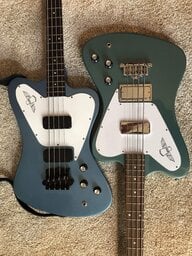
It could be the strings are just dead.Screwdriver tap test shows the coil tap is working. I just don’t hear a significant tone difference. Certainly not as loud when tapped, but not much else. Maybe my hearing is more the issue? All test done with volume and tone at 5.
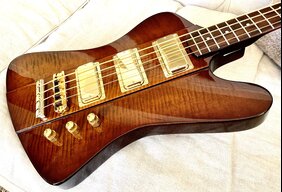
Max the volume and try it again. Coil tapping won’t have a drastic effect on tone. What it will do is make the humbucker sound thinner and clearer but less full and rich. I haven’t checked to see how these pickups are wired, but if they are wired in parallel the coil tap will be less pronounced than if they are wired in series.Screwdriver tap test shows the coil tap is working. I just don’t hear a significant tone difference. Certainly not as loud when tapped, but not much else. Maybe my hearing is more the issue? All test done with volume and tone at 5.
Setup is horrendous. Strings are at least 3/8” off the FB. They also leave fingers gray. Tomorrow will be setup day to make sure the TR has no issues.It could be the strings are just dead.


