• TalkBass has been independent since 1998. Add your voice.
    Create a free account to reply to discussions, view embedded media, and browse with fewer display ads.
    Join freeLog in
    Want zero display ads or expanded classifieds tools? Compare plans.

Thunderbird Club

it is likely an old TKL. The Interior is 52” long, 15” wide (23 1/2” long bottom section). The exterior is 53 3/4” long, 17 1/2” wide, 4 inches deep. I did an extensive search for one like it last year and found nothing. It doesn’t appear anyone makes one that size any more.
View attachment 5346810
Yeah, I know. Otherwise I'd have one. My Coffin(TM) Case will hafta do.
1002181354-00.jpg

BTW, I put a coupla rolled up towels between the lower bout and the edge of the case and another by the H.S.
 
Last edited:
Posted this in a couple other threads but I think some tube geniuses here might have some thoughts. @Chucky Stiletti you listening?

I have two pairs of vintage Mullard 12AX7’s, I got these from TC Tubes (Great folks to work with). They show readings on the boxes which I have no idea what they mean:

View attachment 5347200


I posed the following questions to Chelsea (the “C” in “TC Tubes”) and she did her best to answer, but I’d like to hear what others think. It may not matter all that much, but if there’s an ideal choice for one pair in one amp, I’d like to start there. And, I think, I usually lean toward clean bass tone, clear headroom with not a lot of grit. Clean volume with no speaker distortion. At least I think that’s what I’m hearing when I like my tone… Here’s what I asked:

“Is there a simple explanation for the “readings” you have on the boxes?

In my application(s), one pair will be in the preamp of a 200w tube amp and the other pair will be in the preamp of a 500W class D amp.

Is there one pair more suited to the 200w tube amp and one pair more suited to the 500w class D amp?

Both are Orange bass amps and Orange claims the preamp sections of both amps are identical.

For instance, the ones in yellow/green boxes show higher readings over the ones in the white boxes. Does that equate to a slightly higher output, or….?”


Chelsea’s response was:

“Spec for 12AX7 is 1600 Gm. So the 10M Mullards test at 100% of spec, and the high gain Amperex-labeled Mullards test at 125% of spec. This will likely translate into higher output, though it may not be an audible difference. It might also be a cleaner tone.”

Based on that answer I’d think I’d put the higher output Aperex labeled Mullards in the AD200B 200w tube amp and the others in the TB500 500w class D amp since there’s more wattage available.

And it may just be splitting hairs…
humbled by the vote of confidence Ring..
truth is, those stickers are the wrong ones to use for 12AX7s since Gm pertains to pentodes and not triodes (12AX7s are twin triodes hence the dual set of values) whose gain is specified in Amplification Factor or u (MU). this value specifies how many volts the output will change as a function of the variance of the input voltage (dV/dV). in a 12AX7 triode it’s usually about 100 meaning a 1 volt fluctuation at the input will result in a 100 volt swing at the output. Transconductance (Gm) on the other hand is used in amplifying tubes (usually power) with 4 or 5 (instead of 3 as in triodes) electrodes denoting a swing in current (instead of voltage) at the output as a result of an input voltage fluctuation (dI/dV). the folks at TC may have run out of stickers, who knows….
iP just means the plate current in each tube when the gain measurements were made by the tester as u and Gm are very dependent on this current (mA in this case) value.
this said, I would start with one of the mullards at the phase splitter location of the tube amp (since they are identical, hence well balanced for a splitter) and the Amperex at the gain stage. don’t really know the topology of the class D amp but these placement choices aren’t as critical in them since they don’t operate in a push-pull configuration…..
hope this is not too verbose, PM (or call) me if you want….alternatively, you can come over and we can verify those values with my Orange tester and do some tube rolling…
4BE96A99-C87A-47BF-B0CC-7132058D538C.jpeg
 
Last edited:
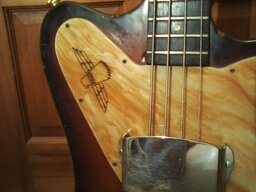
A friend of mine is selling a Vintage Pro. A couple lbs lighter than my Classic I think.
This one is sans pick guard, in need of a Dutchman where there's been a sketchy repair where the inserts are. And the bridge may not beer original... Also I don't know what those p'ups are, but they don't sound terrible. Not originals.
It's also had a headstockectomy repair.

It's been messed with, this one. My friend wants $300 for it. He's holding it for me...
I should get better pix, but it plays nice, the weight is super easy.

View attachment 5346759 View attachment 5346760 View attachment 5346761 View attachment 5346762
I can't tell exactly what going on with the bridge there, but I know why they moved the posts.
I checked the bridge placement on my VP the other day and it is more than 1/8" closer to the fingerboard than it should be! There is enough room on the bridge to get the intonation correct, but if the action was higher, there might not be enough travel for the E string.
I could actually make the string length between the 12th fret and saddle shorter than the 12th fret to the nut:eek:
 
humbled by the vote of confidence Ring..
truth is, those stickers are the wrong ones to use for 12AX7s since Gm pertains to pentodes and not triodes (12AX7s are twin triodes hence the dual set of values) whose gain is specified in Amplification Factor or u (MU). this value specifies how many volts the output will change as a function of the variance of the input voltage (dV/dV). in a 12AX7 triode it’s usually about 100 meaning a 1 volt fluctuation at the input will result in a 100 volt swing at the output. Transconductance (Gm) on the other hand is used in amplifying tubes (usually power) with 4 or 5 (instead of 3 as in triodes) electrodes denoting a swing in current (instead of voltage) at the output as a result of an input voltage fluctuation (dI/dV). the folks at TC may have run out of stickers, who knows….
iP just means the plate current in each tube when the gain measurements were made by the tester as u and Gm are very dependent on this current (mA in this case) value.
this said, I would start with one of the mullards at the phase splitter location of the tube amp (since they are identical, hence well balanced for a splitter) and the Amperex at the gain stage. don’t really know the topology of the class D amp but these placement choices aren’t as critical in them since they don’t operate in a push-pull configuration…..
hope this is not too verbose, PM (or call) me if you want….alternatively, you can come over and we can verify those values with my Orange tester and do some tube rolling…
View attachment 5347317
Really good job explaining. I think even I understood everything, at least generally.
 
I would start with one of the mullards at the phase splitter location of the tube amp (since they are identical, hence well balanced for a splitter)


Thanks for the detailed reply and invitation. More than I can absorb on a Saturday morning, but… and since I have no idea which location is the phase splitter on either amp (although I’m guessing you’re referring to the all tube AD200), I’ll probably just let me ears do the work.
 
Thanks for the detailed reply and invitation. More than I can absorb on a Saturday morning, but… and since I have no idea which location is the phase splitter on either amp (although I’m guessing you’re referring to the all tube AD200), I’ll probably just let me ears do the work.
hey, you asked….:D
on the tube amp, the splitter is 9 outta 10 times the closest one to the power tubes…no splitter on the class D..
have fun…..:thumbsup:
 
Last edited:
A friend of mine is selling a Vintage Pro. A couple lbs lighter than my Classic I think.
This one is sans pick guard, in need of a Dutchman where there's been a sketchy repair where the inserts are. And the bridge may not beer original... Also I don't know what those p'ups are, but they don't sound terrible. Not originals.
It's also had a headstockectomy repair.

It's been messed with, this one. My friend wants $300 for it. He's holding it for me...
I should get better pix, but it plays nice, the weight is super easy.

View attachment 5346759 View attachment 5346760 View attachment 5346761 View attachment 5346762
I've got an inclination anyway! But yeah, I'm hoping to throw it in the car next week.
Thanks for the vote of confidence!
It's a beater, I would pass on it!
For sure you could make it work.
Given the bridge mod, and without the pickups , it's not worth $300 IMO.

If you’re after a project and don’t mind sinking far more money in a bass than it’s worth, go for it. But for me it would be a hard pass.

On neck thru and set neck basses a refin (which this bass is badly in need of) will run between $500 and $700 from a pro shop and then you’d still need trim rings (if you can find some that fit those pickups) and that’s just the cosmetic stuff. The structural stuff with the headstock repair and possibly having to redo the bridge anchors along with the $300 purchase price throws the bass into the North of $1000 bracket. That’s a no go on a VP for me considering there are pristine models out there at about half that price.