• TalkBass has been independent since 1998. Add your voice.
    Create a free account to reply to discussions, view embedded media, and browse with fewer display ads.
    Join freeLog in
    Want zero display ads or expanded classifieds tools? Compare plans.

Thunderbird Club

Ha! I thought at first you said a small batch of PCB’s…fresh are way better!

well...

PCBs accumulate in organisms through the food chain, and food is therefore the main exposure source for humans: it accounts for over 90% of exposure, the highest concentrations being found in fish (such as salmon and shellfish), dairy products (especially milk and butter) and animal fat.
 
  • Like
Reactions: GBassNorth
I can between rosewood and maple…could it be because of the usual lacquer on maple fingerboards? don’t Rics have lacquered rosewood fingerboards?…

Yes, at least the more standard Ric's. They offer a number of different models so possibly some aren't. As far as a fretless fb, maple & ebony are just more durable/harder so a logical choice.

from the net - an explanation of why rosewood is the most common fb choice -

Known to even out a treble-heavy body tone, rosewood has been a favorite for nearly two centuries now. It is described as soft under the fingers despite being a hardwearing wood that stands up to the strain of frequent performance.

Phil Kubicki said that aside from a guitar/basses pu's/electronics, the neck contributes more to the sound of a solid-body than the body. Which means what wood/woods are used. A solid maple neck compared to a mahogany/rosewood neck/fb, maple/ebony, walnut/ebony, walnut/rosewood... all will resonate differently which in turn has effect on the sound/tone of the instrument. Maybe not 'night & day' different - but noticeable.
 
Nice! Can you hear a difference between the ebony & rosewood?
I'll insert my experience for what it's worth. One L2k has rosewood and the other (below) ebony. The '81 is maple but is really warm sounding for a G&L. The below does have GHS flats on it, but prior to that it seemed to have a slightly more crispness to it than any rosewood. I would liken it to maple, possibly more crisp, but not glassy or harsh. But, given each bass can have it's own flavor, how much is the ebony is difficult to say. Most likely it would depend on the bass whether I would prefer it or not. But in general if you think maple I don't think would too far off.


upload_2024-6-20_13-54-36.png
 
I can between rosewood and maple…could it be because of the usual lacquer on maple fingerboards? don’t Rics have lacquered rosewood fingerboards?…
My Ric did. I may be wrong, but seemed to recall it was something other than rosewood. Again, I may be wrong on that. Feel free to correct me on that.
 
PXL_20240620_192642326.jpg
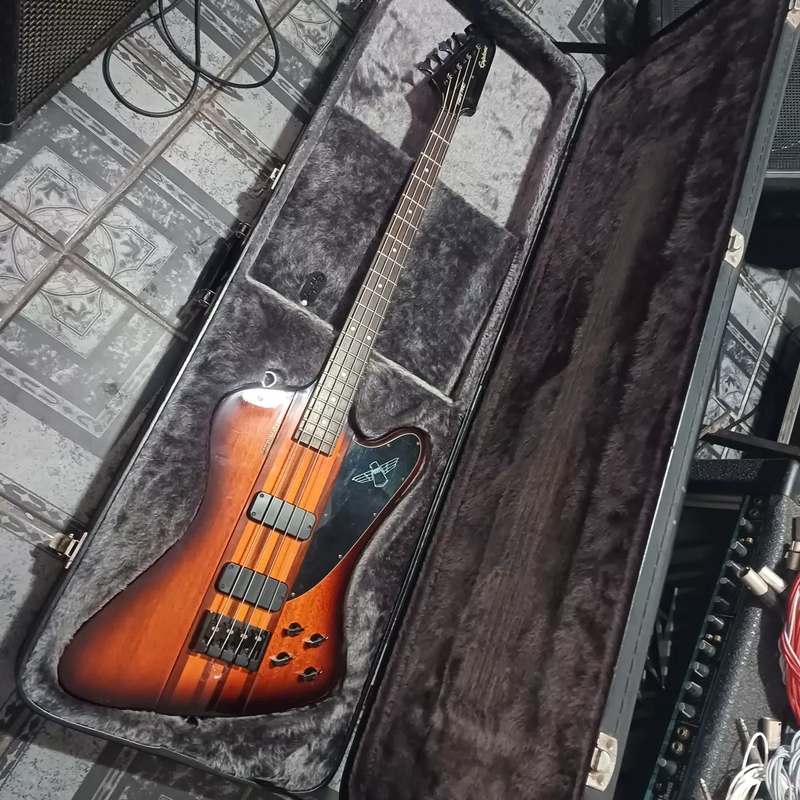
well, cavity is cleaned out. Now I've gotta wait for my 4 way switch so I can cut out and drill the pickguard.

Went with Gibson Moderns cuz I liked the way the G2 I played sounded. I preferred the NR w/ reissues slightly, but the G2 would've filled a bigger gap in my arsenal and was more aggressive like I'm wanting this guy to be. Now I need to order some longer pickup screws. Anybody know what size they are off the top of their head (might run down to Ace and see what's in)?
 
My wife used to work for a food broker, basically a rep firm taking orders for food and sundries to the military commissaries. One of their lines was Reese's peanut butter cups. So, if they wanted to sell them special holiday versions, they had to show them samples a couple months in advance, which is when the production run actually was. You can't believe the difference in taste and texture of a fresh off the line Reese's vs one that is a few months old. The oil from the peanut butter hasn't soaked into the chocolate, firm chocolate and creamy peanut butter. :drool: One time they placed an order for 144 samples and got 144 cases. :hyper:

I agree 10000%!! A fresh batch is sooo much better than one that has been sitting on the shelf for a couple months. That is why I buy a few of the holiday versions when they first hit the shelves.
 
  • Yeah that's Bubinga. It's technically a type of Rosewood, but Bubinga sure looks different and smells different when sanded/cut.
Well, Bubinga is not actually a true Rosewood (genus Dalbergia). It's simply one of a fairly large number of woods that are often called "Rosewood"; more to fool people into thinking that it is, than anything else. The fingerboard on my Canadian '93 Fury Anthem lined fretless bass, is Pau Ferro. Which is also known as Bolivian or Santos Rosewood. But, it's not from the Dalbergia genus; so, not a "True" Rosewood... And, TBH, doesn't look much like the real thing, anyhow...
I know that the fretboard on my '01 Rick 4003 is Bubinga, but I'm not sure that the one on my '73 4001 is. I seem to recall that Rick used Goncalo Alves 'way back then, but...? I do know that they used Ebony for their fretless basses...:cool:
 
Last edited:
Documented science! I listened with my personally calibrated ears and the red sounded better every time. It’s on the internet (right here) so it has to be true!

I stand corrected! :)
 
Last edited:
I'll insert my experience for what it's worth. One L2k has rosewood and the other (below) ebony. The '81 is maple but is really warm sounding for a G&L. The below does have GHS flats on it, but prior to that it seemed to have a slightly more crispness to it than any rosewood. I would liken it to maple, possibly more crisp, but not glassy or harsh. But, given each bass can have it's own flavor, how much is the ebony is difficult to say. Most likely it would depend on the bass whether I would prefer it or not. But in general if you think maple I don't think would too far off.


View attachment 5484334


Nice L2000 - I have three all maple Fender (P & 2 J's) neck basses, my '64 II which is mahogany/rosewood, one maple/ebony necked Jazz bass and the rest are maple/rosewood. My custom basses (for sale) mostly have ebony fb's/maple & one walnut/ebony. They are all pretty different basses and they all sound different so it would be hard to compare. The maple/ebony fb Jazz bass is active, so again - hard to compare with a passive J.