• TalkBass has been independent since 1998. Add your voice.
    Create a free account to reply to discussions, view embedded media, and browse with fewer display ads.
    Join freeLog in
    Want zero display ads or expanded classifieds tools? Compare plans.

Thunderbird Club

Each pickup can be soloed, and any combinations of pickups can also be selected or blended together.

As an example - if I wanted some creamy deep foundation I could solo the DiMarzio (neck pickup) but if I wanted to brighten up the DiMarzio or add more definition to the notes, I could turn the selector switch to position 4 (bridge pup solo) and then twist the pan knob towards center detent to blend in a bit of the bridge pickup or past center detent to gradually overtake the DiMarzio.

It’s an exceptionally flexible and quick on the fly control layout. To get there I had to custom design a control circuit utilizing Aguilar and Dingwall components in a Warwick inspired layout. There were significant challenges along the way, namely fitting ten pounds of components in a five pound control cavity, but it works, and works great.
Very clever. :thumbsup:
 
There is a Genzler head that has a similar trick (same designer?), anyway there is a thread talking about recabling your cab to 16ohms and the amp goes into breakup at much lower volumes.

At least that’s how I (mis?) understood it.
Bingo: same designer the Vintage Horseman
This would be true with most SS heads: with one caveat is that the output section’s behavior is designed to behave a particular way, to compress and breakup in a controlled manner that is musical and not purely driven into square wave and peaks in an uncontrolled manner.
Andy Fields designs his product to stay controlled and behave a particular way to the edge and beyond: not so with many other class d designs.
 
Bingo: same designer the Vintage Horseman
This would be true with most SS heads: with one caveat is that the output section’s behavior is designed to behave a particular way, to compress and breakup in a controlled manner that is musical and not purely driven into square wave and peaks in an uncontrolled manner.
Andy Fields designs his product to stay controlled and behave a particular way to the edge and beyond: not so with many other class d designs.
This is the thread. I don’t understand it enough to endorse it, but maybe enough that I was intrigued.

 
It’s actually much more musical than I thought it would be. I was expecting a gooey Mudbucker, instead I’m finding it to be a powerful but nicely voiced humbucker. If the string spacing worked out it would be just as happy in a bridge position .
DiMarzio makes a wider spaced version, the DP145. The one typically used in the neck position is the DP120.
I've got the 145 in the sweet spot on the Westone fretless. I have to tame it back a bit, and blend in the original Westone bridge p'up as well. It's deep, but articulate and nimble. Even if I'm not... 😆
 
Last edited:
Each pickup can be soloed, and any combinations of pickups can also be selected or blended together.

As an example - if I wanted some creamy deep foundation I could solo the DiMarzio (neck pickup) but if I wanted to brighten up the DiMarzio or add more definition to the notes, I could turn the selector switch to position 4 (bridge pup solo) and then twist the pan knob towards center detent to blend in a bit of the bridge pickup or past center detent to gradually overtake the DiMarzio.

It’s an exceptionally flexible and quick on the fly control layout. To get there I had to custom design a control circuit utilizing Aguilar and Dingwall components in a Warwick inspired layout. There were significant challenges along the way, namely fitting ten pounds of components in a five pound control cavity, but it works, and works great.
That would keep me busy for the next two years. 😀
 
1745156994637.png
 
My first car was a 1968 Dodge Coronet
I had a ‘69 Coronet 440. Mid named Sind mi s only had a 318. Probably just as well. 18yo me with a 4000 lb car, drum brakes and a 440ci surely would have equaled something bad.

…and yes, how I am 58 and still have great, dare I say abnormally good hearing, is a mystery to me but one I’m fortunate to be in. Especially after never using earplugs.

I do use some “Eargasm” plugs at Red Sun Ruins practices. It’s a small room, 2 guitars, hard hitting drummer and vocal PA cranked enough to compensate was enough for me to get smart. Bad Lemon is in a bigger room, and we set up more stage like so the guitarist amp isn’t facing me, the PA speakers are up high and facing us so we don’t have to crank it. I don’t use plugs there or live.

I do bring plugs to shows now and if the band(s) are stupid loud in the small venues I tend to go, then in they go.
 
Bingo: same designer the Vintage Horseman
This would be true with most SS heads: with one caveat is that the output section’s behavior is designed to behave a particular way, to compress and breakup in a controlled manner that is musical and not purely driven into square wave and peaks in an uncontrolled manner.
Andy Fields designs his product to stay controlled and behave a particular way to the edge and beyond: not so with many other class d designs.

Bob Gallien talks about it here.

 
Xyratex acquired Oliver designs in about 2010 so I spent a fair amount of time there supporting the Robotics.
Xyratex built the chassis for both E-mu and data logic drive cages. We built the assembly and tester lines for both WD and Seagate drive mfg plants along with many others. The drive logic duties were often handled by us too.
you mean like the production machines?.....spent weeks (more than once) at their Singapore facility debugging their X-15 drive assy' line in the late 90s...
 
100 watt?

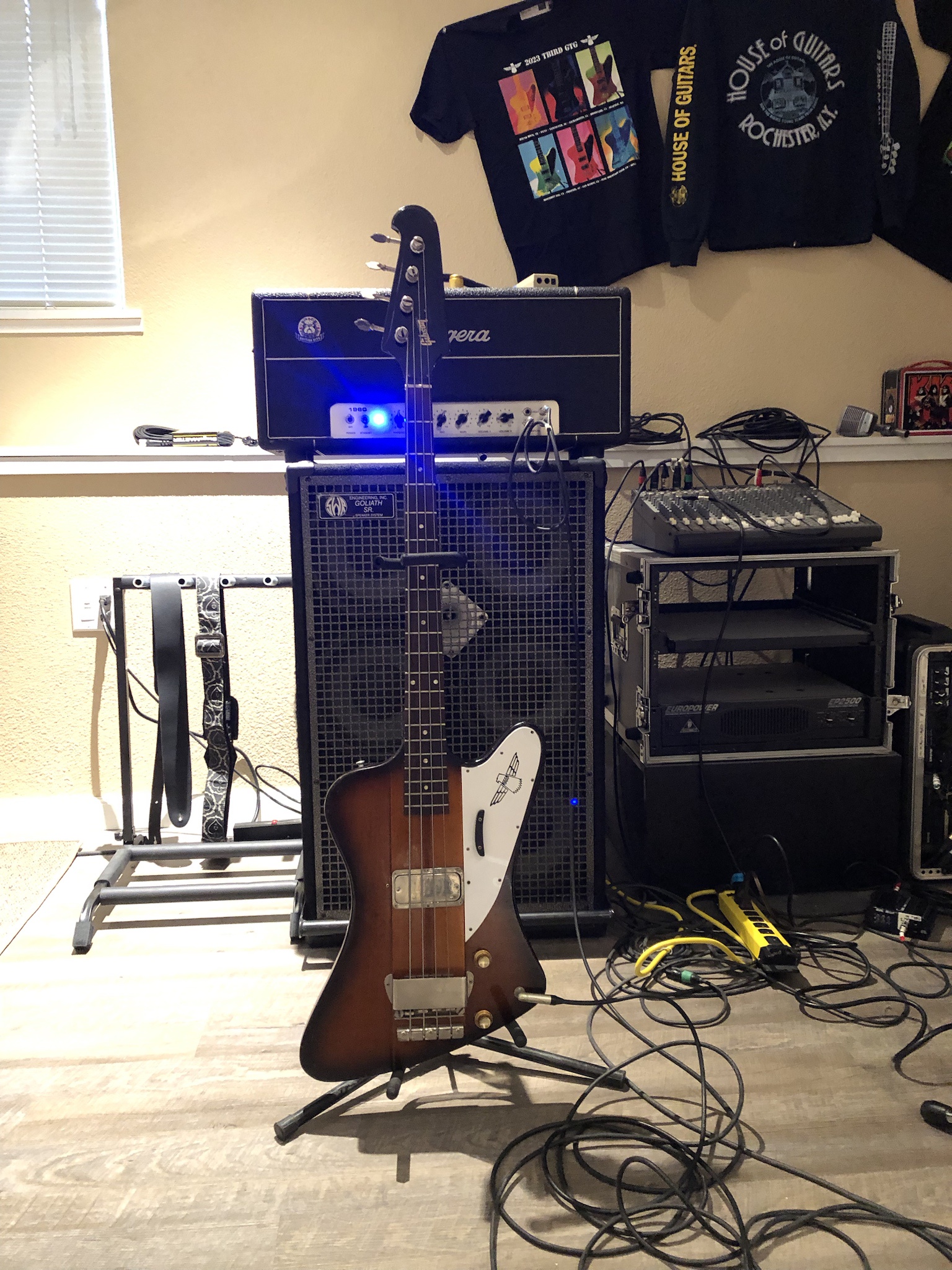
150 watts, it's a clone of a Marshall 1960 Plexi guitar amp, not quite as inherently bassy, a bit more mid forward which I like. The last 2 knobs to right are the volumes for each channel when jumpered, #1 is at about 2 and #2 is at 3 - loud, made that old Bird sound really good!
 
Possible that some amps behave differently than others?
Of course, and all design related, with Class D a lot of the traditional bets are off but traditionally the way to waste the least power (Kirchoff's laws of maximum power transfer) was to equate the source (amp) output impedance (2, 4, 8, 16 or whatever Ohms) to the load (speaker in this case) impedance but this also yielded higher thd levels so mismatching became a common technique to account for this.....higher ratios (more than 1:2 or 1:4) can be seen in preamp stages where wasting power is of less concern than distortion.....
 

Latest posts