• TalkBass has been independent since 1998. Add your voice.
    Create a free account to reply to discussions, view embedded media, and browse with fewer display ads.
    Join freeLog in
    Want zero display ads or expanded classifieds tools? Compare plans.

Thunderbird Club

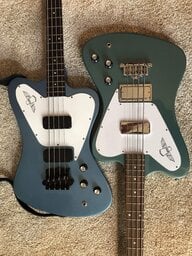
Local guy Dave Ross. He's a guitar tech/luthier, used to have a music store in Warwick called Ross Music. They were there for years.
What brand of pu's did he use in it? And how are the controls arranged? Fender's 1st (Stu Hamm) signature bass was a similar three pu model called "The Urge" - 2 N-S J's and a P in the center.
 
I did a thing today, added another Gibson to the flock, a '69 EB0 routed for a Guild PUP at the bridge, no neck/headstock damage. Harkens back to my first year playing bass, and High School Senior year. I could never afford a birth year bass ('52), so this'll do.
View attachment 7422887
My second bass was a '68 EB-3 and similarly played it in a combo my Jr & Sr years in HS. Stripped the cherry finish & had it made fretless 1st yr in art school when everyone was stripping their guitars/basses. Next bass was my '63 II...

1769936191508.jpeg
 
What brand of pu's did he use in it? And how are the controls arranged? Fender's 1st (Stu Hamm) signature bass was a similar three pu model called "The Urge" - 2 N-S J's and a P in the center.
Seymour Duncan, I think they're 1/4 Pounders? I can check.
It's a P-Bass *or* a J-Bass- w/neck pup closer to the neck heel. That's kind of nice for reggae... Can't use the P and Js together, hence the moniker "Two Face".
It's got active or passive functionality.
Knobs top to bottom:
-Pan for Jazz pickups.
-Master volume. Pulls up for P pickup, down for Jazz set.
-Concentric pots for active circuit, treble is center knob, bass is outer. Center detents, don't know the specs for boost/cut.
-Bottom knob pulls up for active, down for passive. When in passive mode it's a standard tone knob.

Hipshot bridge and tuners, w/ a Bass Extender as the E string tuner.
It's very lightweight, made of White Maple, and the neck is a baseball bat, lol. It's not hard to play at all, but you definitely know the difference between it and anything else in the pile. My plan is to make a sanding block with upward-curved ends, and sand the back of it down a bit to get the profile a little more narrow front-to-back. I spoke to a guy at AllParts who told me I'll be alright as long as I understand about the channel for the truss rod (3/8"deep/wide), and to make small moves until I notice the significant difference I'm after. Won't need much, just mostly a change of shape from the big round "C".
I figure a longish sanding block with up-curved ends with 120 grit should be a way to start. I'm in no hurry... Once I'm there with it I'll put some tung oil on it, wet sand, re-apply oil, and wet sand, ad nauseum... until there's peace...

IMG_20260201_074813492.jpg

IMG_20260201_082536827_HDR.jpg
IMG_20260201_074827858.jpg
IMG_20260201_074836054.jpg
 
Last edited:
Most times when people mention birth Year basses, i think of what i could get as production year for my birth - 1994. & while i could get the typical Ps & Js, i've got enough of those already. But i had stumbled upon this today, & i thought it was unique & out of left field

1769954662166.png


Ibanez CB200. Though i'd try to find it in their Antique Burst offering, as i think it looks nicer than just this black version
 
Do you see a quality difference between Ruby and JJ?
At some point I'll buy a spare set of power tubes.

I’ve found that Ruby’s are made in China, and they have come in some amps I acquired, namely a couple of the PF20 / PF50’s I have. I also ended up with a set in the aforementioned Traynor YBA-200v2. In all cases I removed them. In the PF’s I had a couple noisy 12ax7’s, and one of the 12AU7’s in one of the PF-50’s wouldn’t pass the pencil test. And it really rattled and buzzed when the amp was on top of the cab. In two cases I swapped all the tubes for vintage 12AX7’s and 6V6’s (PF20) or vintage 6L6’s (PF50), and newer Mullards in the other PF50. In the YBA, when I got it it sounded terrible. Luckily, that particular amp was very user friendly as far as testing and setting the bias, and it has very easy to access test points. I was able to determine that one of the Ruby KT-88’s was dead, even though it would light up like the others. That amp got new gen Mullard KT-88’s and a 5751 in v1 which helped that specific amp, with the remaining two preamp tubes being new gen Tung-sol IIRC.

So, my limited experience with Ruby basically dictates that I remove them if I see them and use some of the vintage tubes I have collected or something new like the new gen Mullard, Svetlana, Tung-sol, etc. tubes that are now available.

Chuck has the nice testing gadget and is much more experienced, so if he sees plenty of good testing Ruby’s, then I’d say they probably aren’t as bad as I believe them to be. But I can say, none of my (way too many) amps have any Chinese tubes in them.
 
Last edited:
Most times when people mention birth Year basses, i think of what i could get as production year for my birth - 1994. & while i could get the typical Ps & Js, i've got enough of those already. But i had stumbled upon this today, & i thought it was unique & out of left field

View attachment 7423041

Ibanez CB200. Though i'd try to find it in their Antique Burst offering, as i think it looks nicer than just this black version
I like it!
 
I did a thing today, added another Gibson to the flock, a '69 EB0 routed for a Guild PUP at the bridge, no neck/headstock damage. Harkens back to my first year playing bass, and High School Senior year. I could never afford a birth year bass ('52), so this'll do.
View attachment 7422887
Congratulations!!
 
Seymour Duncan, I think they're 1/4 Pounders? I can check.
It's a P-Bass *or* a J-Bass- w/neck pup closer to the neck heel. That's kind of nice for reggae... Can't use the P and Js together, hence the moniker "Two Face".
It's got active or passive functionality.
Knobs top to bottom:
-Pan for Jazz pickups.
-Master volume. Pulls up for P pickup, down for Jazz set.
-Concentric pots for active circuit, treble is center knob, bass is outer. Center detents, don't know the specs for boost/cut.
-Bottom knob pulls up for active, down for passive. When in passive mode it's a standard tone knob.

Hipshot bridge and tuners, w/ a Bass Extender as the E string tuner.
It's very lightweight, made of White Maple, and the neck is a baseball bat, lol. It's not hard to play at all, but you definitely know the difference between it and anything else in the pile. My plan is to make a sanding block with upward-curved ends, and sand the back of it down a bit to get the profile a little more narrow front-to-back. I spoke to a guy at AllParts who told me I'll be alright as long as I understand about the channel for the truss rod (3/8"deep/wide), and to make small moves until I notice the significant difference I'm after. Won't need much, just mostly a change of shape from the big round "C".
I figure a longish sanding block with up-curved ends with 120 grit should be a way to start. I'm in no hurry... Once I'm there with it I'll put some tung oil on it, wet sand, re-apply oil, and wet sand, ad nauseum... until there's peace...

View attachment 7422998
View attachment 7423004View attachment 7422999View attachment 7423000
The large pole pieces look like Quarter Pounders.
 
Those of you that use SIT Power Wounds, would you say they have more than average tension than average?

I have some medium/32” scale Fender Japan basses and with limited choices of strings, and hardly any sets heavier than 45-105, I really want a little more tension on the medium scale ones I want to use rounds on. I found the Dunlop flats are really good on a couple, but their rounds are a little soft on the 32”s not to mention the G is a bit short.
 
Seymour Duncan, I think they're 1/4 Pounders? I can check.
It's a P-Bass *or* a J-Bass- w/neck pup closer to the neck heel. That's kind of nice for reggae... Can't use the P and Js together, hence the moniker "Two Face".
It's got active or passive functionality.
Knobs top to bottom:
-Pan for Jazz pickups.
-Master volume. Pulls up for P pickup, down for Jazz set.
-Concentric pots for active circuit, treble is center knob, bass is outer. Center detents, don't know the specs for boost/cut.
-Bottom knob pulls up for active, down for passive. When in passive mode it's a standard tone knob.

Hipshot bridge and tuners, w/ a Bass Extender as the E string tuner.
It's very lightweight, made of White Maple, and the neck is a baseball bat, lol. It's not hard to play at all, but you definitely know the difference between it and anything else in the pile. My plan is to make a sanding block with upward-curved ends, and sand the back of it down a bit to get the profile a little more narrow front-to-back. I spoke to a guy at AllParts who told me I'll be alright as long as I understand about the channel for the truss rod (3/8"deep/wide), and to make small moves until I notice the significant difference I'm after. Won't need much, just mostly a change of shape from the big round "C".
I figure a longish sanding block with up-curved ends with 120 grit should be a way to start. I'm in no hurry... Once I'm there with it I'll put some tung oil on it, wet sand, re-apply oil, and wet sand, ad nauseum... until there's peace...

View attachment 7422998
View attachment 7423004View attachment 7422999View attachment 7423000
That is a cool bass Roger.
 
I’ve found that Ruby’s are made in China, and they have come in some amps I acquired, namely a couple of the PF20 / PF50’s I have. I also ended up with a set in the aforementioned Traynor YBA-200v2. In all cases I removed them. In the PF’s I had a couple noisy 12ax7’s, and one of the 12AU7’s in one of the PF-50’s wouldn’t pass the pencil test. And it really rattled and buzzed when the amp was on top of the cab. In two cases I swapped all the tubes for vintage 12AX7’s and 6V6’s (PF20) or vintage 6L6’s (PF50), and newer Mullards in the other PF50. In the YBA, when I got it it sounded terrible. Luckily, that particular amp was very user friendly as far as testing and setting the bias, and it has very easy to access test points. I was able to determine that one of the Ruby KT-88’s was dead, even though it would light up like the others. That amp got new gen Mullard KT-88’s and a 5751 in v1 which helped that specific amp, with the remaining two preamp tubes being new gen Tung-sol IIRC.

So, my limited experience with Ruby basically dictates that I remove them if I see them and use some of the vintage tubes I have collected or something new like the new gen Mullard, Svetlana, Tung-sol, etc. tubes that are now available.

Chuck has the nice testing gadget and is much more experienced, so if he sees plenty of good testing Ruby’s, then I’d say they probably aren’t as bad as I believe them to be. But I can say, none of my (way too many) amps have any Chinese tubes in them.
really careful when I answer these questions because unfortunately, many that post about these subjects lack understanding of necessary technical and logistics potentially making misleading (at least to me) statements .... "Made in China" is relative and has been for a long time....as posted earlier, what part of the process is truly all Chinese? As an example, with all the current geopolitical challenges, even thought most of the process in a semiconductor's manufacture may happen outside of China, the fact that final assembly may happen in China disqualifies the China +1 (some call it "Carbon Free") applicability for that particular device....Ruby Tubes have been around for a long time (shortly after Pittman's Groove Tubes in '79) so it would follow their tube supply base has seen many changes over the years......iow, WAY to many knobs to make a singular deterministic statement imho......
 
That is a cool bass Roger.
Thanks, it's funny how it came to be. The short story is (did I tell this one already?), Dave showed up one day to meet up with a guitar repair- my wife's acoustic. We were standing at the back of his car and he uncovered a case, and this was in it. After telling me how and why it ended up returned to him (not a fun story, it involved a divorce), he laid it on me. The two conditions were 1) I had to play it, and 2) I could never sell it. I agreed.
It is one of a kind as far as I know, with that pickup arrangement. It's a fun bass to play, and super light!
 
Seymour Duncan, I think they're 1/4 Pounders? I can check.
It's a P-Bass *or* a J-Bass- w/neck pup closer to the neck heel. That's kind of nice for reggae... Can't use the P and Js together, hence the moniker "Two Face".
It's got active or passive functionality.
Knobs top to bottom:
-Pan for Jazz pickups.
-Master volume. Pulls up for P pickup, down for Jazz set.
-Concentric pots for active circuit, treble is center knob, bass is outer. Center detents, don't know the specs for boost/cut.
-Bottom knob pulls up for active, down for passive. When in passive mode it's a standard tone knob.

Hipshot bridge and tuners, w/ a Bass Extender as the E string tuner.
It's very lightweight, made of White Maple, and the neck is a baseball bat, lol. It's not hard to play at all, but you definitely know the difference between it and anything else in the pile. My plan is to make a sanding block with upward-curved ends, and sand the back of it down a bit to get the profile a little more narrow front-to-back. I spoke to a guy at AllParts who told me I'll be alright as long as I understand about the channel for the truss rod (3/8"deep/wide), and to make small moves until I notice the significant difference I'm after. Won't need much, just mostly a change of shape from the big round "C".
I figure a longish sanding block with up-curved ends with 120 grit should be a way to start. I'm in no hurry... Once I'm there with it I'll put some tung oil on it, wet sand, re-apply oil, and wet sand, ad nauseum... until there's peace...

View attachment 7422998
View attachment 7423004View attachment 7422999View attachment 7423000
Thanks for the deets Rog - I have two (passive) 3-pu basses and frankly never use the neck pu, but we don't play any Reggae songs. There are big lows on my '63 Burns of London which on the rotary is labeled "Contrabass" - with the right amp you can rattle teeth. Also on the rotary, you can dial B & Middle (like a J*), Middle only (Bass), B-only (Treble). The other 3-pu bass is my Grass Roots/ESP Bass IV. It has what I consider an ideal wiring using a 4 slider-switch plate/unit. 1 is N, 2 is M, 3 is B, and 4 bypasses the two pots/controls (V/T) directly to the jack. So any combination can be switched on and switching 4 gives a very usable, clean boost to the pu's selected. Fender did a RI of their '60s Bass VI (which the Bass IV is based on) but never sold the 4 slider-switch plate/unit separately. (you can get a 3 switch-plate version)

On your neck - I did that for Jeff. He had a C-shaped J neck and wanted a flatter D-shape like on my '68 Coral (Dano) Deluxe Bass. You being a tradesman, I'm confident you can do it. (a luthier would charge at least $100) For Jeff's neck, I made a jig to hold it with side rails at the required lowered/flattened level. If you know the radius you want, Stew Mac sells contoured sanding blocks of various radii and stick-on sandpaper of various grits. They offer a short or long block - I have used a short block and it will do the job (and is cheaper). If I were doing a fretless fb, I might want the long block to assure consistency from nut to heel. I also have shaped necks w/o a jig using rasps/files/sandpaper - it's more of a 'feel' operation and works just as well. Maple (as you know) is ideal to work as it's hard enough to prevent going 'too far' and sands back to a nice smooth feel. I use hand-rubbed alkyd satin poly (3 passes w/emory sanding between) and they feel nice with minimal buildup.


* the first/top setting on the Vista Sonic is labeled "Wild Dog" which I was excited to hear when I acquired it. But it turned out to be reversed wired (from the factory) so it sounded more like an anemic cat. More of a guitar thing - not really useful on a bass. On later models it was labeled "Split-Sound" but I don't know how it's wired. I reversed the wires and it sounds like a decent J (M & B) - my favored position.
 
Last edited:
Most times when people mention birth Year basses, i think of what i could get as production year for my birth - 1994. & while i could get the typical Ps & Js, i've got enough of those already. But i had stumbled upon this today, & i thought it was unique & out of left field

View attachment 7423041

Ibanez CB200. Though i'd try to find it in their Antique Burst offering, as i think it looks nicer than just this black version
Interesting - may sound Dano-esk with those pu's. Wasn't aware of Ibanez doing lipsticks.
 
I like it!

Interesting - may sound Dano-esk with those pu's. Wasn't aware of Ibanez doing lipsticks.

I dig it too! & i'm not opposed to something Dano-esque, i kind alike the Dano sound. Contemplating piecing a 12 string electric build but i'm debating between going Dano style or Ric style. Both classics & unique in their rights, TBSeen.
 
Thanks for the deets Rog - I have two (passive) 3-pu basses and frankly never use the neck pu, but we don't play any Reggae songs. There are big lows on my '63 Burns of London which on the rotary is labeled "Contrabass" - with the right amp you can rattle teeth. Also on the rotary, you can dial B & Middle (like a J*), Middle only (Bass), B-only (Treble). The other 3-pu bass is my Grass Roots/ESP Bass IV. It has what I consider an ideal wiring using a 4-throw slider-switch. 1 is N, 2 is M, 3 is B, and 4 bypasses the two pots/controls (V/T) directly to the jack. So any combination can be switched on and switching 4 gives a very usable, clean boost to the pu's switched on. Fender did a RI of the Bass VI (which the Bass IV is based on) but never sold the 4-throw slider-switch separately. (you can get a 3-throw version)

On your neck - I did that for Jeff. He had a C-shaped J neck and wanted a flatter D-shape like on my '68 Coral (Dano) Deluxe Bass. You being a tradesman, I'm confident you can do it. (a luthier would charge at least $100) For Jeff's neck, I made a jig to hold it with side rails at the required lowered/flattened level. If you know the radius you want, Stew Mac sells contoured sanding blocks of various radii and stick-on sandpaper of various grits. They offer a short or long block - I have used a short block and it will do the job (and is cheaper). If I were doing a fretless fb, I might want the long block to assure consistency from nut to heel. I also have shaped necks w/o a jig using rasps/files/sandpaper - it's more of a 'feel' operation and works just as well. Maple (as you know) is ideal to work as it's hard enough to prevent going 'too far' and sands back to a nice smooth feel. I use hand-rubbed alkyd satin poly (3 passes w/emory sanding between) and they feel nice with minimal buildup.


* the first/top setting on the Vista Sonic is labeled "Wild Dog" which I was excited to hear when I acquired it. But it turned out to be reversed wired (from the factory) so it sounded more like an anemic cat. More of a guitar thing - not really useful on a bass. On later models it was labeled "Split-Sound" but I don't know how it's wired. I reversed the wires and it sounds like a decent J - my favored position.
Ayyy.
Nice run-down of those pickup arrangements- I am a bit intrigued by the tech, but never ventured into it really, but those sound like fun combinations. Very nice.
I'm still getting to know the Two Face, but there have been a few new changes so I'm getting to know most everything in my toolbox now.
Eric Stumpo, Plan 9's founder and guitarist, played a Burns Wild Dog- the same guitar his entire career, and the same 6,000lb Mesa guitar combo, lol. That guitar sounded gorgeous.

... Which Burns bass?