
- Jun 30, 2010
- 49,600
- 222,017
- Disclosures
- musician/artist/owner - Gildaxe
What's with "PRO" in all caps? Is there an acronym I'm not aware of?
 Pretty Rad Option
TalkBass has been independent since 1998. Add your voice.
Create a free account to reply to discussions, view embedded media, and browse with fewer display ads.
Join free Log in
Want zero display ads or expanded classifieds tools? Compare plans.
What's with "PRO" in all caps? Is there an acronym I'm not aware of?
Pretty Rad Option 

Neat bass. Strange that the serial number says it's early September of 2013 being that it looks like the 2014 120th anniversary model and with 2015 pups. And that it's the second Cherry Bird with black pg that's been on Reverb recently
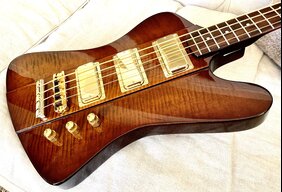
That's pretty cool, but it looks like those toggles would get in the way a lot while playing.
I doubt the brass nut will make a huge difference in the sound you ultimately get, so long as everything is set up the way it should be. I'm in the wood matters, but it's behind pickups and the player when it comes to what sound you get. Same with nut material and whatever bridge you have on the bass.

it's possiblePossibly a conglomerate of those years due to it being a one off?
I would think that a prototype would have a really low batch number or even "x"'s instead of numbers, I wouldn't think that prototypes would be made in the same batches as everything elseThat's pretty cool, but it looks like those toggles would get in the way a lot while playing.
How would one ever even go about confirming this as a factory prototype vs an after market mod by a previous owner?
it's possible
I would think that a prototype would have a really low batch number or even "x"'s instead of numbers, I wouldn't think that prototypes would be made in the same batches as everything else
...or Pretty Retro Option.

If it wasn't so expensive, I would think about it more. I bet it is a killer. It's expensive, and I have too many (if there is such a thing) already.That's very cool - I recently made a similarly passive twin-bucker with a switching set-up like this and it really offers a lot of tonal options. It looks to be a logical evolution for a more sophisticated T-bird. However, judging by a casual consensus of bird lovers here, perhaps less is more / traditional over innovative. I bet that prototype would be a killer bass though.
bingo!
Those are the same pickups I have in my '15 and my '15 also has a coil tap for each 'bucker...its nice to have but honestly, I just keep both pups wide open.That's very cool - I recently made a similarly passive twin-bucker with a switching set-up like this and it really offers a lot of tonal options. It looks to be a logical evolution for a more sophisticated T-bird. However, judging by a casual consensus of bird lovers here, perhaps less is more / traditional over innovative. I bet that prototype would be a killer bass though.
bingo!
Agree on the serial number. It would be interesting to see the dates on the pups, pots and switches and if the switches are the same brand and type as the 2015 bird switches. If they're all about the same date and that date lines up roughly with the serial number date it may be legit. Until then I'll keep my doubts up and just assume some enterprising anniversary bird owner did what I was planning on doing - buy a Gibby Bird for about $1000 and a set of 2013/14 EB pups for about $200 and some switches for about $50 and a black pickguard for about $75 and a bridge for about $150. So with around $1500 invested they make a sweet little profit of nearly $1000 by hyping it as a prototype.it's possible
I would think that a prototype would have a really low batch number or even "x"'s instead of numbers, I wouldn't think that prototypes would be made in the same batches as everything else
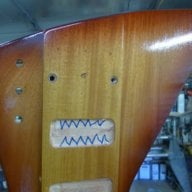
View attachment 1185703 brass nut
Spot on. Sound wise the most impact you'll get from a nut material change is a better or worse match between a fretted note and the same note played on an open string. I have found that all my basses with brass nuts do in fact sound very similar on open vs fretted notes. But that's not to say that other basses I have that don't have brass nuts don't deliver the same level of open/fretted note parity, some do and some don't.
And for the record - I still use my architects multi scale (in real fractional units vs those crazy metric ones) and calipers for fine work. It is getting harder to read those darn little 1/32 hash marks on the architects scale though.
When I think of Architect's Scale' it's the ones I used beginning in 1964 when I started studying Architecture and working summers as a draftsman/flunky. Made for constructing and measuring scale drawings. Not worth using for anything else.
Invalid Link Removed
They're graduated in 3/32, 3/16, 1/8, 1/4, 1/2, 1, 3/8, 3/4, 1-1/2", 3 inches to the foot; one edge to 16ths .
Cool but how is it determined that it is an authentic Gibson prototype vs. homebrew mods?
Yep, that's the one (except mines only 12" long). I used mine 8 hours a day 5 days a week for the better part of 20 years so it's a tool that I'm very used to and get along with quite well. Although my profession was more down the mechanical design path with a smattering of architectural here and there.When I think of Architect's Scale' it's the ones I used beginning in 1964 when I started studying Architecture and working summers as a draftsman/flunky. Made for constructing and measuring scale drawings. Not worth using for anything else.
Invalid Link Removed
They're graduated in 3/32, 3/16, 1/8, 1/4, 1/2, 1, 3/8, 3/4, 1-1/2", 3 inches to the foot; one edge to 16ths .

When I think of Architect's Scale' it's the ones I used beginning in 1964 when I started studying Architecture and working summers as a draftsman/flunky. Made for constructing and measuring scale drawings. Not worth using for anything else.
Invalid Link Removed
They're graduated in 3/32, 3/16, 1/8, 1/4, 1/2, 1, 3/8, 3/4, 1-1/2", 3 inches to the foot; one edge to 16ths .
Yeah, I don't think I've ever seen an 18" one.I'm currently using a similar one, though its 12" and not aluminum, to make a Cad drawing of a hand drawn print from 1944
Yeah, I don't think I've ever seen an 18" one.
12"Beveled flat scales like these were the weapon of choice back in the day but they're a lot more expensive to make.
Architectural Ruler - 6" (Item No. 100217-6) from only $2.65 ready to be imprinted by 4imprint Promotional Products

There most certainly is.Yep, that's the one (except mines only 12" long). I used mine 8 hours a day 5 days a week for the better part of 20 years so it's a tool that I'm very used to and get along with quite well. Although my profession was more down the mechanical design path with a smattering of architectural here and there.
Edit: I'm sure there's a joke in there somewhere, keep it clean guys.


