Pretty typical for a bird...
Stayed up super late last night playing it. Paying the price now at work.

TalkBass has been independent since 1998. Add your voice.
Create a free account to reply to discussions, view embedded media, and browse with fewer display ads.
Join free Log in
Want zero display ads or expanded classifieds tools? Compare plans.
Pretty typical for a bird...
Yep, in that case for step 2 just raise each saddle nice and high then bring your bass to tune. Follow the rest of the steps as outlined but replace "lower your bridge" with "lower your saddles".Wow, thank you! Some of this will be a little easier in that I have a Hipshot bridge.

Thanks, will do. The saddles are already pretty much as high as they’ll go.Yep, in that case for step 2 just raise each saddle nice and high then bring your bass to tune. Follow the rest of the steps as outlined but replace "lower your bridge" with "lower your saddles".
Be sure to let us know if it solved your problem.

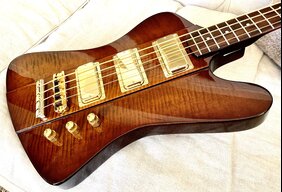
No case. Condition of the bass is great except for some ever so slight scuffing on the top edge of the headstock.
If you already did step one (create slight back bow on the neck while strings are slack) and now have your saddles nice and high with your strings tuned you shouldn't have any buzzing between the 15th fret and the bridge. Just lower the saddles and retune until you start to get a slight buzzing in those frets then raise them a hair to eliminate the buzz if desired then go on to the next step.Thanks, will do. The saddles are already pretty much as high as they’ll go.
If you already did step one (create slight back bow on the neck while strings are slack) and now have your saddles nice and high with your strings tuned you shouldn't have any buzzing between the 15th fret and the bridge. Just lower the saddles and retune until you start to get a slight buzzing in those frets then raise them a hair to eliminate the buzz if desired then go on to the next step.
Just remember, you have to start at step one first, don't skip any steps. If you skip steps you'll just be chasing your tail trying to get the buzz out.
I have a relative that has decided to get into bass playing and he has chosen the Thunderbird as his first bass (I'm so proud of him!). Anyway, he's kind of curious about tapping technique (something that I know nothing about because I've never seen a situation that required it). Does anyone have a link to a YouTube or other clip featuring tapping on a TBird?
Also he's into hard rock - Who are some of the hard rock bands that have TBird bass players out there.
PS - just read that last sentence again and the smartarse answer is, " Yes, they are". So now that we have that out of the way any help is appreciated.
I have a relative that has decided to get into bass playing and he has chosen the Thunderbird as his first bass (I'm so proud of him!). Anyway, he's kind of curious about tapping technique (something that I know nothing about because I've never seen a situation that required it). Does anyone have a link to a YouTube or other clip featuring tapping on a TBird?
Also he's into hard rock - Who are some of the hard rock bands that have TBird bass players out there.
PS - just read that last sentence again and the smartarse answer is, " Yes, they are". So now that we have that out of the way any help is appreciated.
 i hope he will like the bass.
For tapping and hard rock I believe Animals as Leaders is a band to look intoI have a relative that has decided to get into bass playing and he has chosen the Thunderbird as his first bass (I'm so proud of him!). Anyway, he's kind of curious about tapping technique (something that I know nothing about because I've never seen a situation that required it). Does anyone have a link to a YouTube or other clip featuring tapping on a TBird?
Also he's into hard rock - Who are some of the hard rock bands that have TBird bass players out there.
PS - just read that last sentence again and the smartarse answer is, " Yes, they are". So now that we have that out of the way any help is appreciated.

I have a relative that has decided to get into bass playing and he has chosen the Thunderbird as his first bass (I'm so proud of him!). Anyway, he's kind of curious about tapping technique (something that I know nothing about because I've never seen a situation that required it). Does anyone have a link to a YouTube or other clip featuring tapping on a TBird?
Also he's into hard rock - Who are some of the hard rock bands that have TBird bass players out there.
PS - just read that last sentence again and the smartarse answer is, " Yes, they are". So now that we have that out of the way any help is appreciated.

Thanks, will do. The saddles are already pretty much as high as they’ll go.
WOW! I'll agree with your technique for a complete setup "from zero", but that's a lot to go through just to work out a little bad juju. Throughout the various responses I've seen, there are some important details that have been glossed over. Folks keep using the word "bow". It's important to specify forward bow or back bow. Also, using the word "turns" implies full rotations. When I'm adjusting a truss rod, I operate in 1/4 rotations. 1 - 3 full rotations is really drastic (especially if you go in the wrong direction)! Also... if I have to tweek the truss rod, I prefer to do it with the strings at tension, to get a more accurate representation of what the adjustments are doing in real time. I look at it like this... those strings are gonna go in a straight line from the nut to the bridge. When you fret a note, that string needs to be able to go in a straight line from the fret to the saddle, while keeping the strings as close to the frets as possible without interference. I set mine up perfectly straight (verified by fretting on the first and last frets, maintaining light contact with every fret in between), and then giving it just the tiniest bit of forward bow (visible only by closing one eye & looking down the neck from the bridge towards the nut). At this point, I'll set the intonation. If I still need to adjust string height, I do it at the bridge. I may have to go back & forth making small tweeks on the bridge and truss rod a few times to really dial it in where I want it, but I can usually get it in there pretty good (remember... every adjustment means retuning and an intonation check). On the Goth I had, there was a phnarble (you won't find that in any published dictionaryLots of advice on this thread about neck adjustments. I like my action very low so I might as well jump in with what has worked best for me... something I clipped from TB some time ago and modified heavily that has proven to be spot on for all my Gibby needs.
Do this...
1. Loosen the strings to a slack setting then adjust your truss rod to create a slight back bow. From a dead straight neck position it might take two or three 1/3 clockwise turns. BTW, it's clockwise as seen from the headstock end of the bass looking down the neck towards the bridge.
2. Next, lower your bridge until the rear of the bridge is just off the body and the front of the bridge is about 1/8" higher than the rear.
3. Bring your strings up to tension and tune each string (don't worry about intonation yet).
4. Now check your action around the 15th and higher frets to see if it's comfortable for you without any or too much buzz (some players don't mind a little buzz). Don't worry about buzzing in the lower registers at this point. Raise your bridge as necessary to eliminate unwanted fret buzz in the 15th to end of fretboard area but always make sure the front stud is keeping the front of the bridge at least 1/8" higher than the rear of the bridge.
Note: the saddles on the 3 point bridge are specific in height to each string to ensure the strings match the FB radius, they are sequentially numbered so check to make sure each one is in the proper position. Also note that it is much easier on you, the studs and your stud inserts to slightly loosen the strings before raising the bridge height. Yes that means you'll need to retune after each adjustment. As an alternate, you can start step 4 with the bridge in a higher position and keep lowering and tuning until you get the level of buzz in the 15th and higher frets that suits you. Just be sure to always keep the front stud higher than the rears.
5. Now you've got your bass retuned with a lower action at the high frets. Your lower frets will now either buzz (see 6a for the subsequent steps) or the action will still be too high even in the low registers (see 6b for the subsequent steps).
6a: Low Register buzzes: You need to loosen the truss rod. Take off the truss rod cover and insert an allen wrench in the allen nut (the cheaper Epis generally have allen nuts). Don't detune the bass for that, rather lift the A and the D string to the side to the slots of the G and E string to have room for turning the allen wrench. With the bass' butt resting on your toes and the strings/fretboard facing away from you, you - while standing up and looking down - will now turn the allen wrench counterclockwise maybe 1/3 of a turn and immediately look to find out how the action of the bass has altered and buzzing has become less or disappeared. Don't be scared of overdoing it - it is impossible to break a truss rod by loosening it as you are releasing tension. That said, one or two "one third turns" counterclockwise should do it. sometimes you will need a few more of those to actually adjust the bass if the neck is too straight or even curved away from the fretboard (called back bow).
6b: Low Register has too much action: Same as 6a, except that you have too tighten the truss rod now which is done by turning the allen wrench clockwise. You will also have to be more careful as you can break a trussrod by overtightening it. When tightening a truss rod its best to slacken the strings a bit first, then make your truss adjustment followed by retuning and checking to see if your adjustment eliminated unwanted fret buzz.
7. After a combination of either steps 5 and 6a or steps 5 and 6b you should have a relatively or even totally buzz free bass with good to reasonable action. If there is still some persistent buzzing at some places then raise the bridge a little. Raising the front stud will raise all strings (remember to slacken the strings first then after raising the front stud retune the bass). Raising the treble side rear stud just a very tiny bit more may help the D and G string, or raising the bass side rear stud just a tiny bit more may help the E and A strings. The bridge does not have to be dead level but it should be very very close.
8. You should be done... but if you're still getting buzzing just on one string (while the other strings are buzz-free) and you have to raise the bridge considerably to make it go away even though you could stay much lower if it were just for the other strings, then double check you're saddles to ensure they're in the proper sequence. In a pinch you might be able to swap the D and A saddles but only as a last resort. If you still have unwanted buzzing then your low action expectations may be too much or you might have a string or fret level or neck hump problem. See step 9 for string checking. For fret level or twisted neck or neck hump or ski jump problems find a good luthier and see if they can fix the problem.
9. Occasionally it's possible to twist a string when installing a them on a bass. A twisted string can potentially have an odd oscillation that may make it vibrate in more of an elliptical pattern vs a flatter pattern. In some cases the effect is great enough to cause fret buzz on that specific string. To fix this, detune the string and starting at the nut pinch the string between your fingers and slowly slide down the string towards the bridge allowing the ball end of the string to spin as needed to eliminate any accidental twist you may have put in the string when installing. Once untwisted, hold the ball end in position and retune the string without letting the ball flip or spin. This should eliminate any twist related issues.
Edit: follow all the above steps in order. Don't skip steps or start in the middle.
) from the 12th to the 15th fret. No matter what I did, I could not work out the "hump" at the 15th, so I intentionally left a tidbit of back bow in it & elevated the bridge slightly, so I could have nice low action from the 1st to the 15th (where I spent most of my time), and let the action climb from the 15th up. That's right... I intentionally made that Goth have the same problem that @BklynKen is trying to fix right now (it comes as no surprise that a more experienced player would actually want to rectify the situation). This scenario is certainly the exception & not the rule. I would expect that Ken should be able to message that hump out of his neck, but there's no way to know for sure without puttin' the wrenches to 'er. Just remember... small adjustments, and patienceNo case. Condition of the bass is great except for some ever so slight scuffing on the top edge of the headstock.
Epiphone 940-ETBCS?