I get the jist of what you're saying. I'm just surprised to hear it. It's such a common practice to add whatever cab to whatever cab as long as the ohmage lines up. What is the "cost" of not matching cabs? Is it more laborious to the amp, or anything potentially harmful... or does it simply operate less efficiently?A 115 is *roughly* equivalent to a 210. You get into phasing and dispersion issues with different drivers getting the same signal (ie not having a crossover) but we should stop here, before that particular door opens any further.

Enjoy the benefits of a premium membership!
Upgrade Account
-
TalkBass has been independent since 1998. Add your voice.
Create a free account to reply to discussions, view embedded media, and browse with fewer display ads.
Join free Log in
Want zero display ads or expanded classifieds tools? Compare plans.
You are using an out of date browser. It may not display this or other websites correctly.
You should upgrade or use an alternative browser.
You should upgrade or use an alternative browser.
Thunderbird Club
- Thread starter TBird1958
- Start date
-
- Tags
- club thunderbird
More options
Who Replied?
I get the jist of what you're saying. I'm just surprised to hear it. It's such a common practice to add whatever cab to whatever cab as long as the ohmage lines up. What is the "cost" of not matching cabs? Is it more laborious to the amp, or anything potentially harmful... or does it simply operate less efficiently?
You can get phasing or comb-filtering effects and other unpredictable things going on, see 'time and phase alignment'.
I really don't have the energy to go into it in any depth, but should you ask about mixing drivers or cabs over in the Amps&Cabs forum, you can expect several thousand posts in response.

- Mar 8, 2011
- 12,232
- 51,187
- Disclosures
- Authorized greenboy designs builder/Owner of BNA Audio
I get the jist of what you're saying. I'm just surprised to hear it. It's such a common practice to add whatever cab to whatever cab as long as the ohmage lines up. What is the "cost" of not matching cabs? Is it more laborious to the amp, or anything potentially harmful... or does it simply operate less efficiently?
Mainly, it’s a crapshoot to mix cabs...not every 210 is tuned like every other 210, or 115, etc. they are all tuned differently to suit the drivers in them. Best practice to be safe is to find a small cab you really like...if it turns out you really do like it, add a second IDENTICAL cab to avoid phase and dispersion issues.
- Mar 8, 2011
- 12,232
- 51,187
- Disclosures
- Authorized greenboy designs builder/Owner of BNA Audio
You can get phasing or comb-filtering effects and other unpredictable things going on, see 'time and phase alignment'.
I really don't have the energy to go into it in any depth, but should you ask about mixing drivers or cabs over in the Amps&Cabs forum, you can expect several thousand posts in response.
Every time

- Mar 8, 2011
- 12,232
- 51,187
- Disclosures
- Authorized greenboy designs builder/Owner of BNA Audio
Do you guys remember a short while back, a friend sent me a link from a local CL ad for a white ‘Gibson’ T Bird for $1,200 that was a fake? I wrote the seller and he pulled the ad, but never responded. A buddy of mine came up to me at my gig tonight and said, “hey, I got a white T Bird!” I asked him to show me pictures and sure enough, it was the fake! He told me it was listed as an Orville (it’s not) and he paid $750 for it. Once he showed it to a few friends, they determined it was a modded Epi CP with nickel hardware and pickups. He went back to the seller to complain and was offered a $200 refund. The seller explained that he purchased it thinking it was a Gibson and was hoping that by calling it an Orville he could get away with it and take less of a financial beating. Bad form, but my buddy accepted the deal because he loves the bass. Crazy stuff
Last edited:
Do you guys remember a short while back, a friend sent me a link from a local CL ad for a white ‘Gibson’ T Bird for $1,200 that was a fake? I wrote the seller and he pulled the ad, but never responded. A buddy of mine came up to me at my gig tonight and said, “hey, I got a white T Bird!” I asked him to show me pictures and sure enough, it was the fake! He told me it was listed as an Orville (it’s not) and he paid $750 for it. Once he showed it to a few friends, they determined it was a modded Epi CP with nickel hardware and pickups. He went back to the seller to complain and was offered a $200 refund. The seller explained that he purchased it thinking it was a Gibson and was hoping that by calling it an Orville he could get away with it and take less of a financial beating. Bad form, but my buddy excepted the deal because he loves the bass. Crazy stuff
See what happens when you make Thunderbirds fashionable in Nashville?
- Mar 8, 2011
- 12,232
- 51,187
- Disclosures
- Authorized greenboy designs builder/Owner of BNA Audio
See what happens when you make Thunderbirds fashionable in Nashville?
At the risk of being ‘that guy,’ I had a feeling that once folks heard how good a T Bird could sound in a roots/Americana/country context, I wouldn’t be the only one around here playing one for long
At the risk of being ‘that guy,’ I had a feeling that once folks heard how good a T Bird could sound in a roots/Americana/country context, I wouldn’t be the only one around here playing one for long
Far be it from me to suggest you have tickets on yourself.
I don't know none o' them fancy words Kat throws around... but I know that, in a music store setting... walking down the row plugging into this amp & that amp... I generally find it pretty easy to dial in something I like. Not "my sound" per se (I'm still tryin' to work on exactly what that is)... but a sound I can be happy noodling with. I struggle more with that on a Hartke. I don't know if it's a low-mid thing or something maybe... but it's consistent among Hartkes. It's unique to Harke's. I just call it "the Hartke sound". Even though I haven't had recent experience with them... it's still a sound I can only refer to as "modern". I'm from the Blues & dirty old Rock & Roll. In Fantasy Land... I'd have a big fat tube rig! I like life, and breath, and space in my sound. I find modern sounding amps to be quite dry and focussed. Nothing that isn't a tube amp, will ever give you breath or space, but I like GK because I find them to have a very "lively" sound, and because they do a great job of putting out, what's being put in without really coloring it (unless you choose to use the "contour" feature and the likes). GK is certainly capable of procucing a modern sound if you want it to... but they do a better job of not doing that, than most other modern solid state amps IMO. I'm far from the most experienced with Hartke's stuff... but the experiences I've had, led me away from them. I'm not saying it's a "bad" sound... it's just a sound for people that aren't meWhat is it about Hartke cabs that those who don't like them don't like?

Also worth noting... I don't have any experience with running anything other than Hartke power into Hartke cabs (wellllll... I was in a band for a short while with a guy who ran a GK head into a Hartke cab... but he played slap on a Jazz bass. It sounded like he kicked a box of spoons down a staircase!). I don't know how much of "the Hartke sound" to attribute to the cabs. Just being familiar with the kind of sound that Hartke aims for, is enough to make me look at other options when there's no clear reason not to (other than the fact that they do look really cool)
I now have the pleasure of informing you, that you have just participated in a drinking game! Everybody hasta do a shot fer every time they read any form of the word "Hartke"


It sounded like he kicked a box of spoons down a staircase!)
Classic.
How'd I get dragged into this???We just need @theFixer to opine that it looks like a stripper sneezed on it...

- Mar 8, 2011
- 12,232
- 51,187
- Disclosures
- Authorized greenboy designs builder/Owner of BNA Audio
Far be it from me to suggest you have tickets on yourself.
I have no idea what you are saying, but I have no idea about lots of stuff
I have no idea what you are saying, but I have no idea about lots of stuff
I would never accuse you of being up yourself.
You're doing a good job representing though but.
I... I can't do that. I WON'T do that! I'M NOT GONNA DO THAT, AND YOU CAN'T MAKE ME!!!You can get phasing or comb-filtering effects and other unpredictable things going on, see 'time and phase alignment'.
I really don't have the energy to go into it in any depth, but should you ask about mixing drivers or cabs over in the Amps&Cabs forum, you can expect several thousand posts in response.

I... I can't do that. I WON'T do that! I'M NOT GONNA DO THAT, AND YOU CAN'T MAKE ME!!!
Several thousand posts later, hitmen hired and weapons drawn, I should have said.
Do you guys remember a short while back, a friend sent me a link from a local CL ad for a white ‘Gibson’ T Bird for $1,200 that was a fake? I wrote the seller and he pulled the ad, but never responded. A buddy of mine came up to me at my gig tonight and said, “hey, I got a white T Bird!” I asked him to show me pictures and sure enough, it was the fake! He told me it was listed as an Orville (it’s not) and he paid $750 for it. Once he showed it to a few friends, they determined it was a modded Epi CP with nickel hardware and pickups. He went back to the seller to complain and was offered a $200 refund. The seller explained that he purchased it thinking it was a Gibson and was hoping that by calling it an Orville he could get away with it and take less of a financial beating. Bad form, but my buddy excepted the deal because he loves the bass. Crazy stuff
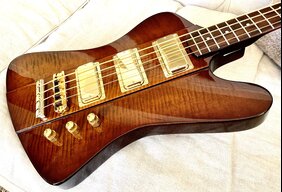
The Optima Gold Rounds are a warm string with lots of punch and clarity. They have a significant bottom end and smooth top end with minimal zing and sizzle. The Unique version that I installed on this bass also appear to have a higher tension than the normal Optima golds I use on my other basses. For me that translates to faster right hand playing but more concentration needed on the left hand to ensure good fretting technique.They sure look nice! How would you describe the sound?
The tone across the strings is balanced exceptionally well, which I find is hard to get on my other TBirds. My others (and same with this bass pre Optimas) had a very bright G string, almost to the point of it sounding like a completely different EQ when going from any of the other strings to the G. In the past there were many times I'd slide down the D string for higher notes that I would have normally just stayed in position and played on the G string. Not any more. Harmonics and chords ring very true and sound crisp and clear, not muddy and no chorus effect or competing overtones.
Three interesting things to note vs the Chrome Rounds I had on this bass before the Optimas - I had to add noticeable back bow to the neck to compensate for the higher tension, which was creating a much higher action than I like. I had to drop the bass side of the neck pickup down to compensate for the much louder E and A strings. I assume the core on these strings may be larger or possibly the material more prone to magnetic pickup than the Chromes, thereby making them sound louder. And lastly, I had to drop the bass side of the three point bridge to compensate for the overwrap on the ball end of the string that extended just a bit beyond the saddle (more a function of the bridge design vs the string design).
Overall I'm very pleased with the sound, playability and look of strings. For some it might be too much bling on a bass but for me it completes the picture on this particular bass, which for a stock Gibson is already on the blingy side due to the gold finish, gold hardware and gold logos. Heck I'd put gold covers and trim rings on it if I could find a set - in for a penny, in for a pound. Which brings us to cost. At $70 a set, these strings aren't cheap but they do last a good long time. I don't have acidic sweat problems with any of my strings, but if you do they might be a string to try. The gold plating lasts forever (as far as strings go) and don't flake, peel or tarnish over time. I get between 1 and 5 years on a set of these vs 3 to 6 months out of a set of Chromes. Here in the states you can get them from JustStrings.com (unfortunately BassStringsOnLine does not carry this brand).
- Mar 8, 2011
- 12,232
- 51,187
- Disclosures
- Authorized greenboy designs builder/Owner of BNA Audio
The Optima Gold Rounds are a warm string with lots of punch and clarity. They have a significant bottom end and smooth top end with minimal zing and sizzle. The Unique version that I installed on this bass also appear to have a higher tension than the normal Optima golds I use on my other basses. For me that translates to faster right hand playing but more concentration needed on the left hand to ensure good fretting technique.
The tone across the strings is balanced exceptionally well, which I find is hard to get on my other TBirds. My others (and same with this bass pre Optimas) had a very bright G string, almost to the point of it sounding like a completely different EQ when going from any of the other strings to the G. In the past there were many times I'd slide down the D string for higher notes that I would have normally just stayed in position and played on the G string. Not any more. Harmonics and chords ring very true and sound crisp and clear, not muddy and no chorus effect or competing overtones.
Three interesting things to note vs the Chrome Rounds I had on this bass before the Optimas - I had to add noticeable back bow to the neck to compensate for the higher tension, which was creating a much higher action than I like. I had to drop the bass side of the neck pickup down to compensate for the much louder E and A strings. I assume the core on these strings may be larger or possibly the material more prone to magnetic pickup than the Chromes, thereby making them sound louder. And lastly, I had to drop the bass side of the three point bridge to compensate for the overwrap on the ball end of the string that extended just a bit beyond the saddle (more a function of the bridge design vs the string design).
Overall I'm very pleased with the sound, playability and look of strings. For some it might be too much bling on a bass but for me it completes the picture on this particular bass, which for a stock Gibson is already on the blingy side due to the gold finish, gold hardware and gold logos. Heck I'd put gold covers and trim rings on it if I could find a set - in for a penny, in for a pound. Which brings us to cost. At $70 a set, these strings aren't cheap but they do last a good long time. I don't have acidic sweat problems with any of my strings, but if you do they might be a string to try. The gold plating lasts forever (as far as strings go) and don't flake, peel or tarnish over time. I get between 1 and 5 years on a set of these vs 3 to 6 months out of a set of Chromes. Here in the states you can get them from JustStrings.com (unfortunately BassStringsOnLine does not carry this brand).
Very in depth review, thanks!
Latest posts
-

-
 Adding J pup to P bass, should I go 60’s or 70’s spacing?
- Latest: Gianni "Orlandez" Orlati
-
-

-
