
Haji
Supporting Member
HA! I'm caught up again!
Yeah, there's really no specific meaning to that.
Yeah, there's really no specific meaning to that.

TalkBass has been independent since 1998. Add your voice.
Create a free account to reply to discussions, view embedded media, and browse with fewer display ads.
Join free Log in
Want zero display ads or expanded classifieds tools? Compare plans.

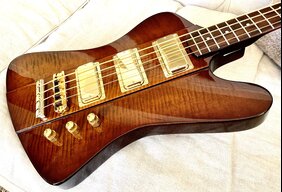
Basses have never been a priority to Gibson. They typically make about a thousand TBirds in a normal production year. That number is a drop in the bucket compared to the number of Les Pauls. They are basically an afterthought.

I shave a piece of wood off of a paint stir stick, put a little gorilla glue on it, then stuff it into the hole. Trim off any excess and put in the new screw. This works any time the hole is stripped or too big.I've always just filled the holes with wood filler, let it dry, sink in the replacement screws. Never a problem.

After 45 seconds, I was waiting to hear him knock knock knocking on heaven's door.

Tip the neck up toward the ceiling a whole lot more and that's about what I do unless the pick comes out or I'm playing with my thumb. Then the neck goes down toward horizontal.I ride my T-bird like you do - north of the belly bevel over the top horn. Less stretch to 1st position.
Try to find any tuba or souzaphone for less than $2k.I wouldn’t quite say ‘afterthought,’ but I get where you’re coming from. Somewhere between 1974-1984 (give or take) Gibson was crazy innovative compared to most large scale manufacturers. Moog Electronics in a bass?! Bill Lawrence pickups that still remain utterly unique. I’m not saying those experiments were successful, but they were clearly going for something original and innovative. During that same time period, Fender was maybe adding a new color or two to what was effectively the same thing they’d been doing for years. I think Gibson tried really hard to push the envelope during that time period, it just didn’t totally work. In the used market, compare a ‘76 T Bird or Ripper to a ‘76 P bass. Massive difference in resale and I think, accurately reflects value.
Made in the US (or Canada, or Germany, etc) still means something to me, and of course it’s going to cost more. I’d get no joy in saving a couple bucks by turning a blind eye to the inhumane labor practices that made that savings possible.
Or search out a mid level oboe or tuba suitable for orchestral work (barely) then tell me $2k is crazy for a well made bass made with humane labor conditions is
Decorative pear trees. They never really drop all their leaves like other trees but they drop most. Back east our pear trees would turn beautiful colors when dropping their leaves, here it's just a bit of yellow then drop. Not nearly the fall show out here, probably because we rarely get a cold snap to set the trees cycle.Are we talking real pear trees or the decorative pears?
My decorative pears still have shriveled brown leaves on them and even through the -20F days of January, those trees still had what looked like healthy green leaves. It's quite remarkable and a bit confusing how long those leaves hold on into winter. Springtime budding will push the old leaves off and the cycle continues.
When installing Schaller strap locks that have smaller screws than the stock strap pin screw I always use the stock screw, not the smaller Schaller screw. I just ream the hole of the Schaller strap lock pin out with a drill bit so the stock screw can fit. I also chuck up the stock screw in my hand drill and run the head across some sand paper for a few seconds to reduce the screw head diameter so it fits down inside the Schaller strap pin. Works every time and keeps from having to alter the bass.I've always just filled the holes with wood filler, let it dry, sink in the replacement screws. Never a problem.
Same here. My Bird is practically on my right hip most of the time with the headstock pointing out to the back corner of the room vs flat across my belly with the headstock pointing stage left (which is how I typically hold my Fenders). I've never done the high on the body armpit mount like so many Jazz players do, besides looking really uncomfortable it looks dorky to me.I ride my T-bird like you do - north of the belly bevel over the top horn. Less stretch to 1st position.

Try to find any tuba or souzaphone for less than $2k.
I've always just filled the holes with wood filler, let it dry, sink in the replacement screws. Never a problem.

Same here. My Bird is practically on my right hip most of the time with the headstock pointing out to the back corner of the room vs flat across my belly with the headstock pointing stage left (which is how I typically hold my Fenders). I've never done the high on the body armpit mount like so many Jazz players do, besides looking really uncomfortable it looks dorky to me.
All caught up here. Have some time to kill. Jumping out to GenPop for shirts and giggles. Wish me luck.

The new 2018 Schaller S-Locks seem intriguing, cause the threaded area on the strap portion are longer. But I don't like the pin bass portion, how are you supposed to know if the screw got loose, without the pin rattling around?When installing Schaller strap locks that have smaller screws than the stock strap pin screw I always use the stock screw, not the smaller Schaller screw. I just ream the hole of the Schaller strap lock pin out with a drill bit so the stock screw can fit. I also chuck up the stock screw in my hand drill and run the head across some sand paper for a few seconds to reduce the screw head diameter so it fits down inside the Schaller strap pin. Works every time and keeps from having to alter the bass.
Be safe!All caught up here. Have some time to kill. Jumping out to GenPop for shirts and giggles. Wish me luck.


Caught up, but absolutely nothing to add to these past pages. Everyone seems to be on it.
Where's Ken? Haven't seen him in a couple days.
I don't understand why brass instruments became the comparator. I was going to suggest that a violin or viola might be a better comparison, but I have no reason to suggest that. In fact, I can think of no logic to comparing cost across any instrument category. I don't think I'm in a position to comment on anything beyond the value of any of these things to me because they are not working assets to me.


