• TalkBass has been independent since 1998. Add your voice.
    Create a free account to reply to discussions, view embedded media, and browse with fewer display ads.
    Join freeLog in
    Want zero display ads or expanded classifieds tools? Compare plans.

Thunderbird Club

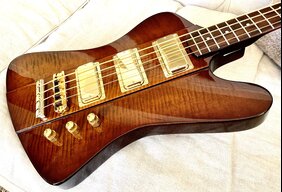
Has anyone played one of these? It's a Gretsch Billy-Bo Jupiter Thunderbird Bass. I'm intrigued but would like to hear from someone with some first hand experience before I go any further down the road with this one :thumbsup:
View attachment 3110311
No experience with one, but that's strange. Not bad strange, definitely different. Sorta like a non-reverse and a reverse mated.:cool:
 
@bylar13 may have a quibble with Babicz and its propensity to go sharp during windmills.

oopsie.....
IMG_20180519_161904489.jpg
 
Cool. Thanks. Was it just you doing the listening?
Yep just me and my confirmation bias. Unfortunately, my confirmation bias lost the argument. He wanted to find the cheapest solutions, I was committed to spend whatever it took to get the sound I wanted. Including the purchase of the Goth I have about $1000 in this bass and countless hours of effort. About $500 of that was in dozens of pots, caps and switches used in the test rigs that didn't make the cut and never made it into the bass.

As an Engineer who spent an entire career in the R&D Scientific community I'm very familiar with proper blind testing, I'm also very familiar with just how easy it is to guide even that type of testing to the conclusion you want. I've seen it done many times. Unfortunately human perception does not necessarily align perfectly with instrument bench testing. That's why we have bench testing, so we can get accurate and repeatable results that help us make better predictions.

If you want verifiable data use instrument testing. If you want to find what sounds best to your ears, use your ears.
 
That was a terrific-and scary-series. WAY ahead of its time.:eek:
I was just a pint back then. It was my first experience in watching someone else handle an existentially difficult predicament. It was kind of dreamy, in a potentially bad way. I remember wanting to see more of it, but my mother intervened.
Lol, not like she prevented anything. ;)
 
I'm in agreement with this, in principle they are good but better for the 5 screw bumper type fixing where the "Full contact" is assured
I'm not sure I understand how a SuperTone (for instance) would put any more pressure on the 3-point anchors (inserts) than the regular 3 point bridge. In fact...it seems to me that the HipShot and Babicz replacement bridges could distribute the tension more evenly. Anybody ever have a Babicz or HipShot yank an anchor?
 
I'm not sure I understand how a SuperTone (for instance) would put any more pressure on the 3-point anchors (inserts) than the regular 3 point bridge. In fact...it seems to me that the HipShot and Babicz replacement bridges could distribute the tension more evenly. Anybody ever have a Babicz or HipShot yank an anchor?

Not yet and whacked it pretty good! I do think the Babicz helped a little with sustain vs. the 3 point but I am also pretty sure I wanted it too, so that's why it probably does.....
 
I'm not sure I understand how a SuperTone (for instance) would put any more pressure on the 3-point anchors (inserts) than the regular 3 point bridge. In fact...it seems to me that the HipShot and Babicz replacement bridges could distribute the tension more evenly. Anybody ever have a Babicz or HipShot yank an anchor?
My thoughts are in that if the insert has been pressed in below the surface then if the bolt holding the bridge down is yanked up tight then it's likely you will pull the insert up a little which sort of defeats the Full contact hardware principle where the surface area in tight contact with the body plays a part if I remember correctly. I don't think it any more likely to actually get pulled out than a three point but I feel that say on an Epiphone which has the raised collar on the inserts then the bridge isn't actually in contact with the body at all.
 
My thoughts are in that if the insert has been pressed in below the surface then if the bolt holding the bridge down is yanked up tight then it's likely you will pull the insert up a little which sort of defeats the Full contact hardware principle where the surface area in tight contact with the body plays a part if I remember correctly. I don't think it any more likely to actually get pulled out than a three point but I feel that say on an Epiphone which has the raised collar on the inserts then the bridge isn't actually in contact with the body at all.
I see what yer sayin'. I've been drooling over a SuperTone for a while now, but have yet to encounter one live & in person. It's good to be aware of that kinda stuff :bookworm:
 
Has anyone played one of these? It's a Gretsch Billy-Bo Jupiter Thunderbird Bass. I'm intrigued but would like to hear from someone with some first hand experience before I go any further down the road with this one :thumbsup:
View attachment 3110311
Oh yes, Gretsch bass weirdness at it's best..
I got a brand new Gretsch Committee Bass in 79...it looked like this..
upload_2018-8-9_11-44-23.jpeg

After messing with it for years, it now looks like this.....much better sound and player...
ysdRR7dJMQG9kRpcN9qNwVwM8f1fyNFrOXt4ZK44oymAQ1ZkU9FiuFuZ8jzJjBbZfcBiAs5E8X1wXYA&owa=outlook.live.jpg
 
I'm not sure I understand how a SuperTone (for instance) would put any more pressure on the 3-point anchors (inserts) than the regular 3 point bridge. In fact...it seems to me that the HipShot and Babicz replacement bridges could distribute the tension more evenly. Anybody ever have a Babicz or HipShot yank an anchor?
I have. That's why I moved away from my Hipshot. The difference is the three point bridge was meant to float as part of it's design. Not the case with the others.
 
Yep just me and my confirmation bias. Unfortunately, my confirmation bias lost the argument. He wanted to find the cheapest solutions, I was committed to spend whatever it took to get the sound I wanted. Including the purchase of the Goth I have about $1000 in this bass and countless hours of effort. About $500 of that was in dozens of pots, caps and switches used in the test rigs that didn't make the cut and never made it into the bass.

As an Engineer who spent an entire career in the R&D Scientific community I'm very familiar with proper blind testing, I'm also very familiar with just how easy it is to guide even that type of testing to the conclusion you want. I've seen it done many times. Unfortunately human perception does not necessarily align perfectly with instrument bench testing. That's why we have bench testing, so we can get accurate and repeatable results that help us make better predictions.

If you want verifiable data use instrument testing. If you want to find what sounds best to your ears, use your ears.
Totally agree. A combination of both however would yield data that's more transferable hence more "shareable" if you know what I mean..