
Thanks. Maybe, but I'm quite happy with my AO. Just curious what works for other people.I was looking at it from the point of view of reverb. The Green Russian is quite popular for bass and reasonably priced too. Maybe check it out?

TalkBass has been independent since 1998. Add your voice.
Create a free account to reply to discussions, view embedded media, and browse with fewer display ads.
Join free Log in
Want zero display ads or expanded classifieds tools? Compare plans.
Thanks. Maybe, but I'm quite happy with my AO. Just curious what works for other people.I was looking at it from the point of view of reverb. The Green Russian is quite popular for bass and reasonably priced too. Maybe check it out?

Both. The above-ground crypts serve as solar crematories. The remains are eventually dumped to the bottom of the crypt to allow for additional burials. If you visit a New Orleans cemetery, you’ll note far more deceased listed on the crypts than there are spaces for coffins. Crypt deeds are transferred (inherited or sold) outside families and the process continues. (Sorry for the pedantic explanation. I’m an L.A. boy who has come to own a crypt in the other LA — New Orleans, LA — as my final place of rest.)Cremation or above-ground crypts?


Thanks. Maybe, but I'm quite happy with my AO. Just curious what works for other people.
Had no idea. Thank you.Both. The above-ground crypts serve as solar crematories. The remains are eventually dumped to the bottom of the crypt to allow for additional burials. If you visit a New Orleans cemetery, you’ll note far more deceased listed on the crypts than there are spaces for coffins. Crypt deeds are transferred (inherited or sold) outside families and the process continues. (Sorry for the pedantic explanation. I’m an L.A. boy who has come to own a crypt in the other LA — New Orleans, LA — as my final place of rest.)
Not as far as the AO knows.You were seeing another dirt pedal behind the AO's back -- don't try to come over all innocent with us!

because Fenders were so expensive in England, Jim Marshall basically copied the Bassman ckt (down to the 5881 mil-spec 6L6s as in the pic) and added a Celestion speaker. later, to again reduce costs, he opted for the Mullard-Philips EL-34 which is a completely different tube than the 6L6 (I'll PM you with details so as not to derail) because of it's European manufacture hence better cost. for this change, he had to have the output transformer redesigned and voila! the true original Marshall tone was born....something tells me your Eminar may be of that early Marshall hybrid flavor..There is a story that Richie Blackmore had some issue (reliability ?) with his Marshall 200s and grabbed some Eminar Bass 200s and found them good. I assume it was on a tour of Oz in the 70s. That’s probably the biggest claim to fame.
So I also assume (from internet comments) that they are Marshall like, but using US style valves - I guess like a Fender Bassman. I now not what differences there are between them all.
I asked the guy that checked it out whether it was a Fender copy or a Marshall copy and he said not really. A bit of it’s own thing but built in that similar style. He also said he loved playing it with his guitar.
Early AC/DC pictures show some Eminars but they may have been supplied at the shows. Mark Evans was mentioned somewhere as using an Eminar Bass 300 at some stage.

because Fenders were so expensive in England, Jim Marshall basically copied the Bassman ckt (down to the 5881 mil-spec 6L6s as in the pic) and added a Celestion speaker. later, to again reduce costs, he opted for the Mullard-Philips EL-34 which is a completely different tube than the 6L6 (I'll PM you with details so as not to derail) because of it's European manufacture hence better cost. for this change, he had to have the output transformer redesigned and voila! the true original Marshall tone was born....something tells me your Eminar may be of that early Marshall hybrid flavor..
View attachment 3347794
because Fenders were so expensive in England, Jim Marshall basically copied the Bassman ckt (down to the 5881 mil-spec 6L6s as in the pic) and added a Celestion speaker. later, to again reduce costs, he opted for the Mullard-Philips EL-34 which is a completely different tube than the 6L6 (I'll PM you with details so as not to derail) because of it's European manufacture hence better cost. for this change, he had to have the output transformer redesigned and voila! the true original Marshall tone was born....something tells me your Eminar may be of that early Marshall hybrid flavor..
View attachment 3347794

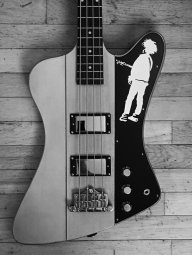
So on the Thunderbird Players Group page on FB(you all should be members if you 1) are on FB and 2) are in this sub lol. So over there I asked the same question. Over there the totals are 5 for & 0 naked so that makes a combined total of 9 for inlays and 6 votes Naked.
I think I am going with the inlays. Im mot at 50/50, instead im more like a 60/40 maybe a 65/35.
Morning! Some random thoughts on pedals...
Hung out with a really nice fella last night at my gig. He was a bass player in one of the other bands on the bill. His band were all original, but it was basically ‘classic’ riff rock, kinda on the hippie side of things. He said he liked my upright playing and Derek Hokes music and half apologized that his gig required that he bring a pedalboard. Fairly small board with two different drives and a modulation pedal. Can’t remember what pedals besides a Green Muff, but all pretty standard stuff bass players use.
I watched his set and either couldn’t hear any changes to his sound at all after watching him press a pedal, or if I did notice a change, it was that his sound got a bit thinner. This is my experience with the vast majority of bass players I see with pedalboards. I either hear no real change in tone, or a change for the worst in tone. This includes players with massive pedalboards sometimes. Once in a blue moon I’ll hear a bass player use a pedal that actually makes a useful difference, but it’s really rare.
Ironically, I love pedals and own some pretty high end ones. I use em for my solo electronic stuff all the time. But live it’s really rare that I notice any change at all, let alone a positive change.
yeah and RCA borrowed those from Western Electric..And Fender circuits were borrowed from the AT&T (was it? RCA?) manual.
yeah and RCA borrowed those from Western Electric..

The concept of hardware design and details being a secret is relatively new. It was not uncommon for electronic gear to include a schematic and parts list. Even the first Apple computer included a schematic. Now you “buy” the hardware, but often you don’t get the right to know what’s inside.Everyone borrowed from everyone. And everyone learned from everyone else, which is why tube technology grew so quickly. The tube companies were selling tubes, not circuits. The more circuits, the more products which needed tubes.
The early days of transistors were somewhat similar, as were the early days of guitar amps, personal computing, etc. You didn't have someone like Mesa trying to patent every little circuit innovation. Quite a few of the early Gibson amps appear to be Fender circuits with tube and/or very minor circuit changes. Fender didn't care; they were selling amps as fast as they could build them.
The concept of hardware design and details being a secret is relatively new. It was not uncommon for electronic gear to include a schematic and parts list. Even the first Apple computer included a schematic. Now you “buy” the hardware, but often you don’t get the right to know what’s inside.
Yeah, the repair guy was saying that the basic design was a common thing that they all worked fromyeah and RCA borrowed those from Western Electric..
do you use it often? be cool to hear it with a T-Bird...Yeah, the repair guy was saying that the basic design was a common thing that they all worked from
No, no opportunities at the moment. But it is a very nice warm tone. Having said that; @fasterpussycat suggested the linking of the two channels. Which I did, and haven’t taken offdo you use it often? be cool to hear it with a T-Bird...
 . Different but good different. This amp will be a keeper.


