• TalkBass has been independent since 1998. Add your voice.
    Create a free account to reply to discussions, view embedded media, and browse with fewer display ads.
    Join freeLog in
    Want zero display ads or expanded classifieds tools? Compare plans.

Thunderbird Club

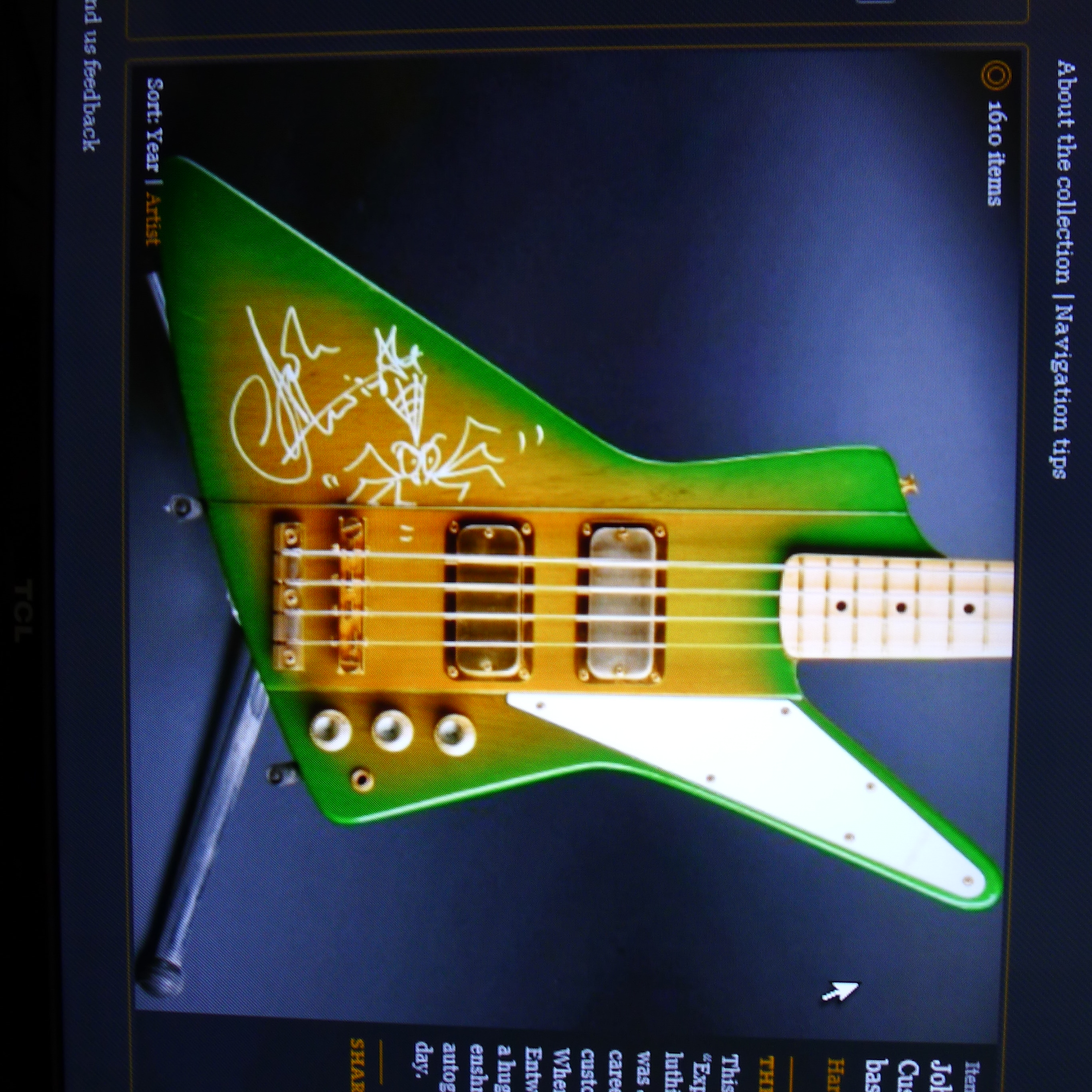
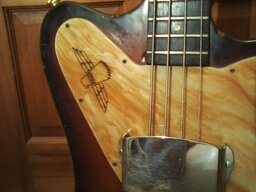
I got this pic off the net somewhere:
View attachment 3556516

....my pic was from barchie‘s guitar shop, Tokyo, a few years ago...was offered for about 10k....said to be owned by Tom Petersson....certainly not true... mine was offered as owned by Overend Watts.....certainly not true, but a great player....
 
Yeah. Poor attempt at a compensated bridge to get intonation. Did they even work when they were new? I assume they were the last thing installed at the factory during setup?

Not sure what's going on there - if there was an attempt to correct the originals lack of saddle play for proper intonation, the bridge unit should be angled opposite to what it has been moved to. E string is always longer than the G string. The originals did not 'work' to allow proper intonation because the bridge unit was too narrow. Scotts Badbird bridge is deeper so the saddles can move further.
 
Not sure what's going on there - if there was an attempt to correct the originals lack of saddle play for proper intonation, the bridge unit should be angled opposite to what it has been moved to. E string is always longer than the G string. The originals did not 'work' to allow proper intonation because the bridge unit was too narrow. Scotts Badbird bridge is deeper so the saddles can move further.

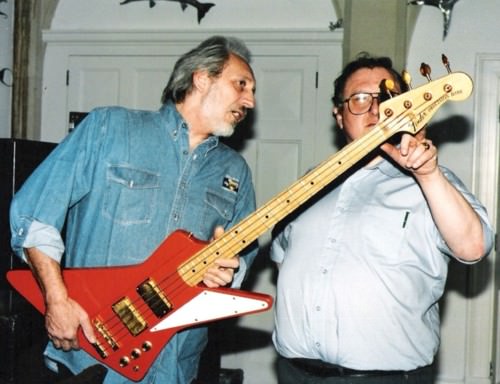
The original Thunderbird bridge didn't work mainly because Gibson put it in the wrong place. Peter Cook and John Entwistle corrected that on their Fenderbirds/ExplorerBirds using John's stash of Thunderbird parts.

RZJsVnJ.jpg


KWIzUht.jpg


6Q0hXQ9.jpg


Scott's Badbird compensates for Gibson's mistake. "Intonation Without Modification" as he puts it. Brilliant solution.
 
I have a kill switch on a couple of basses and like having it. Does it get used much? Not really, but it gets used as much as the tone control that it replaced in the circuit (which was just always set full on). Personally I would never use a toggle if I had it installed because I tend to blend the pickups (usually more neck than bridge) and in fact, the toggle on the bass that has one is removed from the circuit. I would prefer to have a dummy switch in place rather than an open hole on the face of the instrument tho. I'm a bit shallow when it comes to things like that.

On my JBS, I have used the toggle like a kill switch. Roll off the J pickup completely and then flip to that position.

If I understood what I read on here s gazillion pages back, when a pickup is taken out of a circuit the result is ‘better*’ than it is just turned down to zero.

Is that the case when a switch is used to default to the other pickup ?

* better is not a definitive description I know. Perhaps ’stronger’ or ‘louder’ is a better description?
 
If I understood what I read on here s gazillion pages back, when a pickup is taken out of a circuit the result is ‘better*’ than it is just turned down to zero.

Is that the case when a switch is used to default to the other pickup ?

* better is not a definitive description I know. Perhaps ’stronger’ or ‘louder’ is a better description?
Hmm. Good question. Perhaps your fellow Ozzie Kat could shed light on that.