Amen!!Indeed.
This means a lot of "adults" are really still children in big bodies, as far as reasoning goes....

TalkBass has been independent since 1998. Add your voice.
Create a free account to reply to discussions, view embedded media, and browse with fewer display ads.
Join free Log in
Want zero display ads or expanded classifieds tools? Compare plans.
Amen!!Indeed.
This means a lot of "adults" are really still children in big bodies, as far as reasoning goes....
OSHA approved?

OSHA approved?
Right?! They’ve created a bunch of solutions looking for problems
The voice of experience?
 Badminton is a far away memory at this point - I don't think I've ever played it as an adult.
Neo-X 212...that’s it! I used to be a Genz endorser. They hooked me up with a couple amps and two cabs. The Uber 212, which was...ok, but not great, and an Uber 410. Wishing I would’ve gotten either 2 Uber 410’s, or probably better still, two Neo-X 212’s. Jeff Genzler is a really cool dude though. His head designer at the time now works for Mesa, who I’m an endorsing artist for now.
Indeed.
This means a lot of "adults" are really still children in big bodies, as far as reasoning goes....

Something that has been rattling around in my head
No Kat, not the two marbles...
Everyone seems to be so hot on high pass/low pass filters and parametric EQs. Why not a 10 band graphic EQ if you know the frequencies where you have issues? IIRC, the MXR one the sliders are all Bs and the Whirlwind one is all Es (which kind of makes it easy because you can play those notes...).

Unfortunately there’s always a risk that if the app doesn’t get updated, it might not work with a future iOS update.This is exactly why I was looking for a NON PC based stand alone recording method. I've been burned too many times in the past with computer crashes, glitches, brain dead work arounds, non intuitive commands and forced operating system upgrades that impact the operation or performance of the recording program being run.
I'm still looking, but it's gotta be dead stand alone and non PC based. If I can record direct to it with several different instrument inputs and then be able to edit it and save the final recording into a file format like sound cloud that can be shared here or elsewhere it would be perfect.
This is about as promising as anything I've found so far but I think it still runs off an app on the phone or iPad which isn't ideal...
View attachment 3569417

Then you need another computer for transferring files on and off the net, and a quick way to transfer files between your two computers, and dammit now you need a KVM switch so you don’t have multiple keyboards and mice to deal with....At the risk of offering a luddite solution to a computer problem...
For an important function, where everything is working, leave it alone, turn off automagic updating, and unplug it from the internet. Then your stable working platform will remain a stable working platform. Of course, if you want to use that machine for other things, the solution doesn't work as well.

I used to do upright/BG gigs with a PF350. No HPF necessary.For years I kept a 31 band graphic eq in my rack. Still have a couple laying around. I had a 10 band for fly dates. The problem with a 10 band (for me on upright gigs) is the Q is too wide to really dial things in. I wouldn’t fuss with parametric eq on electric bass, but find it pretty crucial on upright. HPF/LPF filters are a no brainer, especially on tube amps, IMO.
The HPFs have a much more drastic slope to the filter than most EQs.Something that has been rattling around in my head
No Kat, not the two marbles...
Everyone seems to be so hot on high pass/low pass filters and parametric EQs. Why not a 10 band graphic EQ if you know the frequencies where you have issues? IIRC, the MXR one the sliders are all Bs and the Whirlwind one is all Es (which kind of makes it easy because you can play those notes...).
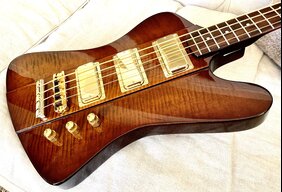
Our road manager bought one and has used it on us...for me, there’s a reason it’s so inexpensive and yes, you need an app :/
At the risk of offering a luddite solution to a computer problem...
For an important function, where everything is working, leave it alone, turn off automagic updating, and unplug it from the internet. Then your stable working platform will remain a stable working platform. Of course, if you want to use that machine for other things, the solution doesn't work as well.
You get what you pay for? When did that become a thing?
2 input interfaces are relatively cheap - less than C$150. that gets the instruments into the computer cost effectively. But, then you deal with all computer things with updates and so on, thus my recommendation of turning off automagic updates and unplugging from the internet.
Unfortunately there’s always a risk that if the app doesn’t get updated, it might not work with a future iOS update.
Then you need another computer for transferring files on and off the net, and a quick way to transfer files between your two computers, and dammit now you need a KVM switch so you don’t have multiple keyboards and mice to deal with....
Sometimes "new and improved" really isn't.Ok, that pretty much settles it then. I'll just stick to using my Tascam 8 channel 4 track cassette recording console to capture the instruments and then play each track back thru Garage Band to edit cut and splice and save in a sound cloud format. Not what I wanted to do but it sounds like nobody makes a stand alone recording/mixing station with full editing of individual tracks and file storage capability. I gotta believe there is something out there but I'm just not seeing it.

Yes, power is an issue. The power going through a tube is primarily a function of the plate voltage. The number of milliamps you can push through a tube is generally a function of the physical size of the plate so voltage is the parameter you can push for more power.
If Memory serves (and it might not) rated plate dissipation for an EL84 is about 10W. If you push voltage up you can get more, but at the expense of tube life. Again, from memory, rated plate voltage is about 300V, but if you push to 400V you can get greater power. I think most power amps are push pull because it is a cost effective.
Tubes are far more fault tolerant than solid state. Whereas if you run a tube over spec, it will reduce service life. Run a transistor over of spec and you release the magic smoke. That doesn't mean you should abuse your tubes, but it is an option.

View attachment 3569715
manufacturers were very conservative with specmanship...i've read that in reality EL-84s could dissipate up to 17 Watt..
Sometimes "new and improved" really isn't.

...IIRC, the MXR one the sliders are all Bs and the Whirlwind one is all Es (which kind of makes it easy because you can play those notes...).

Could be- if you do everything right. They spec’d the tubes to do their jobs well (e.g., produce clean audio) and to last and last. I built a single EL84 guitar amp running almost 7w output, 14-15 watts dissipated. Some tubes will last a long time in it, others not so much. But a Kalamazoo Model One at 5W? Just about any brand lasted for years. The CMI rebranded Mullards lasted for decades.View attachment 3569715
manufacturers were very conservative with specmanship...i've read that in reality EL-84s could dissipate up to 17 Watt..


