Yup. They meet in mid-air like hands clapping.That's the equal but opposite reaction when the bridge inserts fly out. Kind of like having explosive diarrhea and vomiting at the same time.


TalkBass has been independent since 1998. Add your voice.
Create a free account to reply to discussions, view embedded media, and browse with fewer display ads.
Join free Log in
Want zero display ads or expanded classifieds tools? Compare plans.
Yup. They meet in mid-air like hands clapping.That's the equal but opposite reaction when the bridge inserts fly out. Kind of like having explosive diarrhea and vomiting at the same time.

Sure he does. That was a photo of one!Well another one of your posts/pics that can't be unseen.You most certainly seem to have an exceptional proficiency in this area. You sir, have no peers.

Yup. They meet in mid-air like hands clapping.
Thankfully, my 67 NR has a 2 piece.Or on your head, one slapping each side of your face for violating the first rule of Gibson/Epiphone Three Point Bridge Setup Club.

Yup. They meet in mid-air like hands clapping.
Or on your head, one slapping each side of your face for violating the first rule of Gibson/Epiphone Three Point Bridge Setup Club.
Lol, sorry, j/k... I've been thinking about this hpf business, am squirreling away bread for such a pedal. But I'm always looking for a way to cheap out!easy. PM me.

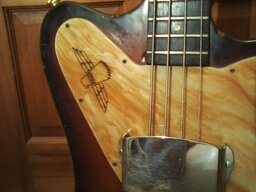
I think it's an EB-3 with an EB-0 TRC. 2 holes for pups but also too many holes in the body, including one for the 4* position switch by the PG. edit-through the PG.
* the older ones had 4 positions-which I never did figure out-like my 66. My 00's Epi had a 3 position switch: neck, both, bridge.
Addendum: 1-neck, 2-bridge, 3-?, 4-??


Don't ask PillO. I didn't like doing vector math when I learned it and that never changed. And, probably not coincidentally, I haven't done it in years. Surely we have a mechanical engineer around here who would be happy to do that math. An electrical engineer could probably do it too. Maybe even a civil engineer.For an equilibrium condition, the forces have to zero out. The short ends are consequential in that regard. The vertical forces have to add to zero, which means that the break angle isn't an issue as far as the inserts pulling out. It's a moment arm. The downward force on the front insert has to be equal to the upward force on the rear inserts. The break angle has more to do with string behavior than whether the inserts pull out. All things being equal, of course. And of course, they have to be. It's euclidean physics. Ask PillO. I'm sure he will tell you.
I'll post some pictures later in the day. Without watermelons.@PillO -- how does the Hipshot sit on the Casady? Do you have any photos? (with or without melons, either is good)
I'll post some pictures later in the day. Without watermelons.


Well I never said that I did well in physicsIncreasing the angle across the bridge increases the force pulling the rear posts up.
 I did read SOMEWHERE that you were supposed to keep the front post a bit higher than the 2 rear posts to keep them from pulling out.
What would Einstein do in this STRESSFUL situation?Giving this a little more thought (far more than it deserves), I think my mental back of the envelope calculations were too simplistic. I failed to account for the fulcrum at the front bolt. I was thinking only of the string break over the saddles. To better analyze the dynamics, I think I need to draw a diagram (and I am not going to do that). But I will say that the quick and dirty mental math I did is probably close to reality; close enough for the discussions here.
Any mechanical engineers here can put their degree(s) to some use and do the actual calculations. Because what else are you going to do? Practice?

My 3 favorites to play are A Day in the Life, The End and Something. Why don't you enjoy playing Beatles tunes might I ask?That song is a whole lot of fun to play. And I don't even like playing Beatles songs all that much for the most part.

Re-tie his shoes?What would Einstein do in this STRESSFUL situation?
Since he's a long-timeRe-tie his shoes?
 , prolly nothing.
My 3 favorites to play are A Day in the Life, The End and Something. Why don't you enjoy playing Beatles tunes might I ask?
Don't ask PillO. I didn't like doing vector math when I learned it and that never changed. And, probably not coincidentally, I haven't done it in years. Surely we have a mechanical engineer around here who would be happy to do that math. An electrical engineer could probably do it too. Maybe even a civil engineer.
What would Einstein have done?What would Einstein do in this STRESSFUL situation?