
Increasing the angle across the bridge increases the force pulling the rear posts up.Keeping the front post a bit higher also gives you a better break angle. Just saying.

TalkBass has been independent since 1998. Add your voice.
Create a free account to reply to discussions, view embedded media, and browse with fewer display ads.
Join free Log in
Want zero display ads or expanded classifieds tools? Compare plans.
Increasing the angle across the bridge increases the force pulling the rear posts up.Keeping the front post a bit higher also gives you a better break angle. Just saying.
Keep in mind that the inserts are friction inserts. The only thing holding them in place is the degree of bond they have with the wood body. Anything you do to weaken that bond increases the likelihood of the insert pulling out. You do not need to pull the insert out an inch to cause the bond to fail, you just need to break the bond. Once the bond is broken the bridge failure is set in motion and may go very quick or very slow.if I understand your post correctly; an increasing force B will augment force C enough to pull out the (over 1" long) inserts from the body if dimension A is shortened?....I think the neck will warp before that..
View attachment 3634183
Keeping the front post a bit higher also gives you a better break angle. Just saying.
 This is the number one reason to do it, everything else you gain is just added benefits.


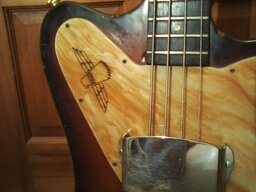
Gots to see that EB-0 when it's done.....someone obviously disliked my testing of the new Lollar pickups for my Precibird...
View attachment 3634621
...maybe I took the wrong decision to order the split coil overwound preci pups instead of a pair of thunderbird pickups, but I ordered this one instead for the same price (always wanted a slothead...)
View attachment 3634624

Well another one of your posts/pics that can't be unseen.There are no pictures of sheep with watermelon helmets. Maybe this will help?
View attachment 3634001
 You most certainly seem to have an exceptional proficiency in this area. You sir, have no peers.
isn’t it an EB-3?Gots to see that EB-0 when it's done.
Giving this a little more thought (far more than it deserves), I think my mental back of the envelope calculations were too simplistic. I failed to account for the fulcrum at the front bolt. I was thinking only of the string break over the saddles. To better analyze the dynamics, I think I need to draw a diagram (and I am not going to do that). But I will say that the quick and dirty mental math I did is probably close to reality; close enough for the discussions here.Ok, I did a little back of the envelope vector math. With a total pull on the strings around 100lbs and a break angle of about 15°, it is a pull around 25lbs on the two posts (12 lbs each). But I did all this in my head without looking up any data. And it has been many years since I did any vector math, so be suspicious.
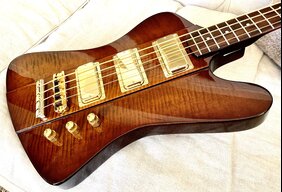
why are you looking to add ring/s?Is the center block on a 2013 Thunderbird the same width as a 60s or 70s? I'm looking into having pickup rings made and since none seem to exist off the shelf for a 2013, I need measurements. Chucky kindly got me them for the pickups themselves, but I need to know that they wouldn't go past the edges of the center block. I've seen ones that say 3-15/16" (100mm).
Edit: I measured 4-1/16" wide.
Cause if you liked it, you should have put a ring on it?why are you looking to add ring/s?

Because I think it looks more complete. Purely cosmetic.why are you looking to add ring/s?
Looking at the holes in the body, prolly. TRC says EB-0.isn’t it an EB-3?
my bad then, thought 0s were single and 3s were dual pickupLooking at the holes in the body, prolly. TRC says EB-0.
on the neck pup (NR?) over the pg as well?Because I think it looks more complete. Purely cosmetic.
take it you got your Christmas shopping done?...Cause if you liked it, you should have put a ring on it?
No, regular reverse Thunderbird.on the neck pup (NR?) over the pg as well?

Looking at the holes in the body, prolly. TRC says EB-0.
the measurements were from a 2013 NR....same pups i’m hoping......the body (including tuners) seems to be an EB-0 with additional routings for a bridge pickup....will keep you informed....
I'd bet on it that they're the same. I'd be really surprised if Gibson changed the pickups between the two, especially from the same year.the measurements were from a 2013 NR....same pups i’m hoping..


