• TalkBass has been independent since 1998. Add your voice.
    Create a free account to reply to discussions, view embedded media, and browse with fewer display ads.
    Join freeLog in
    Want zero display ads or expanded classifieds tools? Compare plans.

Thunderbird Club

I mean, visually I get it, it's not terribly attractive. But it will help quiet your house. In this era of hardwood floors everywhere and other hard surfaces, it never ceases to amaze me how often they follow that with "It's kind of loud in here". Yeah, you removed all the sound absorbing stuff and added 3 kids under 8 years old, what did you expect?
:roflmao:. They've watched too many "House Hunters" and think they are informed.:rolleyes:
 
I mean, visually I get it, it's not terribly attractive. But it will help quiet your house. In this era of hardwood floors everywhere and other hard surfaces, it never ceases to amaze me how often they follow that with "It's kind of loud in here". Yeah, you removed all the sound absorbing stuff and added 3 kids under 8 years old, what did you expect?
I just did a fair bit of sound treatment in my music room: Ten 2x4 panels on the ceiling and two on the walls, a weighted blanket over the window, and a shag rug on the wood floor. The stairs up to the room have no door (and no good way to add one), so I put grommets in a doubled up moving blanket and piece of upholstery fabric, to hang in the opening. That blocks most of the household noise.

What a difference! I wish I would have done this years ago.
 
Cover it in whoopie cushions!
I have even bumped my head on the ceiling jumping up and down while playing. Our singer will never let me forget it. She thought it was hilarious. I had drunk ginger ale and was all sugared up. Note to self - sugar is also a dangerous substance.
 
I have even bumped my head on the ceiling jumping up and down while playing. Our singer will never let me forget it. She thought it was hilarious. I had drunk ginger ale and was all sugared up. Note to self - sugar is also a dangerous substance.

We need video. Does your singer have any? :)
 
The stairs up to the room have no door (and no good way to add one), so I put grommets in a doubled up moving blanket and piece of upholstery fabric, to hang in the opening. That blocks most of the household noise.

But - as I'm sure everyone here knows - sound going down a hallway or stairway, into the house, and back, is one of the sweetest effects.
I fooled myself for a long, long time, wrongly crediting the above to my amp circuit, before I realized what was happening. Feel really dumb for that.
 
I just did a fair bit of sound treatment in my music room: Ten 2x4 panels on the ceiling and two on the walls, a weighted blanket over the window, and a shag rug on the wood floor. The stairs up to the room have no door (and no good way to add one), so I put grommets in a doubled up moving blanket and piece of upholstery fabric, to hang in the opening. That blocks most of the household noise.

What a difference! I wish I would have done this years ago.

If I ever get a dedicated music room, it will definitely have some drapes and/or blankets on the walls, some panels on the ceiling, and possibly a diffuser. Carpet has to go, but there's be a thick rug or three in the middle. meanwhile, the book cases and stuff stored in the RoR help. And the ceiling and carpet, of course.
 
But - as I'm sure everyone here knows - sound going down a hallway or stairway, into the house, and back, is one of the sweetest effects.
I fooled myself for a long, long time, wrongly crediting the above to my amp circuit, before I realized what was happening. Feel really dumb for that.

Nah. Most of us have to figure it out ourselves, unless someone points it out. So you probably just provided shortcuts to at least a couple of people.

Every now and then, I do like to put the amp at the end of our longest hallway and wail away.
 
But - as I'm sure everyone here knows - sound going down a hallway or stairway, into the house, and back, is one of the sweetest effects.
I fooled myself for a long, long time, wrongly crediting the above to my amp circuit, before I realized what was happening. Feel really dumb for that.
LOL - I have a reverb pedal for that "Hall effect" I use for guitars. Never tried it on bass.
:cautious:Next time wifeypoo is out I know what I'm doing.:rolleyes:
 
But - as I'm sure everyone here knows - sound going down a hallway or stairway, into the house, and back, is one of the sweetest effects.
I fooled myself for a long, long time, wrongly crediting the above to my amp circuit, before I realized what was happening. Feel really dumb for that.
My stairway isn’t long enough to create any good reverb
 
Even now, a couple of times, while working on my amp circuit again (now 30+ years later, and now a bass circuit), and while trying to get the cleanest low E from a 2x6L6 amp, I have said to myself "Wow, that is the best low E yet!", before remembering to correct for this effect.

[P.S. Did get a clean 40Hz by wiring the output tubes as triodes (usually a hi-fi idea), but it only makes 20 watts.]
 
Oh yeah, it was a guitar amp at that time, not bass.
It sweetens bass too, but I guess one needs a bigger house, which isn't all bad as then one would have room for more Thunderbirds, en passant. :)

I learned this on trombone, then on guitar. Works for percussion, too!
 
But - as I'm sure everyone here knows - sound going down a hallway or stairway, into the house, and back, is one of the sweetest effects.
I fooled myself for a long, long time, wrongly crediting the above to my amp circuit, before I realized what was happening. Feel really dumb for that.
More reverb just means play louder. More volume makes me play more gooder too.
 
I just did a fair bit of sound treatment in my music room: Ten 2x4 panels on the ceiling and two on the walls, a weighted blanket over the window, and a shag rug on the wood floor. The stairs up to the room have no door (and no good way to add one), so I put grommets in a doubled up moving blanket and piece of upholstery fabric, to hang in the opening. That blocks most of the household noise.

What a difference! I wish I would have done this years ago.

a shag rug? How delightfully 70’s
 
I have even bumped my head on the ceiling jumping up and down while playing. Our singer will never let me forget it. She thought it was hilarious. I had drunk ginger ale and was all sugared up. Note to self - sugar is also a dangerous substance.
Footage from the basement of bad ideas?
Dolph-ziggler-hits-sandow-with-guitar.gif

2mesohv_medium.gif
 
I have to say that I am really surprised how active the TB scene is in this forum ! I was blown away when I saw 7000+ sides of this thread. TB's are not very common over here, at least you never see them live. After I know how good they sound I can't tell why they seem to be so "unpopular" ? Only because of the handling? Or is the optics too much for the average bassplayer?

....you can see them live over there....(if you want to)

ADC078F9-78B1-4798-B1FA-DA8C75D44724.jpeg
 
So, when did Epiphone start making Thunderbirds? Poking around the net, I found one reverse claiming to be from 1993, several NRs claiming to be from 94-97, and steady references to reverses from 1998 on. But these were generally for sale, and oft didn't show serial numbers. Does anyone have a definitive reference? Does Geddy mention it?
 
Your measurement conversion looks about right, sorry I didn't do it in metric, I keep forgetting most of the world operates that way.

The "pin" that the bridge screw threads into is called an "insert". I thought yours looked like it may be a bit high until I looked closely at mine, it's about the same. The difference is that I don't have the bridge bolt screwed in far enough for the bolt shoulder to contact the insert.

Here's what mine looks like on the G string side...
View attachment 3738993

There's a very helpful "how to" guide on setting up the action of a Thunderbird. It was written for the three point bridge but it should work the same for the VP two point bridge (from a set up standpoint the big difference between the two is the saddles on the two point are not removable). @Nocturnal keeps a copy of it handy IIRC, he can post it here. It's pretty easy to do yourself, but you could always take the instructions to your luthier to see if it helps.

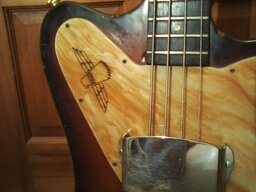
Ask and you shall receive. My usual disclaimer; I didn't write this so I don't take credit or blame for it.


1. Screw down the bridge evenly over all three screws till you have an action around the 15th and higher frets that is comfortable for you without any or too much buzz (some players don't mind a little buzz or even like it, that is a matter of taste). Keep the front stud a little higher for best string to saddle pressure. Retune the bass, don't worry about buzzing in the lower registers at this point.

2. Now you've got your bass retuned with a lower action at the high frets. Your lower frets will now either buzz (see 2a for the subsequent steps) or the action will still be too high even in the low registers (see 2b for the subsequent steps).

2a: Low Register buzzes: You need to loosen the truss rod. Take off the truss rod cover and insert an allen wrench in the allen nut (the cheaper Epis generally have allen nuts). Don't detune the bass for that, rather lift the A and the D string to the side to the slots of the G and E string to have room for turning the allen wrench. With the bass' butt resting on your toes (clean those sneakers!) and the strings/fretboard facing away from you, you - while standing up and looking down - will now turn the allen wrench <--- counterclockwise <---. Epi truss rods move easily (if noisily), turn it and immediately look to find out how the action of the bass has altered and buzzing has become less or disappeared. Don't be scared of overdoing it - it is impossible to break a truss rod by loosening it as you are releasing tension. That said, one or two "one third turns" counterclockwise should do it. sometimes you will need a few more of those to actually adjust the bass if the neck is too straight or even curved away from the fretboard.

2 b: Low Register has too much action: Same as 2a, except that you have too tighten the truss rod now which is done by turning the allen wrench ---> clockwise --->. You will also have to be more careful as you can break a trussrod by overtightening it. But Epi truss rods are hardy and can certainly survive one full turn or even more as your bass is probably a virgin as regards truss rod adjustment.

3. After a combination of either steps 1 and 2a or steps 1 and 2 b you should have a relatively or even totally buzz free bass with good to reasonable action. If there is still some persistent buzzing at some places then raise the bridge a little. Raising the front stud will raise all strings, raising the lower hind stud more the D and G string, raising the upper hind stud more E and A. No radical set ups please! (Like one stud real low and the other two very high.)

4. (optional) Is all buzzing just on one string (while the other strings are buzz-free) and you have to raise the bridge considerably to make it go away even though you could stay much lower if it were just for the other strings? Try this then: I assume that on your Epi too the saddles for the four individual strings do not all have the same height, but that there are two higher and two lower ones. If the persistently buzzing string is on a lower saddle, then exchange that saddle against a higher saddle.