• TalkBass has been independent since 1998. Add your voice.
    Create a free account to reply to discussions, view embedded media, and browse with fewer display ads.
    Join freeLog in
    Want zero display ads or expanded classifieds tools? Compare plans.

Thunderbird Club

Never would do that!

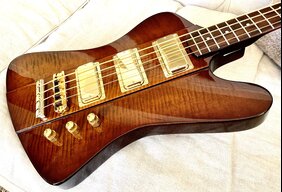
There is nothing wrong with Epis. And it’s not like I want anyone to think it was this when it wasn’t. This is the general idea, but I’m not going to do covers or a tug bar.
View attachment 3850317
Even with the color, I'm not convince that putting a Thunderbird right next to a pool like that is a good idea.
 
Each PU sounds what I would think would be normal individually. Neck sounds pretty good by itself. Bu no, it's not new, it's an '06. Just new to me, so I know, but assume it's always sounded that way. Sounds ok at home, but in a live setting it just seems to have highs and lows and a little nasal honk on the D and G, otherwise becomes a bass blur. Sounds more like a Jazz in some ways than a Thunderbird. At least any I own.
There must be something miswired somewhere. Maybe a bad pot, bad switch, something. It shouldn't sound like that at all.
 
You've got to hurry on this. I can't wait to see the finished project. Have you got the paint ordered yet?:)

I was interested in the bass you posted a pic of, but is was in the guys personal collection. He ended up selling it to some guy in Canada. Geddy something or other. I think the PB on yours will be the envy of us all, and will look way better than that old faded thing that Canadian ended up with.

View attachment 3850514
Those Canadians! Always willing to settle for second hand...
 
I'll save you some effort and take a snapshot of my birds control cavity. You can then see if the wires going to each volume pot are the same as yours.

To help clarify things - there's no need to flip any wires at the Pickup end of the circuit. With your pups in your bass just flip it over and remove the control cavity cover. You'll see the wiring coming into the cavity from each Pickup. Each pup wire will have a woven mesh outer cover and an single wire soldered to your volume pots. The woven mesh outer cover is the shield wire. The single wire is the hot wire.

If your two wires (shield and hot) from each pup are not soldered on to each pot exactly like mine you'll have a phase issue. If your wires are in fact soldered like mine you most likely don't have a phase issue, unless the goofballs at Gibson screwed up the windings/shield wires on the pup before they set it in epoxy, which I highly doubt.

To correct a phase issue you'll need to desolder the woven mesh wire and the hot wire from one volume pot then resolder those two wires back to that same pot putting the hot wire where the mesh wire was and the mesh where the hot was. Good news is, I'd bet money that's not your problem.

Control cavity pic coming up...
it could be, as you say, that the pickup was wired wrong (internally) at the factory. then there's the possibility that this is not possible due to the way they are constructed and (parts) delivered to Gibson....it could also be that there may not be a polarity issue at all and the pickup is plain miswired to the wrong place. Pics would really help. Thx!!
 
yes, basically swap the connection points. You'll need a pretty beefy iron. If not, you could try and connect temporarily with alligator clips just to identify the issue. You could also compare the wiring (before doing anything) to that of another T-Bird.
If the pickup is wired backwards, comparing the wiring won't tell you anything. But, if the controls are screwed up, it will. Just so that's clear.
 
Thanks. My iron is as cheap as they come, unfortunately. Only needed one a time or two. This one is one of the modern black pickups and is pretty different from everything else I have. I haven't looked at the back side of the VP PUs. I assumed that they were metal on the back like the old ones. This black modern PU will have all that black epoxy and I am still uncertain as to what I'm supposed to disconnect and reconnect elsewhere since it seems to be epoxied in and any place else I could connect also has the black epoxy everywhere. Sorry, I'm just very ignorant about this. Never needed to be any more knowledgeable than I am until now! Maybe tonight I can pull one and stare at it as if I know what I'm looking for!

I'll save you some effort and take a snapshot of my birds control cavity. You can then see if the wires going to each volume pot are the same as yours.

To help clarify things - there's no need to flip any wires at the Pickup end of the circuit. With your pups in your bass just flip it over and remove the control cavity cover. You'll see the wiring coming into the cavity from each Pickup. Each pup wire will have a woven mesh outer cover and an single wire soldered to your volume pots. The woven mesh outer cover is the shield wire. The single wire is the hot wire.

If your two wires (shield and hot) from each pup are not soldered on to each pot exactly like mine you'll have a phase issue. If your wires are in fact soldered like mine you most likely don't have a phase issue, unless the goofballs at Gibson screwed up the windings/shield wires on the pup before they set it in epoxy, which I highly doubt.

To correct a phase issue you'll need to desolder the woven mesh wire and the hot wire from one volume pot then resolder those two wires back to that same pot putting the hot wire where the mesh wire was and the mesh where the hot was. Good news is, I'd bet money that's not your problem.

Control cavity pic coming up...

....So here's the control cavity pic
IMG_4088.JPG


Note that in each case the shield wire (wire mesh) is soldered to the back of the corresponding volume pot and the single core wire (hot) is soldered to the center lug of the corresponding volume pot.

Note to self - that that's the cheapest a$$ cap I've ever seen in any bass! I'm shocked that this bass sounds so good with that pathetic excuse for a capacitor. Anybody know the value of these caps (no guessing) I might have a spare orange drop or oil cap I can replace it with.
 
Are their prime years for thunderbirds from 80s on? I knew as a guitar player Gibson was hot with their guitars from like 86 or something to miss 90s. Would this apply to thunderbird basses too?
Somebody probably already replied, but that's OK. I get to talk about Thunderbirds.

I have a 2001 that's just magic. It's somehow different from the 1991 and 2015 Gibsons that I also have. If I were going to look for one, it would be right around that range. As I recall, the earliest reissue Gibson Thunderbirds were built in 1989. I think there were a few prototypes earlier than that, but none that were released into the wild on an official basis. They are all similar and sound similar, although the pickup design has varied over the years. Sometime in the late zeros, the neck angle changed a bit, and the fingerboard changed from ebony to rosewood. I can't tell you the exact timing of that one. The only really different ones were built in 2015, with DiCola pickups and coil taps.

I don't think you can go wrong with any age of Thunderbird. So far as I know, there aren't any bad years. Just the occasional spectacular bass guitar among a whole lot of very good ones. A few might have had issues, but I can't say what those might be since I haven't had any issues to speak of.

Unless you have the money and can skip it all and go for a 1960s Thunderbird. Problem solved! Except you will have to compete with Scott and Geddy for those.
 
....So here's the control cavity pic
View attachment 3851158

Note that in each case the shield wire (wire mesh) is soldered to the back of the corresponding volume pot and the single core wire (hot) is soldered to the center lug of the corresponding volume pot.

Note to self - that that's the cheapest a$$ cap I've ever seen in any bass! I'm shocked that this bass sounds so good with that pathetic excuse for a capacitor. Anybody know the value of these caps (no guessing) I might have a spare orange drop or oil cap I can replace it with.

If it ain't broke, don't fix it!
 
....So here's the control cavity pic
View attachment 3851158

Note that in each case the shield wire (wire mesh) is soldered to the back of the corresponding volume pot and the single core wire (hot) is soldered to the center lug of the corresponding volume pot.

Note to self - that that's the cheapest a$$ cap I've ever seen in any bass! I'm shocked that this bass sounds so good with that pathetic excuse for a capacitor. Anybody know the value of these caps (no guessing) I might have a spare orange drop or oil cap I can replace it with.
Nothing wrong with that cap...the value may be printed on the other side.
 
If it ain't broke, don't fix it!
Lotta truth in that!

Nothing wrong with that cap...the value may be printed on the other side.
LOL - I'd need a microscope to read writing small enough to fit on that cap. No joking, it's about half the size of a match head. I guess the real question is, would you use that cap in a bass you built if you had an orange drop or other higher end cap laying around? I wouldn't. But as Gaolee wisely notes - if it ain't broke, don't fix it.
 
Lotta truth in that!


LOL - I'd need a microscope to read writing small enough to fit on that cap. No joking, it's about half the size of a match head. I guess the real question is, would you use that cap in a bass you built if you had an orange drop or other higher end cap laying around? I wouldn't. But as Gaolee wisely notes - if it ain't broke, don't fix it.
The fact a cap looks ‘nicer’ doesn’t make it better electrically. Oil filled caps are of the dielectric type and used when high voltage decoupling or signal coupling is required in amps. In a bass they would be like a 400 dollar set of Monster ac power cables used into an outlet that has 60 year old wiring on the wall side....all that’s really needed in a passive bass is a decent ceramic cap....even ESR (effective series resistance) equating to loss is negligible taking into account the high impedances in a T-Bird where pups can be as high as 9kOhm and pots range between 250 and 500k...it’s all about ratios..
 
I'll save you some effort and take a snapshot of my birds control cavity. You can then see if the wires going to each volume pot are the same as yours.

To help clarify things - there's no need to flip any wires at the Pickup end of the circuit. With your pups in your bass just flip it over and remove the control cavity cover. You'll see the wiring coming into the cavity from each Pickup. Each pup wire will have a woven mesh outer cover and an single wire soldered to your volume pots. The woven mesh outer cover is the shield wire. The single wire is the hot wire.

If your two wires (shield and hot) from each pup are not soldered on to each pot exactly like mine you'll have a phase issue. If your wires are in fact soldered like mine you most likely don't have a phase issue, unless the goofballs at Gibson screwed up the windings/shield wires on the pup before they set it in epoxy, which I highly doubt.

To correct a phase issue you'll need to desolder the woven mesh wire and the hot wire from one volume pot then resolder those two wires back to that same pot putting the hot wire where the mesh wire was and the mesh where the hot was. Good news is, I'd bet money that's not your problem.

Control cavity pic coming up...
Thank you very much for the insight! Very much appreciated.