• TalkBass has been independent since 1998. Add your voice.
    Create a free account to reply to discussions, view embedded media, and browse with fewer display ads.
    Join freeLog in
    Want zero display ads or expanded classifieds tools? Compare plans.

Thunderbird Club

Still means they want to move it on as the carrying cost just keeps mounting as it sits unsold.
Not really. It is paid for and the cost was minimal. It takes up only a bit of space. Nobody has to move it, and if they do, it is not an added cost. So when you think of a smaller item like any kind of guitar, they can sit on it forever unless they have way too many guitars coming in all the time.
 
:thumbsup: Yes, true and amen!

And worth noting, both the RW series and the VP are basses that many people bad mouth - T-birds in general, and a "fake" RW finish. So much for opinions. A player of either will "get it" and that's what's important.
 
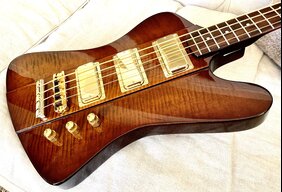
Making nice progress!
Something I forgot to mention when you set your bridge anchors, hopefully you also installed your grounding wire. As thorough as you are you probably already did that but just thought I'd mention it because it's something an anal fool like me once forgot to do.

I did remember! A brand new one :thumbsup:

Thanks for mentioning it! sometimes I can be too thorough, and forget something small/simple, thinking i had done it already! :rollno:
 
Not really. It is paid for and the cost was minimal. It takes up only a bit of space. Nobody has to move it, and if they do, it is not an added cost. So when you think of a smaller item like any kind of guitar, they can sit on it forever unless they have way too many guitars coming in all the time.
But it is cash tied up. Cash that could be used on more productive ventures. Like buying old gold jewelry for 60% of it's melt value.
 
But it is cash tied up. Cash that could be used on more productive ventures. Like buying old gold jewelry for 60% of it's melt value.
Probably not much cash, and they may not have the other opportunities that would compel them to lower the price. And maybe they don't care and are not paying that much attention. There was a battered EB-0 in a pawn shop window around here, and it was there forever. They wanted $1200 or $1600 or so. I do not remember exactly. It was vintage but well used and I figured it was worth about half what they were asking. So it collected dust for several years. It is gone now, so I guess somebody may have made them an offer they liked. I doubt it was the asking price.
 
Probably not much cash, and they may not have the other opportunities that would compel them to lower the price. And maybe they don't care and are not paying that much attention. There was a battered EB-0 in a pawn shop window around here, and it was there forever. They wanted $1200 or $1600 or so. I do not remember exactly. It was vintage but well used and I figured it was worth about half what they were asking. So it collected dust for several years. It is gone now, so I guess somebody may have made them an offer they liked. I doubt it was the asking price.

I suspect that may be the case. There are plenty of small businesses out there making poor decisions.
 
I had a friend who was in the pawn shop business for a while. I asked him if individuals buying or selling instruments from/to a pawn shop was a smart move. His sage advice...

Selling:
If you have a guitar worth $1000 minimum on the used market, Guitar Center will offer you $600 maximum and won't haggle much on price. That same guitar taken to a pawn shop will have a $100 opening offer from the shop, they will haggle but at best will only go up to about 50% of what Guitar Center would give you.

They're logic is, if you really wanted the $1000 you'd sell it yourself; if you didn't want to hassle with advertising and tire kickers and shipping then you'd just take it to Guitar Center; and if you're bringing it to them they assume you're either too stupid to know what it's worth, or too concerned about what Guitar Center might see wrong with it, or you're in need of quick no questions asked cash. Net, don't sell a bass to a pawn shop unless you fit the fool, or the worried, or need fast money without questions category.

They assume once you walk in the door with that guitar it's staying there, or you wouldn't have walked in with it in the first place. Hence the 10% starting offer with heming and hawing as needed to fill space on the wall. If they have room for ten guitars and they already have 15 in stock, they're gonna stick pretty close to their opening bid, if they only have two on the wall you might get them up to $300.

Buying:
Pawn shops can be an occasional source of hidden treasures, but the vast majority of of the time that's not the case, most pawn shops are fairly good at determining the street value of a guitar. Where you find the gems is when there is a specific model year that might be a sleeper or a country of origin that might make a difference or possibly some after market modifications that aren't obvious but add value. Net, know exactly what you're looking for and how to spot value added features that aren't obvious (i.e. an Epiphone VP with lull pickups).

They assume anyone walking in their door is willing to haggle on price. So that same guitar that they paid between $100 and $300 for that has a minimum value on the used market of $1000 is going to be priced at its maximum used street value of let's say $1500 regardless of its condition. That gives them tons of haggle room and also room for discount tags to be hung on it occasionally. Yes, they will come down in price or even mark it down if they want to move it but not a whole lot unless they need the space for something else. They typically target a rock bottom sale price at 75% of the minimum street value, in this case $750 rock bottom.

As far as inventory is concerned it's a double edged sword. Pre Internet, they wanted things in the shop that created a draw since they really didn't advertise much beyond their store front. Now with eBay, Craigslist, reverb and other on line outlets they expect to have a much more rapid turn over but still need to keep some stuff in stock in the store for walk in customers, which is still a good portion of their business. The shops that are doing well have a normal size store front but somewhat less floor space than years ago, and now have a lot more storage in the back room or warehouse for the overflow and on line sales. Back to guitar specifics - I was told it's not uncommon at all to have a guitar in the inventory for years if the store relies largely on walk in sales, but with the internet they like to move things much faster than that, maybe six to twelve months max.

That's all the inside info I have and it's from about 10 years ago, but I suspect things haven't changed much.
 
Happy Labor Day weekend all!!
099E53F1-0423-4302-830A-B955E6049FDF.jpeg
 
I had a friend who was in the pawn shop business for a while. I asked him if individuals buying or selling instruments from/to a pawn shop was a smart move. His sage advice...

Selling:
If you have a guitar worth $1000 minimum on the used market, Guitar Center will offer you $600 maximum and won't haggle much on price. That same guitar taken to a pawn shop will have a $100 opening offer from the shop, they will haggle but at best will only go up to about 50% of what Guitar Center would give you.

They're logic is, if you really wanted the $1000 you'd sell it yourself; if you didn't want to hassle with advertising and tire kickers and shipping then you'd just take it to Guitar Center; and if you're bringing it to them they assume you're either too stupid to know what it's worth, or too concerned about what Guitar Center might see wrong with it, or you're in need of quick no questions asked cash. Net, don't sell a bass to a pawn shop unless you fit the fool, or the worried, or need fast money without questions category.

They assume once you walk in the door with that guitar it's staying there, or you wouldn't have walked in with it in the first place. Hence the 10% starting offer with heming and hawing as needed to fill space on the wall. If they have room for ten guitars and they already have 15 in stock, they're gonna stick pretty close to their opening bid, if they only have two on the wall you might get them up to $300.

Buying:
Pawn shops can be an occasional source of hidden treasures, but the vast majority of of the time that's not the case, most pawn shops are fairly good at determining the street value of a guitar. Where you find the gems is when there is a specific model year that might be a sleeper or a country of origin that might make a difference or possibly some after market modifications that aren't obvious but add value. Net, know exactly what you're looking for and how to spot value added features that aren't obvious (i.e. an Epiphone VP with lull pickups).

They assume anyone walking in their door is willing to haggle on price. So that same guitar that they paid between $100 and $300 for that has a minimum value on the used market of $1000 is going to be priced at its maximum used street value of let's say $1500 regardless of its condition. That gives them tons of haggle room and also room for discount tags to be hung on it occasionally. Yes, they will come down in price or even mark it down if they want to move it but not a whole lot unless they need the space for something else. They typically target a rock bottom sale price at 75% of the minimum street value, in this case $750 rock bottom.

As far as inventory is concerned it's a double edged sword. Pre Internet, they wanted things in the shop that created a draw since they really didn't advertise much beyond their store front. Now with eBay, Craigslist, reverb and other on line outlets they expect to have a much more rapid turn over but still need to keep some stuff in stock in the store for walk in customers, which is still a good portion of their business. The shops that are doing well have a normal size store front but somewhat less floor space than years ago, and now have a lot more storage in the back room or warehouse for the overflow and on line sales. Back to guitar specifics - I was told it's not uncommon at all to have a guitar in the inventory for years if the store relies largely on walk in sales, but with the internet they like to move things much faster than that, maybe six to twelve months max.

That's all the inside info I have and it's from about 10 years ago, but I suspect things haven't changed much.


I don't know anything specific, but this sounds right and matches my observations on pawn shops. The pawn shops around here aren't worth checking as they are asking top dollar. The asking price is sufficiently high that I just walk out on the assumption that no matter how much I haggle at best, I will get a fair deal, but likely less than that.

Contrast to L&M. Buying used from L&M, I get 30 days warranty including no questions asked returns. Instruments also come with a free setup, including used. I had a chat with the guitar dept manager and he told me that they offer about 70% of their asking price unless you are trading in, in which case there may be some upward haggle room possible (but not more than 80%).

They calculate their selling price based on a discount from the price when it was new. So if the same model is hanging on the wall for $1000, but you bought it a decade ago for $500, they will offer it for a discount to the $500 you paid (and being 10 years old, a pretty steep discount). That is how I got a Traynor 1510 for $200 and a Mesa Boogie 410 for $250 and an EB3 for less than $200.

What I find really interesting was their margins. As I expected, their biggest margins are on "accessories" - strings, cables, pedals etc. But their margins on guitars and basses is almost 0. Assuming that he was telling me the truth (and I have no reason to think otherwise). Having said that, L&M is the Canadian distributor for 7ender, Gibson, Ernie Ball, and many other brands, so while the transfer price on instruments from wholesale to the store may leave little margin, I fully expect a healthy wholesale margin and perhaps the opposite on accessories.
 
I had a friend who was in the pawn shop business for a while. I asked him if individuals buying or selling instruments from/to a pawn shop was a smart move. His sage advice...

Selling:
If you have a guitar worth $1000 minimum on the used market, Guitar Center will offer you $600 maximum and won't haggle much on price. That same guitar taken to a pawn shop will have a $100 opening offer from the shop, they will haggle but at best will only go up to about 50% of what Guitar Center would give you.

They're logic is, if you really wanted the $1000 you'd sell it yourself; if you didn't want to hassle with advertising and tire kickers and shipping then you'd just take it to Guitar Center; and if you're bringing it to them they assume you're either too stupid to know what it's worth, or too concerned about what Guitar Center might see wrong with it, or you're in need of quick no questions asked cash. Net, don't sell a bass to a pawn shop unless you fit the fool, or the worried, or need fast money without questions category.

They assume once you walk in the door with that guitar it's staying there, or you wouldn't have walked in with it in the first place. Hence the 10% starting offer with heming and hawing as needed to fill space on the wall. If they have room for ten guitars and they already have 15 in stock, they're gonna stick pretty close to their opening bid, if they only have two on the wall you might get them up to $300.

Buying:
Pawn shops can be an occasional source of hidden treasures, but the vast majority of of the time that's not the case, most pawn shops are fairly good at determining the street value of a guitar. Where you find the gems is when there is a specific model year that might be a sleeper or a country of origin that might make a difference or possibly some after market modifications that aren't obvious but add value. Net, know exactly what you're looking for and how to spot value added features that aren't obvious (i.e. an Epiphone VP with lull pickups).

They assume anyone walking in their door is willing to haggle on price. So that same guitar that they paid between $100 and $300 for that has a minimum value on the used market of $1000 is going to be priced at its maximum used street value of let's say $1500 regardless of its condition. That gives them tons of haggle room and also room for discount tags to be hung on it occasionally. Yes, they will come down in price or even mark it down if they want to move it but not a whole lot unless they need the space for something else. They typically target a rock bottom sale price at 75% of the minimum street value, in this case $750 rock bottom.

As far as inventory is concerned it's a double edged sword. Pre Internet, they wanted things in the shop that created a draw since they really didn't advertise much beyond their store front. Now with eBay, Craigslist, reverb and other on line outlets they expect to have a much more rapid turn over but still need to keep some stuff in stock in the store for walk in customers, which is still a good portion of their business. The shops that are doing well have a normal size store front but somewhat less floor space than years ago, and now have a lot more storage in the back room or warehouse for the overflow and on line sales. Back to guitar specifics - I was told it's not uncommon at all to have a guitar in the inventory for years if the store relies largely on walk in sales, but with the internet they like to move things much faster than that, maybe six to twelve months max.

That's all the inside info I have and it's from about 10 years ago, but I suspect things haven't changed much.

I've only been in a few over the years. The one I bought my '63 II from in 1974 was the first time I'd been to one. I went looking for a Fender P-bass that a friend said he saw there. (it was gone when I got there) Hock-shops (as they were known as then) were considered low-life places located in seedy areas, filled with things that desperate people had to give up for a little money. This particular shop exemplified that - dark, dingy and not at all inviting. I was the only person in there other than the proprietor. The more recent visits to a couple were well lit and they felt more like a Goodwill with lots of people looking at things. Thrift stores back then were sort of like that also - now they look like a Target, Nordstroms or Marshalls.
 
I'm dating myself. Professional Write was one of the early, at least for me, and I thought somewhat common word processing programs for PCs. Late 80s early 90s. It was before "Word" took over the world. It was around, but wasn't dominate like today. It was less expensive as I recall. WordPerfect was maybe more common than even Word in the 80s. At least in my circles, which were often more like ovals.
 
I had a friend who was in the pawn shop business for a while. I asked him if individuals buying or selling instruments from/to a pawn shop was a smart move. His sage advice...

Selling:
If you have a guitar worth $1000 minimum on the used market, Guitar Center will offer you $600 maximum and won't haggle much on price. That same guitar taken to a pawn shop will have a $100 opening offer from the shop, they will haggle but at best will only go up to about 50% of what Guitar Center would give you.

They're logic is, if you really wanted the $1000 you'd sell it yourself; if you didn't want to hassle with advertising and tire kickers and shipping then you'd just take it to Guitar Center; and if you're bringing it to them they assume you're either too stupid to know what it's worth, or too concerned about what Guitar Center might see wrong with it, or you're in need of quick no questions asked cash. Net, don't sell a bass to a pawn shop unless you fit the fool, or the worried, or need fast money without questions category.

They assume once you walk in the door with that guitar it's staying there, or you wouldn't have walked in with it in the first place. Hence the 10% starting offer with heming and hawing as needed to fill space on the wall. If they have room for ten guitars and they already have 15 in stock, they're gonna stick pretty close to their opening bid, if they only have two on the wall you might get them up to $300.

Buying:
Pawn shops can be an occasional source of hidden treasures, but the vast majority of of the time that's not the case, most pawn shops are fairly good at determining the street value of a guitar. Where you find the gems is when there is a specific model year that might be a sleeper or a country of origin that might make a difference or possibly some after market modifications that aren't obvious but add value. Net, know exactly what you're looking for and how to spot value added features that aren't obvious (i.e. an Epiphone VP with lull pickups).

They assume anyone walking in their door is willing to haggle on price. So that same guitar that they paid between $100 and $300 for that has a minimum value on the used market of $1000 is going to be priced at its maximum used street value of let's say $1500 regardless of its condition. That gives them tons of haggle room and also room for discount tags to be hung on it occasionally. Yes, they will come down in price or even mark it down if they want to move it but not a whole lot unless they need the space for something else. They typically target a rock bottom sale price at 75% of the minimum street value, in this case $750 rock bottom.

As far as inventory is concerned it's a double edged sword. Pre Internet, they wanted things in the shop that created a draw since they really didn't advertise much beyond their store front. Now with eBay, Craigslist, reverb and other on line outlets they expect to have a much more rapid turn over but still need to keep some stuff in stock in the store for walk in customers, which is still a good portion of their business. The shops that are doing well have a normal size store front but somewhat less floor space than years ago, and now have a lot more storage in the back room or warehouse for the overflow and on line sales. Back to guitar specifics - I was told it's not uncommon at all to have a guitar in the inventory for years if the store relies largely on walk in sales, but with the internet they like to move things much faster than that, maybe six to twelve months max.

That's all the inside info I have and it's from about 10 years ago, but I suspect things haven't changed much.
In Louisville, pawn shops never produced anything good in the instrument area. Even 30 yrs ago it was more often junk and generally over-priced junk. The items that weren't junk were even more over priced. I only recall one guitar player buying an instrument here. Things seemed to stay for years. I eventually just stopped wasting my time. Today, I have yet to find a decent bass. All $150-300 range, and not worth that most of the time. Guitars are a generally different with at times Gibsons and Fenders available. But still more other brands.

All the good stuff was to be found in many music stores in the area. One of the things I do miss about the old days.
 
Last edited:
*warning: Ibenez Pawn Shop Content*

I’ve been feeling guilty about neglecting my Ibenez Ergodyne (EDB 500 Cort made 2002 in Korea) that I bought at a pawn with a Gator case in 2016. $250. That was the average price at the time on Reverb without a case. I liked the case, so I took a flyer that the bass I was getting for $175 was decent. It was. But I never gelled with the tone. So I wasn’t playing it much and was going to list it on CL before the pandemic. Didn’t get around to it.

I put a set of @BklynKen ‘s SIT Power Steels on it a couple weeks ago. Today I dialed in the setup. And wow, what a difference. I’m keeping it.

There are deals to be had at pawns. There is the same bass on Reverb today for $400 + $50 shipping. Just sayin’. And it’s a better bass than most $400 basses.
81EE1570-6CCD-4E8A-A813-C08412D96908.jpeg

13AB0478-7571-4895-86C5-E8F101C707F5.jpeg