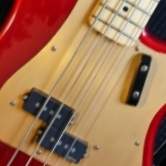
I'm not crazy about how it ages in that it doesn't. So when you're a clutz like me, 20 years down the road you end up with a perfect finish with chips in it. At least if it was nitro, there would be aging to go along with it.
Apologies up front for Fender content, but it is relevant to the discussion on poly finishes.
While I also like how nitro ages, actually, some Poly finishes do age and wear, just a bit differently to nitro. I think they also generally take longer. from my experience
I have a few very heavily used non Fender poly finished basses.- my Ibanez V (1975) and my Greco TB II (1977). The finishes on both look almost like the day they were applied with the exception of the usual, expected light use scratches and impact chips in the finish, as you say. I have had other MIJ poly finished guitars that showed yellowing to the clear coat.
The Poly on 70s Fenders often gets described as thick and virtually indestructible. Detractors will sometimes say, amongst their many issues with CBS Fenders, that the finish will withstand nuclear attack. (They also reckon it affects the tone, but I won't go there). However it will age and wear given enough time and use.
Here are some pics of my very heavily used 73 P Bass. She is a beauty and consequently has been used a lot. The black finish is factory and was a custom colour at that stage, as I understand it. I have a black 75 Jazz that is similar but not quite so advanced, probably not quite as much use. I have seen a number of other poly finished Fenders of similar age in a variety of colours showing this type of wear and in some cases more extreme than my P Bass. You also see a lot with little wear.
A couple of things can be seen from these pics.
The clear top coat will yellow- see the neck in the first pic.
The clear top coat is worn through in places of high abrasion while leaving the colour coat around the edge of the tummy cut- see second pic. Not saying you can't wear through the colour coat- just that it hasn't happened yet in this bass. I have seen others where it has.
The body finish will weather check, but a little differently to nitro. This one is finely checked all over the body. If you look at the first and second pics carefully you can see that the checking is through the clear top AND colour coats (see the wear on the edge of the tummy cut) but not through the clear sealant (visible in the first pic) , which remains unchecked.
The clear top and colour coats will flake off as single largish flakes in places, following the checking- see first pic. That is continuing without any active assistance from me. I have seen others where the checking is not as fine as this one.
The whole area where your right fore arm comes in contact with the bass when playing, while also checked like the rest of the bass body, has become quite porous. See the slightly duller area in the third pic. In high humidity or while playing (and sweating on it), it goes a pale whitish grey. I don't have a pic of this at present. It returns to black when it dries out.
Chips occur through impacts- see third pic- top edge of bass above the pickup.
Maybe I haven't sweated enough on the Greco TB II or the Ibanez V or the poly is different to what Fender used in the 70s.