- Jun 30, 2010
- 49,588
- 221,963
- Disclosures
- musician/artist/owner - Gildaxe
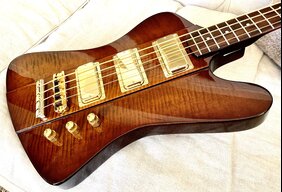
Installed the Badbird bridge on my '64 T-bird II. It's a very nice piece of kit and addresses the intonation issue with style. (kudo's Scott!  ) While I was installing it I did a bit of cleaning of the pu cover, as good as possible considering its 52 year old age. (tarnish happens)
The T-bird bridge in my opinion is not a great design for a couple of reasons including the lack of required space for proper intonation. Originally because of the folded brass mute plate which was riveted to the pu side of the bridge, you needed to adjust the saddles from the butt side of the bridge. With the string end-stop unit right there (1/2" space) and the strings tightly overhead, it made for 'challenging' adjustment unless strings are off or at least very slack. When I got the '64 in '78, it still had the brass mute plate with white felt blocks, which I carefully removed and still have in storage. (pic below) So once gone, it creates a much easier access to adjusting the saddles - from the top of the bridge (pu side). I personally prefer philips-head bolts so I bought 4 stainless steel bolts (same thread/size as original & Scotts) and incorporated the original end caps to secure the saddle/bolt loosely to the bridge unit. (as in, it all stays put if the strings are changed) The original '64 bridge did not have springs and I feel you really don't need them, but I used the ones sent anyway to keep it tight.
So now those lower fb chords I used to hit that sounded slightly off now are ringing clean and clear. R&R!
Next to the original set-up. (BB bridge upside down!)

You can see that the E saddle is near where it would be on the original narrower unit - but all the other saddles rest past it's restricting boundary thanks to the deeper box.

easy access to saddle adjustment

Here you can see the saddle differences - on the '64, the E & G saddles are (equally) shorter and the A & D saddles are (equally) taller, for fingerboard arch compensation. The bottoms of the saddles have a subtle arch as well (not flat). The original is the upper one of the two near the wrench. I used them as they were ready to go w/o filing etc.

original folded brass mute unit with (now loose) felt pads and rivets still connected

) While I was installing it I did a bit of cleaning of the pu cover, as good as possible considering its 52 year old age. (tarnish happens)The T-bird bridge in my opinion is not a great design for a couple of reasons including the lack of required space for proper intonation. Originally because of the folded brass mute plate which was riveted to the pu side of the bridge, you needed to adjust the saddles from the butt side of the bridge. With the string end-stop unit right there (1/2" space) and the strings tightly overhead, it made for 'challenging' adjustment unless strings are off or at least very slack. When I got the '64 in '78, it still had the brass mute plate with white felt blocks, which I carefully removed and still have in storage. (pic below) So once gone, it creates a much easier access to adjusting the saddles - from the top of the bridge (pu side). I personally prefer philips-head bolts so I bought 4 stainless steel bolts (same thread/size as original & Scotts) and incorporated the original end caps to secure the saddle/bolt loosely to the bridge unit. (as in, it all stays put if the strings are changed) The original '64 bridge did not have springs and I feel you really don't need them, but I used the ones sent anyway to keep it tight.
So now those lower fb chords I used to hit that sounded slightly off now are ringing clean and clear. R&R!
Next to the original set-up. (BB bridge upside down!)
You can see that the E saddle is near where it would be on the original narrower unit - but all the other saddles rest past it's restricting boundary thanks to the deeper box.
easy access to saddle adjustment
Here you can see the saddle differences - on the '64, the E & G saddles are (equally) shorter and the A & D saddles are (equally) taller, for fingerboard arch compensation. The bottoms of the saddles have a subtle arch as well (not flat). The original is the upper one of the two near the wrench. I used them as they were ready to go w/o filing etc.
original folded brass mute unit with (now loose) felt pads and rivets still connected
Last edited: