
It seems to me having an actual emblem might be uncomfortable there depending on your playing style. Sure looks cool!Ja, saw that - I dig it!

TalkBass has been independent since 1998. Add your voice.
Create a free account to reply to discussions, view embedded media, and browse with fewer display ads.
Join free Log in
Want zero display ads or expanded classifieds tools? Compare plans.
It seems to me having an actual emblem might be uncomfortable there depending on your playing style. Sure looks cool!Ja, saw that - I dig it!

I think it depends which batch you get a VP from. I’ve heard some are thicker than others. IIRC mine is about 8.5 lbs. There’s a fair bit more wood in the headstock than a modern Gibson! And the machine heads weigh more.Had the opportunity to try out VP for the 1st time today and compare it to a new Gibby.... the VP sounded a bit meaner, but she was on the heavier side, is that their DNA, being mean and heavy ? The Gibby was a jem, just not ready for her yet.
I think it depends which batch you get a VP from. I’ve heard some are thicker than others. IIRC mine is about 8.5 lbs. There’s a fair bit more wood in the headstock than a modern Gibson! And the machine heads weigh more.
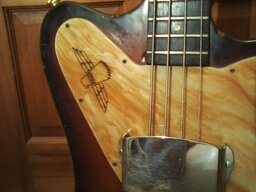
I'm liking this!Saw this on FB. Those are actual emblems, but it’s giving me ideas:
View attachment 4330696
It cuts for this room and audience(older[60+]crowd). It's on a stand 'cos the hollow stage really booms. I can get sufficient clarity for our repatwah...er, repputwoh...er, song list(60s/70s rock and country). I don't want a modern sound. My usual settings are[clock settings] GAIN:9-10, VINTAGE: on, BRIGHT-on(for this room), OD: always off/mute, BASS:10, LO MID: 2, HI MID: 2(~3+ here), TREBLE: 10(~NOON here), VOLUME: 10. Fairly low ceiling in this room. I have a 200c, but it's a little too much for this stage.So the 100 cuts the gig? Wow. Do you get clarity out of it? Or is it just low mids/ bass? Just want to know. I’m considering a 200 for my small gigs.
The 67's TRC hasn't laid flat for years. I'd hafta redrill. Or...just not look at it. Think I'll go with option 2.The TRC on my '76 bulges out in the middle some (like me). Almost as if the headstock shrunk a little. Which I suppose is pretty likely at times. Or may have been a quick slap it on and get it out the door thing.
I prefer to be on his left. This venue works out that way. Others? Nope.At least you have a little bit of room this time. But you should be on the other side of the drums so you can hit cymbals with the headstock.
Actually did that once by accident right on time and looked like I planned it. Other times didn't look planned....


It seems to me having an actual emblem might be uncomfortable there depending on your playing style. Sure looks cool!
Yeah, but you could do a comprehensive report on pick longevity.I think I would constantly be hitting the larger emblem with my picking style.

A doctor told me years ago to never delay getting hand or foot injuries looked at. The one time I didn’t waas painful a looong time.I should also note that, depending upon the problem, delaying doing something about it can result in fewer options that have good outcomes.

Neck was definitely chunkier than the Gibson, dat fo sho.

A doctor told me years ago to never delay getting hand or foot injuries looked at. The one time I didn’t waas painful a looong time.
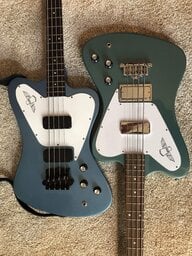
That looks great.
Look for occupational therapists who specialize in hand rehabilitation. See if you can find one familial with guitar payers and ask for consultation with your instruments. A skilled therapist may be able to pinpoint something and help you correct it and develope some hand exercises to help eliminate it.I have developed some pain playing my Thunderjazz, it's dull pain in the center of my palm. I have been playing MANY years, and back in the 80's had to quit playing my '66J (D profile) because of fretting hand cramping. I've avoided 1.5" necks ever since. The neck I put on my Thunderjazz is a 1 5/8" with a shallow profile, and up until now it has been a joy to play, and I practice at home with it. The second day I experienced the pain was a band practice day, so I practiced a little at home (pain again), and went to band where I use the ThunderP, which has a 1.6" neck with a slightly thicker profile, and didn't experience any pain.
Yesterday, tried the Thunderjazz again, pain again. Pulled down my '59 NOS CS P, 1.75" with shallow profile, and the pain went away.
Any suggestions short of not playing one of my favorite basses of all time?
Although a good suggestion, absent other changes (change of instrument, playing duration, playing speed, etc.) the development of pain suggests an underlying disease process.Look for occupational therapists who specialize in hand rehabilitation. See if you can find one familial with guitar payers and ask for consultation with your instruments. A skilled therapist may be able to pinpoint something and help you correct it and develope some hand exercises to help eliminate it.
Yep, all my Gibson necks are smaller, faster and easier (for me and my smallish hands) to play. Not a deal breaker by any means though.

I would call it olditis caused by the the onset of age, after all, I am 69Although a good suggestion, absent other changes (change of instrument, playing duration, playing speed, etc.) the development of pain suggests an underlying disease process.

Ahem.I would call it olditis caused by the the onset of age, after all, I am 69
.


