Hi Lo-Freq. With apologies to all for the topical detour (well, there is TF content) ...
The Traynor is quieter and capable of the same volume. There's a similarity in design in so far as they're both tried-and-true fairly simple chassis-as-heat-sink designs. Obviously the TF comes with the modern bells & whistles (DI, Speakon, Limiter and more), is easier to EQ, and smaller/lighter.
The 'Block is about 32 lbs and roughly the size of a 2.5u shallow rack. On the plus side, it's got to be the toughest amp ever made. If you ever see one in person, you won't doubt it. It has no fancy features - just a very well-voiced (but not semi-parametric) active 5-band EQ with nice big sliders, 3 rotary EQ, gain, master, preamp out and power amp in. Non-detachable power cord

and two speaker outs of course. All 1/4". Like the TF, the 'Block stays unusually free of breakup all the way up on the gain and master. Your speakers will likely break up and explode long before these amps will.
If I had to strip it down to one line, I'd say the Traynor has a pleasant very faint grind (roundness?) in the mids that's just perfect in a mix. I'd say the same about the Gibson GB440 by comparison too, and my limited knowledge plus the input of a couple electrical engineers who are also amp freaks leads me to believe it's in part due to the old op-amps & caps being built to lower tolerances. Technically inferior, but to some ears musically sweeter.
In occasional half-hearted attempts to get these reverse-engineered and perhaps mass-manufactured in a modern/light box, I've been told that's where I'd fall short - that the modern chips can't give that same sound and the old ones can no longer be had in bulk. I hope Mr. Funk won't mind if I say that he's agreed on that likely making the difference.
That said, it's not a mid-machine. You can easily get a boom car sound if you want it. Just that it can do things in the mids that the TF won't. Like any good amp, it can be used for any style of music, but I'll say the mids along with its toughness and 2 ohms capability make it ideal for hard-gigging rockers that require maximum volume (via stacks of cabs) and simplicity (not in use, but in things that can go wrong). Since that ain't me, I prefer to carry a small/lighter amp hence my participation in the on-topic portion of this thread.
In these clips (all a two-mic blend on a Schroder 1212 at higher than my gigging volumes) both amps were set not far off flat, but both slightly tweaked to take advantage of their different mids, mostly. The TF may seem to have a bigger bottom, but that's coincidence that the tracks I used it on benefitted from more lows in the mix vs. busier tracks I used the 'Block on (plus the passive tone setting and playing style on the basses for a given track - hard plucking with tone maxed on some vs. tone rolloff and heavy palm muting on others ... you get the idea). Could've done this entire CD with only either amp, but I wanted to use a variety of gear for fun and I figured the clips would come in handy so with apologies to those who've heard 'em before (they might be of interest to those researching Thunderfunk amps?) ...
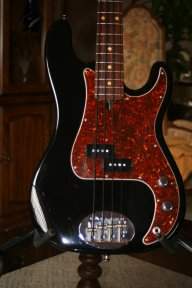
'78 fretless P bass, Thunderfunk.
Invalid Link Removed
Roscoe Beck 5, Traynor Mono Block II.
Invalid Link Removed
'78 fretted P bass (Bart 8S pickup), Thunderfunk.
Invalid Link Removed
Rocoe Beck 5, Traynor.
Invalid Link Removed
'74 J, Traynor.
Invalid Link Removed
'74 J, Thunderfunk.
Invalid Link Removed
Caveat : Not all Traynors share these qualities, and especially not the newer/Yorkville ones. Their stuff has always been a good bang for the buck, and frequently innovative (anyone scoffing at that ... first 8x10 cab, first bass head over 300 watts, first wedge monitors were all Traynor) ... where was I ... yeah, always been good reliable gear, but this unit is uniquely exceptional (IMO/IME/etc.) and rare so that's why I call it my #1 as its comparatively irreplaceable (plus indestructible, and does 2 Ohms).





 I just got a pair of Mini 12's from Jorg, and I'm looking foward to using one of those with the Thunderfunk for my new "small" rig.


 and esp the sound of your bass on that song. Of course there's nothing like hearing your rigs live...that's what I was hoping for- a description of how each sounds live, if you could do that...I just love
  that raw, low, fat, dark, meaty, bass tone that I rarely hear that is totally non-distorted, yet cuts thru the mix, but doesn't overpower the band ,yet drives the band. I think I'll be able to find a Schroeder cab to finally try out on my travels south this week,but I doubt I'll find a TF and Schroeder cab in the same place,so I'm hoping for a little expert help on how the Thunderfunk makes the Schroeders sound...
  Do you have a favorite amp yet to power your 1212,and why?...Peace...DAcat.