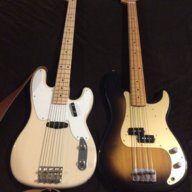
i’m still a beginner, despite being a total gear head, and i just wanted to ask for some tips on memorizing notes! it’s a bit time consuming hitting the open e or a or d or g string and being like “ok that’s a g... one two three...” etc and counting the half steps between b and c and e and f, just to arrive at a fret you’ll forget about once you move away for a second or two. beginners problems i guess

. my picking technique and left hand technique are pretty okay, one finger per fret (sometimes i cheat and either use my middle finger or pinkie when i should use my ring finger), but i want to start getting into theory to better my playing. what’s the point of playing good if you play the wrong stuff??
1) learn the music alphabet. There are only 12 notes. So it’s not much more difficult than learning a phone number. I mention there only being 12 notes because people look at their bass and think things like “ well there’s 5 strings and 24 frets, that’s 120 notes” no there are 12. Learning the notes of the music alphabet is something you can work on anytime. You don’t need a bass in your hands to do this.
2) once you have a grasp on the music alphabet. Learn the c major scale. Why c major in particular? Because C major Contains all the natural notes (aka white keys of a piano) so once you know The music alphabet and you know the c major scale you can combine these two and “connect the dots” and realize all the notes that you don’t play in the c major scale are your sharps and flats (aka black keys of a piano).
3) you can then expand how much of the fingerboard you know simply by learning to play the c major scale in different octaves/positions. play it from the 3rd fret of the A string, play it from the 15th fret of the a string, play it from the 8th fret of the E string, if you have a 5 string bass play it from the 1st fret of the b string then the 13th fret of the b string. Say
the notes as you play them. Get to know the c major scale well all over the neck.
those first 3 steps will go a long ways as far as learning the notes on the fingerboard.
If you’d like to go further i have Special a tip for 5 string players in particular. If you can learn to play a 2 octave c major scale from the 1st fret of the b string to the 5th fret of the g string and identify that each octave has its own pattern. I can pretty much instantaneously teach you a lot of scales. For example if you play one octave of C major from low C 1st fret of the B string to the 3rd fret of the A string. Then shift that same exact pattern one string and start on F(first fret of e string) , that’s the f major scale, shift it up one more string to Bb (1st fret of a string) and that same exact pattern is Bb major. If you know c major from the 3rd fret of the A string to the 5th fret of the g string. Play that same exact pattern starting on G, the 3rd fret of the E string and you’ll have g major, if you start that pattern from the D, the 3rd fret of the b string you have D major. Learning how many scales share the same fingering patterns will increase the pace you learn every key.
How about learning major/minor keys. First let’s talk relative keys. Relative keys are keys that contain the same notes. On bass guitar identifying the relative minor of a major key is fairly simple. For example the c majors relative minor is A minor. C major and a minor contain the same notes that’s why they are relative keys. Recognize that C is the third fret of the A string. And A is the open note on a string pay attention to this relationship because it will provide you with the relative minor of all the major keys I’ve mentioned already. For example G majors relative minor is E minor. See how the relative minor is the same distance from the major in both cases? The third fret of the D string is F. F majors relative minor is D minor same deal right? I know this may seem confusing for some, im not the best at explaining things in words. Maybe if I have some free time after the holidays I can make a quick video with a bass and actually show this stuff.