• TalkBass has been independent since 1998. Add your voice.
    Create a free account to reply to discussions, view embedded media, and browse with fewer display ads.
    Join freeLog in
    Want zero display ads or expanded classifieds tools? Compare plans.

Tips for new fretless player?

Apr 18, 2015
3,136
3,495
65
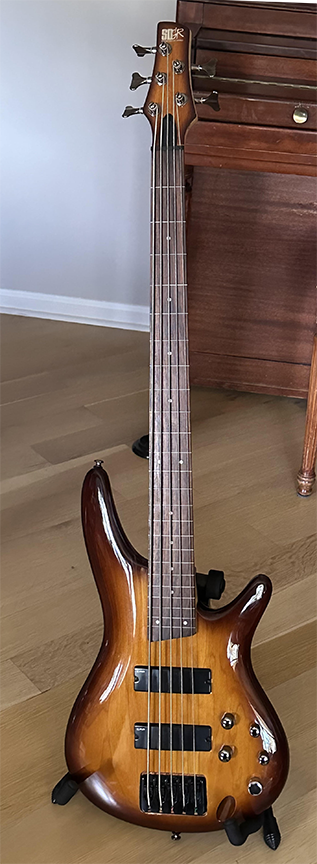
FINALLY I have a fretless that is playable and I think I can keep. I sort of understand how things work as I wasn't half bad at cello in my strings methods class at Uni., But that was a LONG time ago and bass is another animal.

I'd like to become as good with it as a fretless bass, so I'm looking for tips/advice/practice routine, etc to get used to it. Love the "zingy" sound. I won't play it on Friday night's gig get, but have a rehearsal on Monday which will be the perfect time to try it playing with guitars and drums and maybe keyboard.

Thoughts?
1723073665481.png
 
Practice everything that you normally practice on your fretted bass, then pick up the fretless and do it all over again.

The muscle memory that you gain from playing fretted bass becomes your reference point when you play fretless.

Also, utilize open strings as much as possible to help give you intonation reference points.

Lastly, listen, listen, listen!
 
Ok, you got this.

First, set your tuner in “through” mode if you can. Or line it out of your amp or whatever you need to do so it is always on and visible. Practice your normal home practice routine. Watch the tuner. You’ll get sharp/flat feedback better than your ears may give you when playing solo.
This transition is more about challenging your fretted muscle memory, each intended note on fretless is a slightly sharper finger position.

In my own experience, your brain will respond a bazillion times more quickly to intonation when playing with a band or others. Your brain will recognize the dissonance and call your hand north or south. But home alone the more you do now the more prepared you’ll be.
You have lines. But even looking is a little dicey because your fingertip is bigger than the target.
Just practice, don’t panic.
And if/when you clam a note just remember it’s not a gaff, it’s an opportunity for that mean glissando you’ve been waiting for.

Thingy to note, there’s no wrong notes on a fretless. Your fretless doesn’t make that clatter that your fretted bass makes when you hit wrong. It just makes a note. Get used to letting your wrist do the work.
 
Practice intonation way more than you think is necessary. ;)

Ok, you got this.

First, set your tuner in “through” mode if you can. Or line it out of your amp or whatever you need to do so it is always on and visible. Practice your normal home practice routine. Watch the tuner. You’ll get sharp/flat feedback better than your ears may give you when playing solo.
This transition is more about challenging your fretted muscle memory, each intended note on fretless is a slightly sharper finger position.

In my own experience, your brain will respond a bazillion times more quickly to intonation when playing with a band or others. Your brain will recognize the dissonance and call your hand north or south. But home alone the more you do now the more prepared you’ll be.
You have lines. But even looking is a little dicey because your fingertip is bigger than the target.
Just practice, don’t panic.
And if/when you clam a note just remember it’s not a gaff, it’s an opportunity for that mean glissando you’ve been waiting for.

Thingy to note, there’s no wrong notes on a fretless. Your fretless doesn’t make that clatter that your fretted bass makes when you hit wrong. It just makes a note. Get used to letting your wrist do the work.
Thanks for the advice. When on a gig I ALWAYS play through a tuner; a Korg CA50 specifically... interestlingly in front of a Korg Pitch black pedal. Sounds strange, but I started doing it for a reason. During the summer I play outdoors in the sun and the Pitch Black readout isn't well seen in the sunshine. So the Pitch Black becomes a mute and I let them co-witness each other, but the CA50 is always live. So that's a good tip. thanks.

I have a pretty good ear for intonation, but getting my hands to know where they need to go to be in tune will be something else. I guess a lot of practice with this instrument is in order.

String guage? I know that the bass now has lihts or "super lights". High G measures about .038 and B about .110. I presume D'Addario strings based on the colored ball ends. I'm not finding .038-.110 D'Addarios out there. but the strings could be stretched out a bit? But my calipe has always been pretty accurate.
 
  • Like
Reactions: Killing Floor
I regularly practice/check my intonation with a drone track on youtube. I would say that intonation is the most important skill on a fretless. Secondary and also important is setup and technique. If you want maximum mwah you need low action and control over your plucking hand dynamics. You have to adopt a feel for how a fretless responds to different plucking strengths.
 
Thanks for the advice. When on a gig I ALWAYS play through a tuner; a Korg CA50 specifically... interestlingly in front of a Korg Pitch black pedal. Sounds strange, but I started doing it for a reason. During the summer I play outdoors in the sun and the Pitch Black readout isn't well seen in the sunshine. So the Pitch Black becomes a mute and I let them co-witness each other, but the CA50 is always live. So that's a good tip. thanks.

I have a pretty good ear for intonation, but getting my hands to know where they need to go to be in tune will be something else. I guess a lot of practice with this instrument is in order.

String guage? I know that the bass now has lihts or "super lights". High G measures about .038 and B about .110. I presume D'Addario strings based on the colored ball ends. I'm not finding .038-.110 D'Addarios out there. but the strings could be stretched out a bit? But my calipe has always been pretty accurate.
.110 is extremely light for a low B. I've never played anything lighter than a .120 and that was way too light for me. These days my rounds are .45 to .130.

A .110 B would be pretty floppy (That's what SHE said!).
 
I practice my fretted bass first. Making sure I do the one finger per fret routine that I was taught many years ago. Keeping my fingers as close to the fret as possible. This helps my fingers to get use to being in position as accurately as possible. These are my warm up stretches.
The finger patterns are:
1,2,3,4,
1,3,2,4,
1,2,4,3
1,4,2,3,

I go up from the first fret one fret at a time to the 12th and then repeat each one. I then do my major and minor scales from the lower octave to the high octave. Then switch to my fretless and repeat the same routine. It has help my intonation tremendously.
 
Welcome to the fretless players society!

Practice suggestions:

1. Develop confidence in your ability to find and correctly intonate notes. Do that by practicing chord triads, octaves, and intervals to get your hand used to grabbing notes on adjoining strings and help develop your sense of where the ‘box’ on the neck is.

There’s a natural tendency when you’re first starting out to loiter on just one string or only play in ascending and descending scale steps to help maintain your note reference point. That’s a cheat that can easily become a habit that’ll be hard to get rid of. So you want to “avoid playing like you’re always just walking up and down a staircase or back and forth in a long hallway” as one of my upright bass teachers put it.

2. Practice. A lot. But do it intelligently. Have a plan and set goals for yourself. Don’t just sit down and noodle. And put in some of your practice time with backing tracks or actual music. Don’t confine yourself to purely technical exercises. You need to apply what you’re learning as soon as possible. A slow blues backing track is a good starting point. Stick to roots and fifths focusing on your intonation at first and branch out from there as you become more comfortable with the fretless neck.

Note: it doesn’t hurt to record your practice sessions for later review. You’ll catch things (especially any bad intonation) you might have otherwise missed when you were playing.

3. Don’t give up. It’s extremely doable even if it can be challenging at first. “80% of success is showing up,” as Woody Allen so famously put it. To which I’ll add : And the remaining 20% is being the last person to quit.

4. Accept the fact that there will be days when your hands and your bass will have trouble communicating and your fretless just won’t want to cooperate. And when that happens it’s best to just put it down for a while, or even for a day or two, and let yourself recharge. It’s a temporary problem that soon passes if you don’t let it discourage you. FWIW it can sometimes even happen to experienced players. Take comfort in knowing that little annoyance will occur less and less often the longer you play and gain experience.

5. Don’t forget to have fun. It can be frustrating at times. But it’s also (IMO) one of the more satisfying accomplishments you can achieve as a bass player once you get comfortable on a fretless neck.
 
Last edited:
  • Like
Reactions: vindibona1
Tips? Yeah: Play it a bunch and have fun with it. It's not as hard as people make it.

Yes, listen and make sure you're in tune.
Yes, root-5-octave is more annoying to play than on fretted instruments and you have to adjust your left hand technique for it slightly sometimes.
Yes, it can take a little more finger/hand strength than a fretted instrument to make sure you play cleanly.

But really, it's not that different. And it's really fun. And the more fun you have with it, the better at it you'll get, and the quicker you'll get better.

And when you're able, incorporate open strings into the playing. You know they're gonna be in tune and are good reference pitches to hear relative to the reset of your playing.

And maybe do some ear-training on the fretless. Play whole-note octaves in unison and really listen to how slight finger adjustments put them in & out of tune. The same for 5ths and Maj & Min 3rds. Listen to how a major third is actually consonant ever so slightly sharp of the fret-line and then go slightly mad when playing a fretted bass and realize major 3rds are always slightly out of tune. 🤯 😇:laugh:

But mostly have fun with it.
 
Tuner through is a hack I never thought of. I'm in the same sort of boat, and I was gonna straight up cheat by getting fret dot stickers from Amazon, I think I paid $2 for em, and put them where the frets would be..