• TalkBass has been independent since 1998. Add your voice.
    Create a free account to reply to discussions, view embedded media, and browse with fewer display ads.
    Join freeLog in
    Want zero display ads or expanded classifieds tools? Compare plans.

To compress or not to compress?

i was reading a bass supplement that came with a guitar magazine and it said every bassist should be using a compressor pedal,

1) would you agree with that?
2) what does it actually achieve?

No, definitely not.

I am not sure why someone would be of that opinion. Did they expand on it? There are many ways to use a compressor in all honesty. Many of the subtle ways are better suited to front of house or in the studio.

Nothing against guys using compressors. I tried it for 6 months as well on my board before coming to my opinion of it not being a must have.
 
...it said every bassist should be using a compressor pedal,

1) would you agree with that?
Absolutely not. They work for many, the don't work for many. I've used one on and off over the years and I simply prefer to not have it in my chain. What FOH does is their business altogether and out of my hands, I just don't prefer it before my amp.
 
I'm an always on guy. However, I don't like 'squishy' compressors. To borrow from elsewhere in the thread, the "you don't notice it until it's not there" settings are the way I like it. All the sound dynamics without the spikes in volume.
 
i was reading a bass supplement that came with a guitar magazine and it said every bassist should be using a compressor pedal,

1) would you agree with that?
2) what does it actually achieve?

1) I am sure some people don't need the effect, but I think most would benefit from using one

2) It raises the volume of your bass, while reducing the "peakiness" of it. So if you really hit a string hard it won't sound as loud, while the softer notes will sound louder. It's reducing the dynamic range in your volume.
 
As with any processor the trick is not overdoing it. I just use the compressor in my Zoom B-1 to simplify setup now, but I used to use a separate compressor and set the threshold so the -3 LED would come on most of the time. If you set the threshold too low it will squash your tone (you don't want the -6 db LED to be coming on all the time). The attack and release times are important and you can find some suggestions online. For a one knob or two Knob unit or head do some playing and dial it in, you should be able to hear it kick in and when your tone/sound starts to suffer back it off.
It helps the bass sit in the pocket. You usually want to put your EQ pedal before the compressor because if you crank up 60 hertz for example your low notes will be louder and the compressor can help keep them at a good volume so the higher notes don't disappear.
 
Ok but the last thing I’ve ever wanted in a bass was sustain. I’m more interested in muting notes than sustaining them. I’ve never really understood why bass players want sustain.

There are two reasons why I like to use a compressor: to prevent spikes when playing harder and to make the high notes sound more even with the low notes. There are many world class players much better than me with super high end Basses that use compressors. If they’re ok with it then I don’t see a problem for me.

Didn't mean to infer it was a bad thing or wasn't right for you.

I like good sustain in a bass because I like to control the dynamics of my sound with my hands. If I need to let a note ring out for a full measure in common time, I don't want it fading out when it gets to the count of 2 or 3. The last thing I want to be doing when the note is supposed to be held is be whacking on it 4 more times to fill in the measure. I control muting with both my plucking hand and the fingertips of my fretting hand. I don't even think about it anymore because I've done it so long. I learned the importance of muting strings back in 1965 when I first started playing bass.

My 1965 Fender Jazz Bass didn't have decent sustain when I bought it in '66. I played that bass with the neck cover removed but the ash tray bridge pickup cover still on. That bridge cover had a strip of open cell foam across it at the bridge that muted the strings. Idea was to emulate the sound of a stand-up bass a bit better. I removed the foam strip from the inside of the bridge pickup cover and sustain was much better. If I needed a muted sound, I'd do that by resting the heel of my palm on the strings at the bridge like I would with a guitar.

Hopefully that gives you a little insight on why some bass players want sustain in their bass.

I have to point out that your comment about making the high notes sound more even with the low notes (presuming we are talking dynamics) creates sustain with your compressor - it's the nature of the beast. The higher you run that ratio control to "even out the peaks", the more of your signal is converted to sustain. It's not a bad thing and it works great for you, so use it and enjoy it. I'm just telling you why I don't use one in my playing. I do use compression in mixing recordings though, but that's a bit of a different animal.
 
  • Like
Reactions: StrangerDanger
I use very light compression to control volume imbalances/peaks between pedals (I use several pedals).
This is the main reason I use compression as well. I find that when I dial in the growl I want from my various gain stages, it becomes too loud above my clean signal. So with a simple compressor/limiter at the end I can have the best of both worlds. Uneffected, dynamic clean tones and slightly squished drives, fuzzes, and OD’s. Not to mention with as many effects as I like to use, I can get crazy with odd sounds and crazy sequencing/delay tails without the worry of spikes overpowering the mix.
 
  • Like
Reactions: Gyver
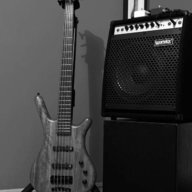
I play only in my Room (Warwick Corvette GPS 5 String Bubinga Body, Daddario Pro Steels 0.40, 0.60, 0.80, 1.00, 1.25 tapered B), and use Bayerdynamic DT770pro 80 Ohm Headphones. btw, I play Bass Guitar for almost 30 Years, if that matters.....
Always with background Music coming from my PC, and that Source is Eq-ed so my playing cut through the mix. Basically, I cut bass, lower mids and highs (highs to compensate overall sound) for background Music.
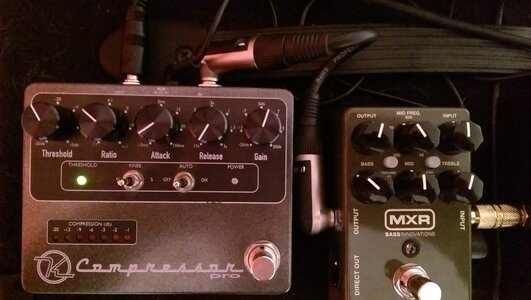
I dont like preamp on Warwick, so i bypass it, and use MXR M81 preamp for subtle corrections - mainly for reducing bass frequencies (This Headphones are bass heavy and to compensate for it).

As for Compression, I use Kelley Compressor Pro in manual mode for fingerstyle, and in auto mode for Pick (Treshold is set so Compression LEDs show between 3 and 6 db when playing, Ratio is 3:1). I found that auto mode is very similar to settings where Attack and Release is in their fastest settings and for pick playing, thats ok for me, but when playing fingerstyle, i like little more attack on every note. Picture says it all (for fingerstyle). With pick, I often play without engaging M81 Preamp.

P.S.
Attack Times slower than this on Picture is unusable for me - Attack is waaay too long - even on this Settings is too long for Slap and hitting B, E or A String is too aggressive because of Attack duration and percussion part of Note is too pronounced. "I could swear" that on slowest setting, Attack duration is almost 1 second before Compression kicks in.

(sorry for bad English)
 

Attachments

  • IMAG1933.jpg
    IMAG1933.jpg
    151.7 KB · Views: 39
Last edited:
I have to disagree, compressor does change sound, otherwise we wouldn't use it. It aims at sound dynamics, but your instrument sounds different with it. Besides, not all good compressors are transparent.
As for small gigs, it really depends on the musicians. Jazz trio bassist playing in a restaurant doesn't need compression i.e.
In the end, what works best for you is what counts. Maybe my list of reasons is wrong, but compression is just a good tool, and in no way a necessity.

Maybe I should have said doesn't change the tone, but I don't consider reducing the volume of a really loud note as a change in sound, which many good multiband comps can do.

The bass player in the Jazz trio I used to know could have done with one every now and then he'd slap a little or get extra excited and play a line too loud.
 
Yep, but it needs to be a good compressor and use judiciously. Only for limiting extreme peaks. I like my Markbass single tube Compressore.
View attachment 2786412

I tried Markbass Compressore (vs. MXR M87 i had at that time), but, that tube have sound signature - coloring Sound too much for my taste. Added Value if that is what you like.


Btw, i replaced M87 with Keeley Compressor Pro - even M87 was not transparent enough for my taste.
 
Last edited:
  • Like
Reactions: Eddie LeBlanc

Latest posts