
Smooth_bass88
vaxx!
- Oct 31, 2006
- 12,123
- 16,798
- Disclosures
- have been on nationally released albums, charting on the Billboard 200

TalkBass has been independent since 1998. Add your voice.
Create a free account to reply to discussions, view embedded media, and browse with fewer display ads.
Join free Log in
Want zero display ads or expanded classifieds tools? Compare plans.

The bass being auctioned looks like a '66 with mods. It has a transition logo.
But I'm almost certain it's not the same bass as the one Elvis is holding. Look close at the Memphis boys photo and you can see that the tug bar was moved above the pickguard as a thumb rest. The holes are visible in the pg on the treble side, that's an original gold pg not the aftermarket on the auction bass. If the thumb rest was later removed, there would be visible holes in the body of the auction bass. Also, the 12th fret dots have pre-cbs spacing.
My best guess is the bass in the Elvis photos is a late '59.
View attachment 5104827
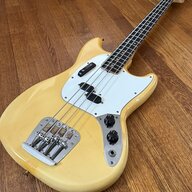
I'm not sure exactly when they transitioned from the gold guards to the tort guards
Tort was introduced in early 1960. 3TSB, slab rosewood, and gold = mid to late '59.
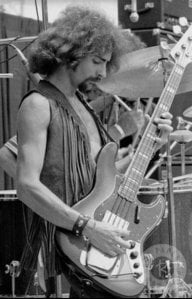
Have seen numerous late '59s with tort - even with three different screw patterns: 10, 11 and 13 hole. Have certainly seen more '59s with tort/slab combo than gold guard/slab combo. Have never seen any early '60 with gold guard.
It seems strange that an old Fender bass is at its absolute peak value when closest to 100% original, but a significantly modified old Fender bass can be worth much more if it was used / owned by a legendary player & played on classic hit songs, HOWEVER, the mods must have been made by the legendary player / owner or the mods kill the value.
 :
:
Then there is a chance my original 62 P with mods my by a legendary musician (me!Interesting to look at, but I play all the basses I own. This is obviously a collectible that will be owned by an eclectic (and wealthy) individual or some type of museum, & likely never played again, which is kind of a shame, but it's the society in which we live.
It seems strange that an old Fender bass is at its absolute peak value when closest to 100% original, but a significantly modified old Fender bass can be worth much more if it was used / owned by a legendary player & played on classic hit songs, HOWEVER, the mods must have been made by the legendary player / owner or the mods kill the value.
Nobody buys an all original '66 Guild Starfire in 2023, rips out all the electronics, and replaces them with new pickups and a combination of nine different switches & pots, but a lot of folks would jump at an opportunity to own the highly modified one Jack Cassady played with Jefferson Airplane that was used on White Rabbit. It would probably be much more valuable than a 100% original version.
So, mods are a negative unless done by a famous player, which makes them a positive? I suppose it's not the mods that devalue a bass, it's the person doing the mods.
 ) has a chance...

Bass in the period photos with Elvis sure looks like a mid '59. Slab board, etc. And then there's this:
View attachment 5104691
The studio bass from American which I believe was Chips Moman's (or co owned with Tommy).
There are photos of Tommy playing a mid 60's P with tort guard. I imagine more than one bass at play here - and a possibly changed pickguard (and bridge and pickup). Surely someone like Tommy owned more than one bass?
I've heard he used another studio P bass on the Aretha recordings - but can't know for certain.
He's on motion picture film at Atlantic Studios in NYC circa 1967 playing a White P-Bass with a tort guard and rosewood board.
On most of the still photos online comes from a session where Tommy is playing guitar.
The auction is a bit vague considering the price.
"Zero" people in his family were at any of his famous sessions to see which bass he was actually playing.
Buyer beware.
He's on motion picture film at Atlantic Studios in NYC circa 1967 playing a White P-Bass with a tort guard and rosewood board.
Thanks Dynacord!
Then there is a chance my original 62 P with mods my by a legendary musician (me!
View attachment 5104946 View attachment 5104948
By the way Jack used a modified Jazz on the first three albums. That would include White Rabbit on the studio album version...
"FlyGuitars So when you first joined Jefferson Airplane you were using Fender basses?
Jack Casady Yeah the first three albums are recorded with a Fender Jazz bass, and I customised that by adding a P pickup right butted up against the neck. So in essence I had on the very bassy end of the speaking length of the string an offset P pickup and then two bar pickups of the Jazz bass."
Jack Casady talks about his mid-sixties modified Fender Jazz basses >> FlyGuitars
I really had no idea and didn't research what Jack played on recordings, I had just seen a lot of pics of Jack with a VERY highly modified Guild Starfire with all kinds of added knobs & switches. I'm sure it would be more valuable than a stock Starfire just because of who did the mods.View attachment 5105067
Maybe I should have used Phil Lesh's Alembic….
View attachment 5105083
Both heavy Alembic modified Guilds.I really had no idea and didn't research what Jack played on recordings, I had just seen a lot of pics of Jack with a VERY highly modified Guild Starfire with all kinds of added knobs & switches. I'm sure it would be more valuable than a stock Starfire just because of who did the mods.View attachment 5105067
Maybe I should have used Phil Lesh's Alembic….
View attachment 5105083
Both heavy Alembic modified Guilds.
Here's Jack's true full Alembic.
View attachment 5105108
Jack Casady and the first Alembic bass >> FlyGuitars


