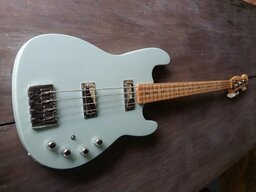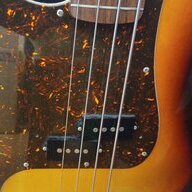
I never use the tone controls but I don’t need to remove them. It’s not important enough to spend the time and money rewiring and replacing the pick guards.

TalkBass has been independent since 1998. Add your voice.
Create a free account to reply to discussions, view embedded media, and browse with fewer display ads.
Join free Log in
Want zero display ads or expanded classifieds tools? Compare plans.
In my own defense (because who else is going to do it?) the preamp in my WAV4 went bad (a Seymour Duncan which I had installed to replace the rather lame original) and it was 18 days out of warranty. With encouragement from @mapleglo, I swapped it from active to passive with no tone control. It has no pickguard and is a white bass. I just bought some white plastic hole plugs to fill the extra holes. They're still there if I ever want to reconfigure it. The SB-2 had a pickguard that was beginning to crack, so a replacement was needed anyway.I never use the tone controls but I don’t need to remove them. It’s not important enough to spend the time and money rewiring and replacing the pick guards.

I did something like that 50 years ago. Just volume for each pick up and a phase switch each for the jazz and p pick ups.
View attachment 5338554
The "tone" came from blending the pick ups or not.

A unique tribute to the Charles Kaman helicopter bass, a beauty. Lovely minimalism too. I never touch the volume or tone knobs on my basses, both being maxed at all times. Of course I am a bedroom bass student with the Orange Crush 50watt amp within arm's reach to change sounds.The Ovation-inspired bass looks stunning!

Bluetooth output?I'm waiting for the guy who's such a purist he forgoes tone controls, volume controls, and the output jack. Anyone that brave?
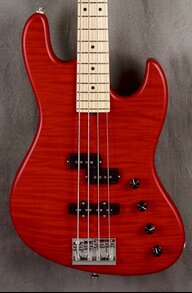
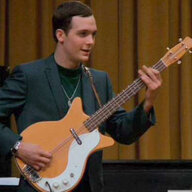
I’m the exact opposite. I think every active bass should have an overall tone control. Different strokes, I guess.I have zero use for a passive tone control. I like active tone circuits, but I never use them to roll off treble. I love the clank!
Is there anybody else out there brave enough to go volume-only?

Two (soon to be three) of my basses have a switch that, when engaged, bypasses the volume and tone controls and makes the signal go from the pickup selector straight to the output jack. I usually just use the switch on.




Yes, both in tone and in volume. One of the basses has TI JFs while the other has Rotosound Ultramags. For the TIJFs it's a little less noticeable, but for the Rotos it is very noticeable. Not just in the highs, but the high mids too. Volume increases just a little bit. It's nice to take an overdrive pedal like a BBBOD, turn the bypass on and set my drive tone, and then turn it off, roll back the volume and tone, and set a good clean tone. Lets me cop 2-channel amp tones with just the bass and pedal.Do you notice a difference in tone if you have everything fully open and you flip the switch?


I use my tone controll on my P-bass all the time.