• TalkBass has been independent since 1998. Add your voice.
    Create a free account to reply to discussions, view embedded media, and browse with fewer display ads.
    Join freeLog in
    Want zero display ads or expanded classifieds tools? Compare plans.

Tone loss with longer cables

I'll check out the John East preamp, that for the tip.

Another option would be to take the bass to the luthier to have a battery compartment installed on the back. I was thinking something like Stingray has, should be able to buy it. All it needs is really careful routing and it flushes in nicely.

That would be really neat and then I can install pertty much any preamp. Not sure whether the body is thick enough though, Stingray is much thicker.
 
Actually, yes it achieves exactly the same thing, electronically. The difference is that tone knobs are generally "all or nothing", i.e. you don't hear any change until BAM all the highs are rolled off, whereas the long cable is "fixed" at a very gentle rolloff.
 
I don't know much about it, and I have never noticed this kind of signal loss, but if it is no noticeable to you people, have you tried wireless transmiters? How good are them? I mean, do the good ones suck tone too?
 
Unwritten law of the universe - batteries only die at a gig.

I've been using some form of active bass since 1977, and have never had a battery die during a gig.

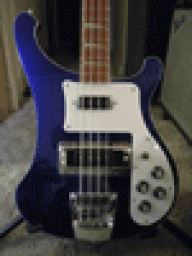
And back then they didn't have these battery boxes, so I would have to unscrew all the pickguard screws on my Rick, loosen the strings and remove the pickguard to get to the battery! So, when when I changed my strings, I'd put a fresh battery in. I used to change my Rotos every 5 weeks or so.

These days it's easy to get batteries in basses. Now I periodically check them before a gig.

EMGs in particular don't use a lot of power. I used to leave my EMG equipped basses plugged in for days and the battery still lasted about six months.

So while I never had a battery go dead at a gig, I have broken strings during a gig... and more than once. :bassist:
 
Yes, but you have to remove the entire PG everytime you need to change or trouble shoot it.

As in my post above... been there, done that. :D

Unless it's a vintage bass, just add a battery box. People worry about resale value, but none of the basses from this century will be worth big money. They aren't historic enough. Make the bass usable for you.

Or get a clean buffer in a box attached to your strap, and use a short cord from the bass.
 
As in my post above... been there, done that. :D

Unless it's a vintage bass, just add a battery box. People worry about resale value, but none of the basses from this century will be worth big money. They aren't historic enough. Make the bass usable for you.

Or get a clean buffer in a box attached to your strap, and use a short cord from the bass.

This thread has mutated from what it started. Somebody asked if a battery will fit in a P bass without routing a battery box. I answered that it will, but you'll need to remove the pickguard to change it. That scenario sounds unpleasant in an emergency. I'm not sure how a Ric got involved.
 
I'm not sure how a Ric got involved.

Because I played Rics, and was removing pickguard screws to get to the battery. Same scenario with a different brand bass.

I was pointing out that as long as you maintain your battery, you wont have an emergency. But it's an inconvenient way to do things.
 
Actually, yes it achieves exactly the same thing, electronically. The difference is that tone knobs are generally "all or nothing", i.e. you don't hear any change until BAM all the highs are rolled off, whereas the long cable is "fixed" at a very gentle rolloff.

i dont know the electronics and science behind it so maybe its technically the same thing, but my ear is telling me they are nothing alike.

i use an old school coil cable for its high capacitance. compared to a "high quality" cable, a passive bass has some of the upper treble string noise attenuated and the lower treble grind gets accentuated. its grindier sounding overall. rolling off the tone control doesnt get me that.
 
Actually, yes it achieves exactly the same thing, electronically. The difference is that tone knobs are generally "all or nothing", i.e. you don't hear any change until BAM all the highs are rolled off, whereas the long cable is "fixed" at a very gentle rolloff.

That's not true at all. I use passive tone controls on all my guitars and on the basses that have them, often half way down.

You can hear that the highs have been reduced at that frequency, but they aren't all the way off.

If you want to simulate a long cable, you need a much smaller value cap and probably a resistor to limit the affect.

All you need to do is find out what the capacitance per foot is and use a cap of that value. It probably would be around 0.002µF or similar.