• TalkBass has been independent since 1998. Add your voice.
    Create a free account to reply to discussions, view embedded media, and browse with fewer display ads.
    Join freeLog in
    Want zero display ads or expanded classifieds tools? Compare plans.

"Tone" "Wood"

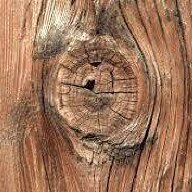
I've been tapping this board all night, trying to see if 'Roundabout' or 'My Generation' or 'YYZ' will come out of it, but so far just "thuck". Am I doing it wrong? Maybe it would be better to go to the source and tap test the tree? Do master luthiers do that?

It sure is tough to be a luthier. So many rules, so many ancient traditions. But I know it's not all just medieval nonsense. Otherwise, the whole luthier world would fall apart. Can you imagine if it was possible to build a good guitar out of pretty much anything? That would be crazy !!!

I just accidentally tap tested my kitchen table. It also went "thuck".
 
Last edited:
What about my other question about fretboards:

I understand that maple is brighter than rosewood, that's obvious just from looking at them, you don't even need to do a tap test. As soon as you see a maple fretboard, you automatically know it is bright. Your ears merely confirm what your eyes have already told you ( but only if you have the sensitivity of a true luthier. An untrained barbarian would probably not notice any difference. ) Just compare a maple J-bass to a rosewood EB-0, the difference in fretboard tones cannot be ignored.

So again, I'm looking for a fretboard wood with a nice midrange push that also accentuates the highs and lows. Such a wood must exist, as woods have properties far beyond hardness, strength, density, and grain, that can only be recognized by luthiers with decades of experience.

That is another of my goals here - to get all this vital information publicly recorded for posterity before these grand wizards of woodwork pass on from old age or too many Doritos. Much of this knowledge is closely guarded secrets in the vaults of Gibson, Rickenbacker, and Fender. Only a bit of it has ever slipped out. For example, who knew that firewood made great guitars before Leo Fender made the first Telecaster out of a piece of alder he found behind the shed. Or another example: after "exhaustive research", Gibson discovered that the cheapest wood in Africa - korina - had such incredible "tone" that you could charge ten times for it !!!

I've been experimenting with compressed grass clippings in the lab. If I can find the right formula of strength, weight, and tone, I will have a virtually endless source of material, CITES-free, renewable and green. Much of my testing has been on the tonal differences between bluegrass, fescue, and rye. Bluegrass has a nice twang to it, while fescue is weightier, more suited to heavy metal. I've also been working on a "hemp" guitar, but I have my doubts about how long that would last in the hands of most musicians.

 
Last edited:
This new learning amazes me ...

I never considered tap testing knobs, but clearly the tone knob should be tested. And of course, this raises the tap testing of pickguards, and the tonal effects of single vs three-ply.

The tone effects of finishes and colors is also worthy of investigation. I was tap testing cans at the hardware store ( using the knuckle on my middle finger, as instructed, ) and I was amazed at the difference between lacquer and polyurethane. The lacquer can really rang out, while the poly can sounded dead.

As for the board in question, I notice that it has some open pores. This, as any knowledgeable luthier knows, is critical for resonance. Just listen to the pores resonate in this video:


and this:


this hurts:


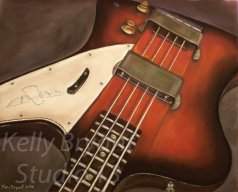
'78 4001 still my first love, but this guy is absolutely right - horrible design

The Ric's tone clearly comes from the solid maple body and through-neck, it has nothing to do with the pickup placement.


Dang, that Rickenbacker video is good! They are incredibly crappy. I only have a 360/12 guitar - for $2900 list price (at the time) you get < $200 Chinese quality. Stupid purchase, I agree. The 12 string guitar comes with a 6 string bridge, so intonation is never quite right. Had it replaced by a famous shop. Ric basses sound terrible. Paul only played one because he got one for free and they gave him a right handed one initially, imbeciles.

Sorry Adolf, they've screwed up your brand.
 
I believe that tone is in the pickups/strings and the resonant frequency /vibration/construction of the neck.

It's not in the fingers. If it were I wouldn't be spending the inordinate amount of time that I do searching for and experimenting with all things related to tone.

That is the most subtle thing I've read recently.
Because of this deep wisdom I have stopped practicing.
Thank you.
You've saved me so much time and effort. :)
 
Last edited:
Seriously though, strings terminate at the body not the neck. The first impulse is picked up by the pickups then the second is influenced by the resonance through the body/neck combination. This happens with what to us seems immediate.

The body is a significant part of the equation. A bad neck body combo will just sound bad no matter what pickups are installed. Can we compensate with electronics. Yes. But that obscures the distinction we seek.

Often overlooked is the capability of the amplification to showcase the difference in body, neck etc. I've played rigs at jams that every bass sounded the same because the THD was just too great.

When Fender pickups were hand wound there was a measurable difference in why 10 different P basses wouldn't sound alike. Now that thats not happening why did we pick one over another of the same color. One sounds better to us. One responds like we like. That response, "feel" is where tone is in your fingers is trying to emerge.

This is discernible unplugged. Unplugged is the first way to hear and feel an instrument. If it doesn't do it there then it won't really do it plugged in. Plugged in should be an enhanced version of its unplugged character.

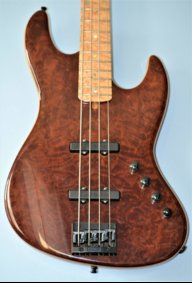
To the OP rap with a knuckle. Whether Sadowski would pick that piece of wood is the question.
 
Seriously though, strings terminate at the body not the neck. The first impulse is picked up by the pickups then the second is influenced by the resonance through the body/neck combination. This happens with what to us seems immediate.

The body is a significant part of the equation. A bad neck body combo will just sound bad no matter what pickups are installed. Can we compensate with electronics. Yes. But that obscures the distinction we seek.

Often overlooked is the capability of the amplification to showcase the difference in body, neck etc. I've played rigs at jams that every bass sounded the same because the THD was just too great.

When Fender pickups were hand wound there was a measurable difference in why 10 different P basses wouldn't sound alike. Now that thats not happening why did we pick one over another of the same color. One sounds better to us. One responds like we like. That response, "feel" is where tone is in your fingers is trying to emerge.

This is discernible unplugged. Unplugged is the first way to hear and feel an instrument. If it doesn't do it there then it won't really do it plugged in. Plugged in should be an enhanced version of its unplugged character.

To the OP rap with a knuckle. Whether Sadowski would pick that piece of wood is the question.


Actually, the strings terminate twice at the neck. The nut and the tuners. Hmmm ....

Plus, hit a string and place the headstock of your bass against a wall then do the same with the body. Which one produces more volume? So which one resonates more?


Before you take offense, remember what forum this thread is in.
 
  • Like
Reactions: Ant Illington
Dang, that Rickenbacker video is good! They are incredibly crappy. I only have a 360/12 guitar - for $2900 list price (at the time) you get < $200 Chinese quality. Stupid purchase, I agree. The 12 string guitar comes with a 6 string bridge, so intonation is never quite right. Had it replaced by a famous shop. Ric basses sound terrible. Paul only played one because he got one for free and they gave him a right handed one initially, imbeciles.

Sorry Adolf, they've screwed up your brand.

Yes. Rics are beautiful objects. The shapes and curves, Gibson only wishes they could do something like that. And the finishes are top notch. But as guitars, they are pretty awful. The string spacing on the six-strings is not for human hands, and the hardware is just so so so bad. If you've ever looked at a Ric trussrod, you can see why they need two. Horrible flimsy design, so hey, use two and call it a feature! The bass bridge is one of the worst designs of all time, makes Gibson's 3-point mess look positively genius. Some of the things that Ric has done under the pickguard are real head scratchers too, not to mention their tremolo designs. The 12-string headstocks are neat though. I still love my 4001.
 
I am getting a hackberry tree cut down in my yard tomorrow. Should I listen while they are chopping it up to find out if it has any tones? I could save a piece and build a tone bass out of it.

By all means. The hackberry is an under-studied tone wood. It may have been used by Native Americans. I strongly suggest tapping the tree after it is cut down, so that the grain will be in a horizontal orientation.
 
  • Like
Reactions: Ant Illington