• TalkBass has been independent since 1998. Add your voice.
    Create a free account to reply to discussions, view embedded media, and browse with fewer display ads.
    Join freeLog in
    Want zero display ads or expanded classifieds tools? Compare plans.

As long as you give yourself numbers.
I want my Tonewood Club member number to be 3.1415926535897932384626433832795028841971693993751058209749445923078164062862089986280348253421170679, because every argument here is circular.
 
To me, I swear after so many years of playing I can most definitely feel the differences between maple, rosewood, and Pau Ferro fretboards, especially on Fenders. I find maple to the the brightest and cut the best, however I find Pau Ferro to both cut and sit in the mix the best. I'd say the majority of my preference goes to Pau Ferro and Maple boards.

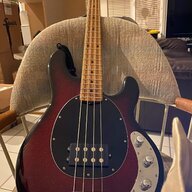
After playing bass for so many years I feel like the wood that the bass is made out makes LESS of a difference and just by looking at my two main basses you can get even more confused trying to categorize them by sound; I have a Fender Vintera 70s Jazz made of a heavier, denser ash and a EBMM Stingray Special made out of a lightweight swamp ash.

They both sound very different but sound different within a similar realm they both share. I feel like when I'm playing an instrument made out of ash with a maple neck, at that point the tone capabilities are maximized and its up to how good of an instrument it is from there.

For me, an ash body and a maple neck with a Pau Ferro fretboard hits the best with a drummer and a full band mix.
 
I spent the morning looking for my study documentation and it's gone. I really don't want to do the tests again - I got the info I wanted for my own purposes, but maybe someone here could do it - it's not difficult. Any pickup will do, any bridge, any tuning machine. Use those same components on different pieces of wood sized the same. You will need an interface for your computer and some spectrum analysis software. Take many samples and compare looking for consistent differences. Then repeat the tests changing the order - if at first you compared a maple board with a walnut, a mahogany and an alder, then do walnut alder mahogany then maple. Use the same boards.

If you want to pursue it further, try it again with different boards of the same species. You may also see differences from board to board, but the differences will likely be far less pronounced.

It has gotten really busy here again and I am trying to retire! Otherwise I might actually set up to do the tests again. I highly encourage someone else to do them.
 
- i haven't heard/read anyone claiming that woods have "absolutely no impact" re: EB bodies and necks made from woods.

- even 'tonewood deniers' (i'll include myself in a broad stroke) are likely to acquiesce = "every part of an EB contributes to its tone/sound" --- it's a gestalten.

- as above, with this caveat: "some parts/designs/considerations contribute to that tone/sound more/less than others."

IME: if i wanted a different "tone" from my solid-body EB i'd probably change the pickups first...if only because changing the wood parts is too much of a hassle. :D
 
So in a blind test, can you actually tell which one has the maple vs rosewood board??

I've never tried doing a blind test with fretboards so I really can't say but the differences will be subtle (unless the rosewood board has been completely ruined by overuse of oil, like I mentioned in a previous post, that will certainly make a noticable difference!). In my experience the differences are much bigger if we're talking about the entire neck or body.

For example I've got two otherwise 100% identical basses where one has a mahogany body and the other has a maple body. Built by the same luthier. The maple one is so much brighter that I don't even need a blind test to confirm what I'm hearing. They are so different that I can't use one as a backup for the other or even use them for the same genres of music. I can't say for sure if this is because they're different types of wood or if it's about the QUALITY of the wood but I get to play lots of guitars/basses at the workshop (typically 2-3 on my bench every day) and there are certain patterns I've noticed, like maple body basses usually being extraordinarily bright. Or solid mahogany Les Pauls GENERALLY sounding noticably darker than those with a maple laminate top. Or ash Strats USUALLY having glassier highs than alder Strats. There will always be exceptions, two pieces of wood are never the same, but there are certain noticable trends with different woods, even with solid body electrics. Personally I normally find the differences easier to hear with guitars than basses but it's definitely there.

Of course a bass/guitar is a sum of all it's parts and the wood is just one of many factors that will affect the tone. The pickup position (but not necessarily the pickup itself) will certainly affect the tone more than the wood but even the most expensive boutique pickup won't help with dead spots, lack of sustain, uneven response along the neck. That's down to the acoustic properties of the instrument - the wood. It's not just about "tone", it's also about how the instruments responds dynamically. Perhaps even more so.
 
OK, I’ve never done this particular type of test but I’ve done a ton of systems testing, and user acceptance testing for software and IT systems and a similar and objective approach could be followed here…

if we truly want to end this endless debate and finally answer the question in an OBJECTIVE approach to remove ALL subjectivity, feelings, tribal knowledge (I know this wood is darker/brighter), but Jaco said, the Easter Bunny told me, yada yada. :)


Rather than attempting to “boil the ocean” and attempt remove subjectivity with an objective approach to this SINGLE question…

Q - Does wood by itself make a difference in the tone of the bass (not guitar, not acoustic, etc.) / not in a band setting, not on an outdoor stage, in a dive bar, etc.

The test should isolate all similarities and other components to be the same and only swap out the wood element in a consistent and repeatable process. For the first round of testing, let’s take this example approach:

Consistent elements in test #1
  • The same neck wood and fingerboard wood (same neck swapped to each body) with the same tuners and the same nut material
  • The same bridge (swapped to each body)
  • The same pick ups, preamp and location on the body (swapped to each body)
  • The same body type shape and size
  • Have the same player, play the same composition for each body swap (yes this will be the only subjective component to this approach)
  • for each test - record DI with no effects, patches, filters, EQ’ing, etc.
  • the audio can then be analyzed/collared side-by-side for changes in frequency
Variable element #1
  • Body wood sample number one
  • Body wood sample number two
  • Body wood sample number N
  • All in the same body type shape and size
Test number two could then replace the body as the variable element with the neck wood fit test round #2.

Meaning that all of the consistent items above would have a consistent body type added to it. Then with a series of different neck woods and finger board wood combinations, run the tests again with the same player, same composition, etc. so that set of audio tracks could be analyzed and compared with the first set of sound samples.

The big question is, who has the resources, willingness, skills AND most importantly the time to go through and do a true scientific test and will stay true to the parameters throughout the process of testing these elements to answer this question once and for all?

Should we start a Go Fund Me page???
Should we contact Consumer Reports to see if they would be game to do this?
;)
You don't need to go that far to determine the effect of wood on tone of an electric instrument. You just need the same components on a board and vary the board. As long as the boards are the same dimensions and the rest is the same, a spectrum analyzer will tell the tale.
 
  • Like
Reactions: Afc70 and Gregory H
IME: if i wanted a different "tone" from my solid-body EB i'd probably change the pickups first...if only because changing the wood parts is too much of a hassle. :D
I would say that if I wanted to change the tone of any of my basses I would start by replacing the strings.
 
Blind testing is used in perceptual trials to remove biases and preconceptions. Sighted tests are pretty much worthless for this reason.

I find it very strange that people start talking about blind tests whenever tonewood is discussed but never when other stuff like pickups, hi-mass bridges, string through designs, bolt-on vs neck through, etc. is discussed. For what it's worth, in my experience wood matters more than most of these other things.

Arranging a proper blind test requires lots of work and the help of at least one extra person so I simply can't be bothered. My ears tell me all I need to know. If others hear things differently, fine.:thumbsup:
 
  • Like
Reactions: GlennRH and Afc70
in my experience wood matters more than most of these other things.
More than pickups? So wood differences mean more than say a set of Alembic Series pickups vs a Gibson mudbucker? Show me a wood change that is going to have anywhere near the pronounced sonic change that is?

I find it very strange that people start talking about blind tests whenever tonewood is discussed but never when other stuff like pickups, hi-mass bridges, string through designs, bolt-on vs neck through, etc. is discussed.
Agreed. I see no reason for any of the claims about those differences not to be examined the same way.
 
  • Like
Reactions: Durham52
You don't need to go that far to determine the effect of wood on tone of an electric instrument. You just need the same components on a board and vary the board. As long as the boards are the same dimensions and the rest is the same, a spectrum analyzer will tell the tale.

And you need to test several examples of each wood type to confirm that identical boards fashioned from each wood type produce spectra that are (nearly) identical and that differ significantly from those produced by the other wood types.
 
  • Like
Reactions: Durham52 and Snert
I'm a believer. I've swapped necks on a P body before keeping everything else constant, including strings - went from 1.5" maple/maple jazz neck to a rosewood maple/rosewood 1.625" neck - the sound was super different. I did it mostly to test the feel and balance and was surprised how much the tone changed. It was all in the mids in this particular case.
 
Here's the thing guys you play your instrument so much and your instrument sounds so great that you don't notice the tone think about it when you play certain basses the tones are different and of course it's in the electronics but the wood plays a huge part in your tone keep in mind when you play there's a vibration from strings to pick up to wood it all works together but we as players we really don't notice it..
 
I would say that if I wanted to change the tone of any of my basses I would start by replacing the strings.
most folks would, and should! but: i'm married to a couple of sets/types, so that experience isn't the same for me as it might be for some.

FWIW: i don't change pickups much either. i use good ones, i'm not a tone-chaser, so i'm pretty easy to please. about the only reason i'd consider a pickup change would be to approximate outputs, 'hotness' from one ax to another. e.g., i have a J that needs a 'boost' so i'll install different pickups (and probably the preamp) just to approximate the same 'universe' as the rest of my axes --- it's an outlier and it bugs me a little bit...i just want a louder tone! :D
 
Last edited:
  • Like
Reactions: Mike Lock
What I find interesting is that so many think that the wood has nothing to do with the tone, but they insist it comes from the fingers. Obviously, the definition of tone is NOT understood. Tone has to do with ALL aspects of the bass as well as the amp and effects. Fingers don't create tone. Let the argument begin.
I'm also confused why a hollow body instrument affects the tone, but not a solid body instrument. Or why closing f holes reduces feedback.
 
most folks would, and should! but: i'm married to a couple of sets/types, so that experience isn't the same for me as it might be for some.

FWIW: i don't change pickups much either. i use good ones, i'm not a tone-chaser, so i'm pretty easy to please. about the only reason i'd consider a pickup change would be to approximate outputs, 'hotnesses'.
I'm also confused why a hollow body instrument affects the tone, but not a solid body instrument. Or why closing f holes reduces feedback.
I would agree somewhat see most people are talking about the tone of what your fingers are able to produce...produce...but we are talking about overall tone and sound of the bass and I think that's what people are getting confused with..see when we speak of what your fingers can do we are speaking on Technic in which you play maybe this can clear things up for everyone.

Technique and skill are completely separate from the overall tone of your bass and wood definitely matters when it comes to overall tone