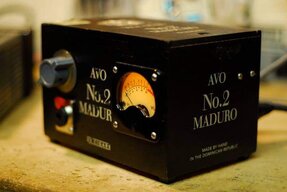
I’m enjoying playing my instruments that are made from ash, maple, spruce, ebony and rosewood. Trees are wonderful things. We should
all be planting a few each growing season.
all be planting a few each growing season.

TalkBass has been independent since 1998. Add your voice.
Create a free account to reply to discussions, view embedded media, and browse with fewer display ads.
Join free Log in
Want zero display ads or expanded classifieds tools? Compare plans.
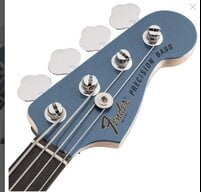
I don't think I could live in a world where there are basses made from guitarwood.
Yep, like thisThey’re all made of guitar wood. Unless they’re made of lovely, beautiful graphite.
Beautiful instrument. I’m lucky enough to have a pair of those, fretted and fretless (both are four strings).Yep, like this
View attachment 4716798
Nice, I’ve looked for a used fretless for a couple of years without success. I bought this one direct from Rob, great basses.Beautiful instrument. I’m lucky enough to have a pair of those, fretted and fretless.
But that's wood too. Really, really, really old wood that's been compressed for eons and pumped out of the ground in evil liquid form.They’re all made of guitar wood. Unless they’re made of lovely, beautiful graphite.
Interesting observation. Check this out for the details.But that's wood too. Really, really, really old wood that's been compressed for eons and pumped out of the ground in evil liquid form.

I did that many many years ago. I cut various pieces of wood to the same size, mounted a set of tuners and a pickup on each in turn in the exact same position (same pickup, same tuners, same strings) and used a spectrum analyzer to examine the wave forms from the signal from the pickup. This is important because I was not measuring the vibration of the wood, but the signal from the pickup.Does anybody have links to anything remotely scientific that would prove/disprove tonewood? Discussion without properly researched data is akin to he said she said; damn near pointless.

all jokes and kidding aside…. This is the most logical, plausible explanation I’ve read out of all of the 100s of noisy comments across multiple threads on this topic.I did that many many years ago. I cut various pieces of wood to the same size, mounted a set of tuners and a pickup on each in turn in the exact same position (same pickup, same tuners, same strings) and used a spectrum analyzer to examine the wave forms from the signal from the pickup. This is important because I was not measuring the vibration of the wood, but the signal from the pickup.
Different woods showed different frequency responses coming from the pickups across the audible spectrum. The reason was that different woods absorbed and reflected different vibrations at different frequencies and at different levels. That effected how the string vibrated - i.e. more of a certain frequency being absorbed by the wood means less of that energy at that frequency in the string. Since the string was the source of the energy, a loss of that energy by absorption into the wood means that energy is no longer in the string. The pickup "sees" that.
When you start adding or subtracting certain frequencies from a signal, you affect its tone.
If I can find my original research I will post it, but I'm afraid it might have gotten lost in one of my hard drive crashes. I back up my system regularly now.
I'll do my best to find the research.all jokes and kidding aside…. This is the most logical, plausible explanation I’ve read out of all of the 100s of noisy comments across multiple threads on this topic.
We’d all love to see the research and resulting data if you can locate it.

Fascinating stuff, I would love to read it. I hope it can be found.If I can find my original research I will post it, but I'm afraid it might have gotten lost in one of my hard drive crashes. I back up my system regularly now.
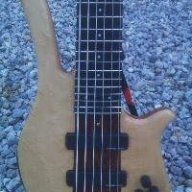


Anyone who don't believe in tonewoods should compare two otherwise IDENTICAL basses where one has a maple body and the other has something more traditional like alder or mahogany. Of course all pieces of wood are different so there MIGHT always be unexpected results but every single maple body bass I've ever played has been extremely bright sounding when comparing to a similar type of bass with similar pickups/bridge/etc. Even just a maple laminate in the body can brighten the tone noticably in my experience.
A quick experiment (that I will NOT recommend anyone actually doing) is to SATURATE a rosewood fingerboard with oil, like REALLY overdoing it and hear what happens. It won't be good (and please don't ask me how I know this...). The natural oil content in rosewood clearly has an affect on the tone but too much oil and your tone will suffer. Mass/density matters.
Personally I think tonewood matters even more with things that aren't really about "tone" but stuff like dead spots, sustain and most importantly having an even response along the neck. It's all about mass/density and the distribution of the mass in the body/neck. Different pieces of wood will have a different density and also a different distribution of mass.
Have you ever tried attaching a Fat finger to your headstock and hear the dead spots shift a couple of frets? This difference can not be explained in ANY other way than adding mass to the headstock. Density/mass DOES matter and different types of wood have different density. Even between two pieces of wood from the same species, which of course means that it's not just about different TYPES of wood but the QUALITY of the wood.
Some people seem to think you can mount the strings between a workbench and a shelf, stick a pickup under them and get the same tone as using the same pickup/hardware with a top quality guitar (someone posted a video about this a while back). I can only say I'm shocked that so many people didn't seem to hear the hideous, ringing overtones as the tones sustained with that "shelf guitar".
Of course the neck/body matters, even with a solid body electric. The body and neck affects how the strings vibrate and which frequencies are affenuated the most. Sure, it matters even more in an acoustic but acoustics are completely different designs. With an acoustic the soundboard is the "amplifier". With electrics is more about which frequencies are attenuated by the neck/body. That doesn't mean it won't affect the tone, or even that it's negligible. The pickup doesn't generate sound on it's own. It picks up the vibration of the strings and if anyone says the mass of the body/neck won't affect the vibration of the strings they need to learn a thing or two about basic physics.
...............Different woods showed different frequency responses coming from the pickups across the audible spectrum. The reason was that different woods absorbed and reflected different vibrations at different frequencies and at different levels. That effected how the string vibrated - i.e. more of a certain frequency being absorbed by the wood means less of that energy at that frequency in the string. Since the string was the source of the energy, a loss of that energy by absorption into the wood means that energy is no longer in the string. The pickup "sees" that.
When you start adding or subtracting certain frequencies from a signal, you affect its tone.
If I can find my original research I will post it, but I'm afraid it might have gotten lost in one of my hard drive crashes. I back up my system regularly now.